


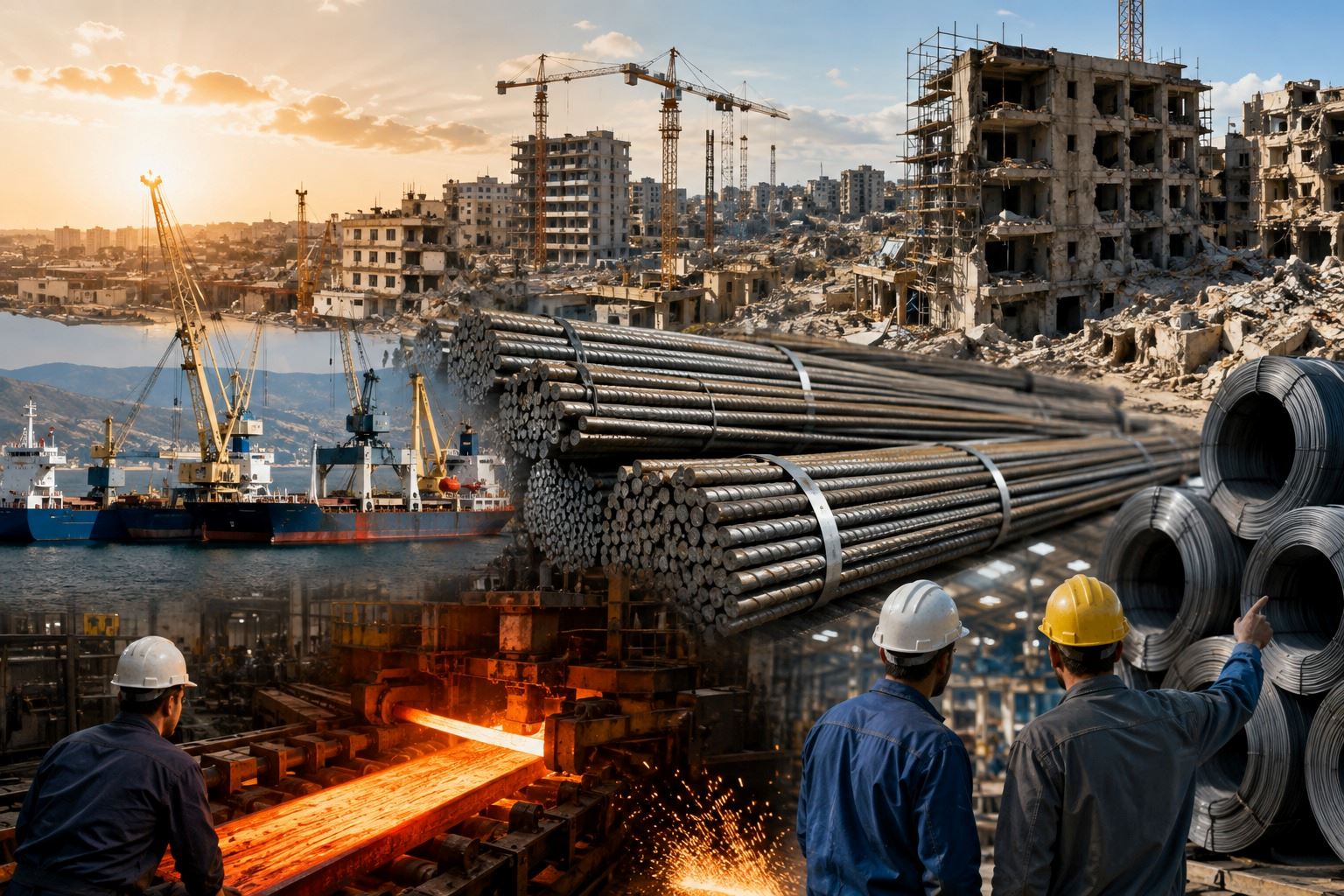
The acceleration of reconstruction activities and the gradual recovery in economic activity in Syria are strengthening expectations for a renewed increase in steel production and consumption. According to an industry assessment published by the Arab Iron and Steel Union (AISU) on August 23, the steel sector is emerging as a key component of the country’s reconstruction process.
Speaking to AISU, Anas Joud, Chairman of Joud Steel and Chairman of the Latakia Chamber of Commerce and Industry, said Syria consumed approximately 2 million tons of steel annually before 2011. He noted that consumption could rise to 3-4 million tons as reconstruction efforts expand. The expected increase in demand is primarily linked to the rebuilding of housing, infrastructure and areas damaged during the war.
Domestic Production Capacity Remains Limited
Steel plants in Syria are currently unable to operate at full capacity. According to Joud, capacity utilization at the country’s mills stands at around 20-30%. Joud Steel has restarted one of its facilities following an extended shutdown, with current production reaching approximately 5,000-6,000 tons per week while operating for around three days a week.
Energy costs and supply constraints remain among the main obstacles to increasing capacity utilization. Although electricity supply in Syria is gradually improving, high energy costs compared with neighboring countries continue to limit the competitiveness of domestic producers. Producers are also facing pressure from fuel and raw material costs.
Türkiye Emerges as a Key Source for Supply and Technical Cooperation
According to the AISU report, Türkiye stands out as an important source of supply and technical cooperation for Syria’s steel industry. Joud said the company had benefited from technical experts from Türkiye during the process of restarting its production facilities and plans to work with Turkish specialists on production management as well.
In addition to its geographical proximity, Türkiye offers advantages in the supply of raw materials, spare parts and technical equipment. The report also notes that Turkish investors have begun evaluating investment opportunities in Syria, with the steel industry emerging as one of the sectors attracting interest.
Domestic Market Expected to Remain the Priority
A significant portion of Syria’s current steel production is consumed domestically. With reconstruction and housing rehabilitation expected to drive demand, domestic producers are likely to prioritize the local market in the coming period.
According to Joud, if existing steel plants return to full capacity, domestic production could reach levels sufficient to meet local demand. As a result, the short-term priority for Syria’s steel industry is expected to remain the recovery of domestic production and the supply of the local market rather than exports.
Port Activity and Supply Chains Recovering
Improvements in logistics conditions are also becoming increasingly important for Syria’s steel industry. According to AISU, maritime activity at the ports of Latakia and Tartus is picking up, while the return of international shipping companies is contributing to the normalization of supply chains.
Latakia Port is positioned to play a role in container transportation, while Tartus Port, with its capacity to accommodate larger vessels, is expected to support bulk cargo operations. Storage, handling and logistics infrastructure at the ports are also being redeveloped.
New Investment Opportunities Emerging for the Steel Industry
Rising steel demand driven by Syria’s reconstruction is expected to create opportunities not only for capacity expansions at existing plants but also for new investments. However, realizing this potential will depend on establishing a stable energy supply, reducing production costs, securing raw material availability and rebuilding the industry’s technical workforce.
According to AISU’s assessment, restoring Syria’s steelmaking capacity to meet domestic demand is likely to remain the sector’s primary objective during the reconstruction period. If domestic production eventually exceeds local consumption, exports to neighboring countries could also become an option.




Comments
No comment yet.