


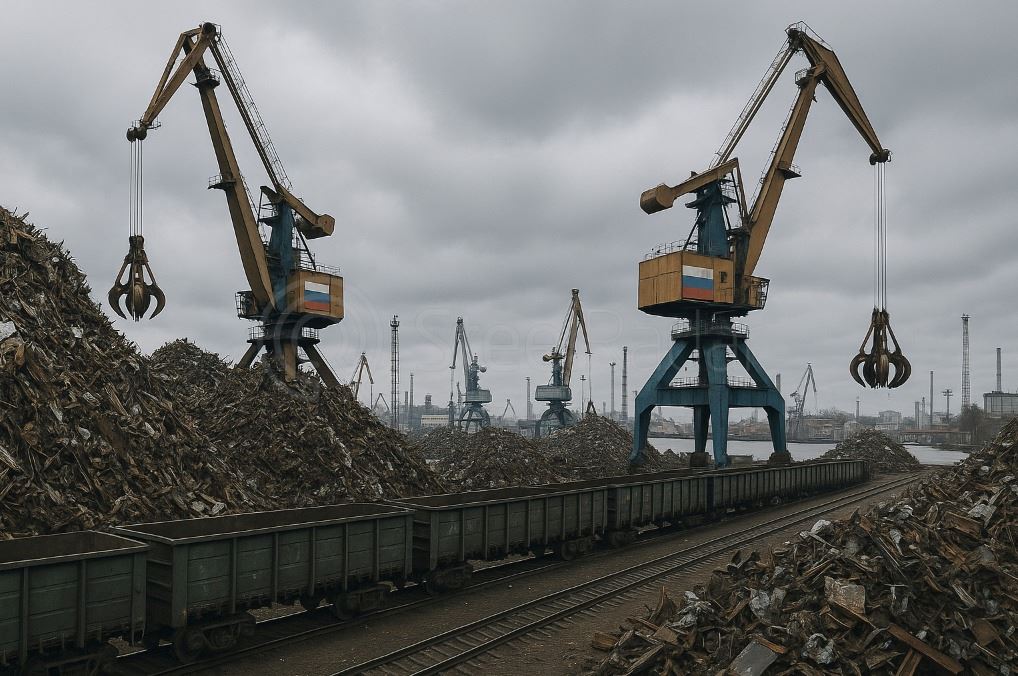
Total ferrous scrap deliveries in 2025 amounted to 7.45 million tonnes, representing a 33% decrease year on year and a 48% drop compared with 2023. For three consecutive years prior to this, annual deliveries had exceeded 10 million tonnes.
The steepest decline was recorded in central Russia, where shipments fell by 43% year on year to 2.07 million tonnes. In the Urals, deliveries decreased by 30% to 3.22 million tonnes. In Siberia and the Far East, volumes dropped by 28% to 905 thousand tonnes, while the southern regions saw a 23% decline to 1.24 million tonnes.
The pace of decline accelerated across all regions except the south, where deliveries had already fallen more sharply in 2024, by 36%. In Siberia and the Far East, scrap shipments have been decreasing for three consecutive years.
Ferrous scrap is mainly used in electric arc furnace steel production, which accounts for about one third of total steel output in Russia. Scrap supplies have been shrinking amid declining domestic demand for steel and lower steel production. According to preliminary data, steel output in Russia in 2025 totaled 67.4 million tonnes, down 4.6% from the previous year. A recovery in investment activity and steel consumption is considered possible only if the key interest rate falls to around 12%, which is unlikely to happen in 2026.
Among major steel producers in the Urals and central Russia, significant reductions in scrap procurement were recorded in 2025. MMK cut purchases by 42% (or 542 thousand tonnes), OMK-Steel by 81% (111 thousand tonnes), Severstal by 60% (123 thousand tonnes), and the Nadezhdinsky Metallurgical Plant by 59% (87 thousand tonnes). Only UGMK-Tyumen increased consumption in the region. In the south, shipments declined for all plants except Novostal-M, Abinsk Electric Steel Works, and Balakovo Metallurgical Plant. All Siberian and Far Eastern producers reduced purchases, including EVRAZ ZSMK, which cut volumes by 57% (283 thousand tonnes).
A recovery of the ferrous scrap market in 2026 is not expected. On the domestic market, further declines in scrap collection of about 7% compared with 2025 are forecast. Although final collection figures for 2025 are not yet available, there are concerns within the industry that volumes may fall to 16–17 million tonnes, which would be 10–15% lower than the previous year. For comparison, scrap collection in Russia reached 30.1 million tonnes in 2021.
One of the key challenges for the market has been the rise in non-payments and the extension of average payment periods to more than three months. Overall, the ferrous scrap market in 2025 remained in a downturn, and 2026 is expected to be a year of stabilization at a low point rather than a full recovery, with only limited, isolated opportunities.
A meaningful recovery in scrap supplies is considered possible only if steel production increases, the share of scrap in the raw material mix rises relative to alternatives such as hot briquetted iron, pellets, or pig iron, and regulatory conditions are eased.
Exports of scrap from Russia outside the Eurasian Economic Union remain restricted by a quota system. Within the quota, exports are subject to a duty of 5%, but not less than €15 per tonne. Shipments exceeding the quota face a duty of at least €290 per tonne. For 2026, the export quota has been increased to 2.2 million tonnes, 400 thousand tonnes more than in the previous year, though this increase is viewed as too limited to bring about substantial change.







Comments
No comment yet.