


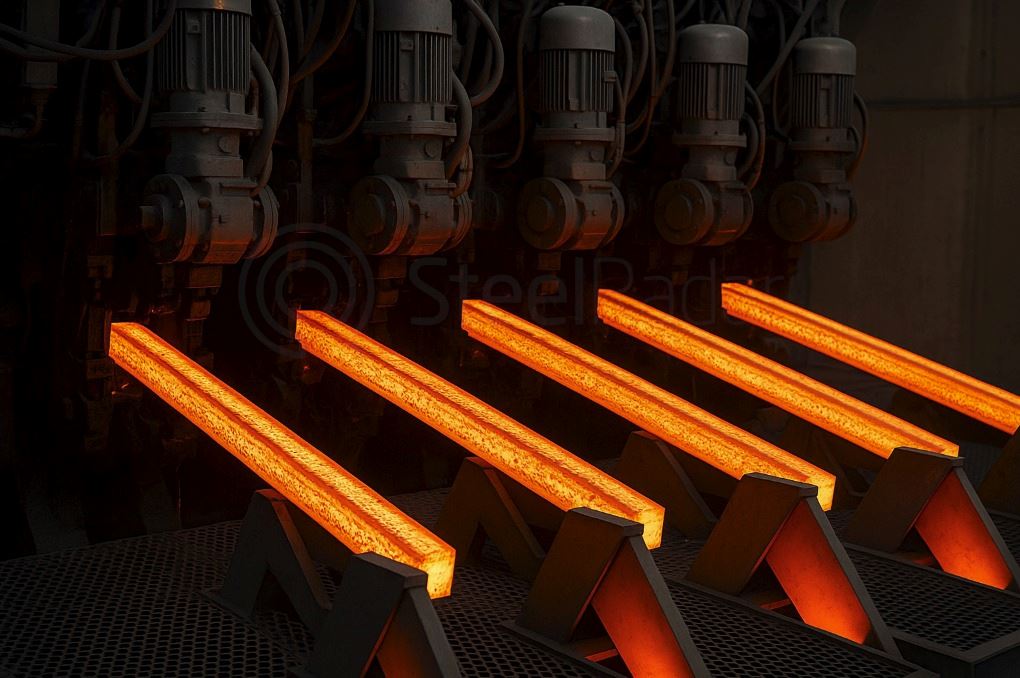
The key story is the mismatch between mill price expectations and actual buying appetite, and for Russia this gap is being widened by currency and seasonal factors at the same time.
Russian billet: squeezed by currency and demand
Russian mills are operating in a complicated environment. On paper, they have arguments for firmer prices. The rouble has strengthened noticeably, which directly raises the dollar-denominated export price required just to maintain the same rouble revenue. Even small FX moves now translate into $8–10/t swings in export parity for some producers. Add to this relatively solid scrap sentiment globally, and mills feel justified targeting $445–450/t FOB Black Sea and above as a minimum workable level. But the market is simply not giving them room.
Actual tradable ideas for Russian square billet have been clustering lower, with $440–445/t FOB Black Sea repeatedly appearing as the realistic range buyers are willing to discuss. Some suppliers tested higher numbers or talked about postponing sales from February production rather than accepting lower netbacks, yet at the same time, volumes have still quietly moved when prices approached the low $440s FOB. This shows that while mills talk tough, cash flow and stock management are still forcing selective deals.
In short, Russian exporters are trying to defend margins structurally, but tactically, they are still selling into a soft market.

Türkiye: the main battlefield
Türkiye remains the reference export outlet, and it is not providing support. Russian offers into the country have mostly been heard at $460–465/t CFR, but buyers’ workable levels sit closer to $455/t CFR or below. That gap looks small, yet in today’s market, it is enough to stall business.
More importantly, Turkish buyers do not feel urgency. Rebar demand inside the country is weak, and construction activity in many regions is seasonally slow, made worse by winter conditions. Mills openly say there is no logic in building billet stocks when finished steel sales are uncertain. This removes the psychological floor that normally supports the semis market.
Kardemir’s recent actions added another bearish signal. By trimming billet prices and pushing sizeable volumes into the domestic market within hours, the company effectively confirmed that finished steel price levels do not justify higher semis costs. With rebar and sections not showing strong upward momentum, billet buyers see no reason to chase import cargoes; at best, only small Russian lots may find homes.
Limited support from other regions
Outside Türkiye, demand signals are also lukewarm. Black Sea suppliers have appeared only sporadically in the wider international market. Even when offers were adjusted slightly down, purchase interest remained thin, keeping many price ideas nominal rather than deal-based.
In North Africa, occasional offers have surfaced, but these tend to reflect either very competitive freight or special conditions rather than a broader recovery in demand. They are not enough to shift the overall sentiment or absorb significant Russian volumes.
Seasonal drag and Ramadan effect
Timing is another negative layer. The market is in a classic seasonal trough, with winter curbing construction in several consuming regions. On top of that, many participants are already looking toward Ramadan as a period of reduced activity. Some buyers are effectively in “wait mode,” expecting any meaningful restocking only after this phase passes. That pushes real demand improvement further down the calendar.





Comments
No comment yet.