


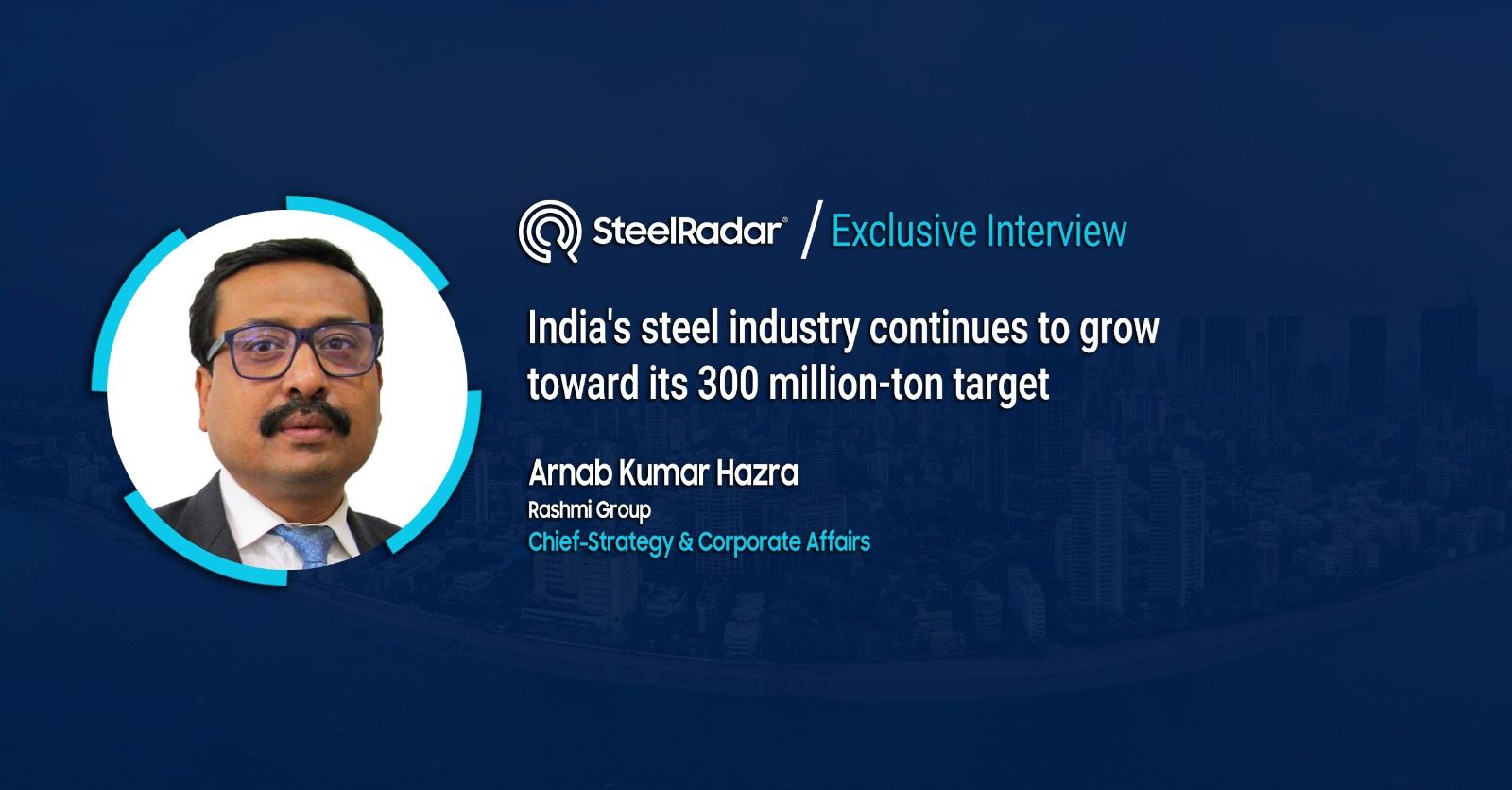
How would you assess the performance of the Indian steel industry during the first half of 2026? What are your expectations for production, consumption, and prices for the remainder of the year?
In the first six months of 2026, India produced and consumed around 86 million tons of finished steel, which is more than what any other country produces annually, except China. During H1 CY2026, India’s finished steel production increased by 9.5% year-on-year while finished steel consumption increased by 9.7% year-on-year. These are extremely high growth rates. Such high single digit growth in both production and consumption makes India the only bright spot in the global steel scenario.
This is especially significant as India is the second largest producer as well as the second largest consumer of steel. To further put it in perspective, in H1 of 2026 India produced an additional 7.4 million tons and consumed an additional 7.7 million tons compared to H1 of 2025. And this is a continuing trend. India has been producing and also consuming additional 12-15 million tons every year, at an average, post pandemic. Only China has seen similar high growth rates but the difference is that, India’s steel growth story is entirely driven by market dynamics and more than 86% of the finished steel came from private producers.
In the second half of 2026, similar (or marginally lower growth) in both production and consumption is expected, which is in line with the current growth trajectory witnessed since the last 4 years and which is likely to continue for another 4 years at least. Overall, we expect both finished steel production and consumption to grow by around 9.4%-9.5% in calendar year 2026.
However, steel prices have not been reflective of the high sustained steel demand, and which have been growing every year by 12-15 million tons. This is because capacity addition and production (or supply) have also increased simultaneously and continuously. So, the demand-supply balance has never titled towards excess demand. Moreover, supply is usually lumped, as capacity expansion is also lumped. So, the Indian steel market has oscillated between slight over supply and market tightness post the pandemic. Any spurt in imports, especially at predatory prices further escalates the tightness.
The first two months of the second half of 2026 will see weakened demand due to the monsoons when construction activities take a back seat. This will reflect in subdued prices, especially for long products. Thereafter both demand and prices are expected to recover due to the festival season demand. However, due to weak monsoons and possible effects of El Nino, rural demand will remain subdued. This, coupled with energy and supply chain disruptions due to the on-going middle east conflict, the recovery in demand and prices will be subdued and gradual. The last couple of months will see prices and demand sustaining. However, if raw material prices, especially of coking coal (which is largely imported and sourced primarily from Australia), witnesses price volatility, then cost push price increases is a possibility.
300 million ton crude steel target
How realistic do you find India's steel production and consumption targets for 2030? In your opinion, what are the biggest opportunities and challenges in achieving these goals?
The National Steel Policy 2017, a Vision document of the Government, envisaged a Crude Steel making capacity of 300 million tons by the end of the Financial Year 2030-31 (FY 2030-31). India’s Financial Year runs from April 1 to March 31. By the end of FY 2025-26 (March end 2026), India’s Crude Steel making capacity provisionally stood at 220.3 million tons, very much in line with the vision of the Indian Government to reach 300 million tons by another 5 years. Moreover, the announced capacity additions by various steel manufacturers lend credence to the Indian steel industry reaching a crude steel making capacity of at least 300 million tons by 2030-31.
Again, a 300 million tons Crude Steel capacity would translate to around 255 million tons per annum of Crude Steel production (at 85% capacity utilization, presently it is below 80%), and around 235-240 million tons per annum of Finished Steel production (at a conversion rate of 0.92 to 0.94) by FY 2030-31. This would require a supportive annual steel domestic consumption demand of around 230 million tons by FY 2030-31.
Now, the first post pandemic normal financial year was 2021-22. The last financial year was 2025-26. In these 4 years, the data as per Joint Plant Committee, Government of India, and the CAGR (for 4 years) is given in the Table below:
|
|
2021-22 |
2025-26 |
CAGR (4 Years) |
|
Crude Steel Capacity |
154.1 |
220.3 |
9.3 % |
|
Crude Steel Production |
120.3 |
169.4 |
8.9 % |
|
Finished Steel Production |
113.6 |
162.0 |
9.3 % |
|
Finished Steel Consumption |
105.8 |
164.2 |
11.6% |
Source: Joint Plant Committee; Data for 2021-22 & 2025-26 in Million Tons; Data for 2025-26 is Provisional
There are two clear messages from the table. One, given the current growth rate, the targets envisioned in the National Steel Policy 2017, are likely to be surpassed and therefore realistic.
Two, domestic steel demand is the primary driver of growth in the Indian steel industry. Nevertheless, the question beckons as to whether the current growth rates can be maintained this decade. The Indian economy grew by over 7% in the last three financial years and clocked a growth rate of 7.7% in 2025-26. This has translated to double digit growth in steel demand. Moreover, the continuous focus of the Government on infrastructure spending along with a robust real estate sector has propelled steel demand and in turn steel production as well as capacity addition. These factors, namely, robust economic growth, increased focus on infrastructure spending, the "Make in India" program supporting manufacturing, and a growing real estate sector, are likely to continue this decade. Therefore, ipso facto, these factors remain the biggest opportunity and any blip in these factors remain the ensuing challenges.
Both infrastructure investments and the "Make in India" program have made significant contributions to steel demand
To what extent are government initiatives such as infrastructure investments and the "Make in India" program supporting steel demand in India?
Government’s increased capital expenditure (Capex) and infrastructure push has supported steel demand to a large extent, especially since the onset of the pandemic. During the financial year 2020-21, the year marked by the pandemic, Government Capex was roughly USD 53 billion. Thereafter, it has grown rapidly to USD 147 billion for the current financial year 2026-27. This sharp rise has meant Government capex rose from 2.1% of India’s GDP in 2020-21 to 3.4% of India’s GDP in 2026-27. Roadways and Railways have been the main beneficiaries, and the later, is highly steel intensive. The growth in infrastructure investments has also catapulted real estate developments and has had a multiplier effect on steel demand through increased demand for capital goods. It has also begun to crowd in private capex.
The “Make in India” program has had a relatively lesser impact. Since this policy focusses on manufacturing, and creating manufacturing hubs, steel intensive sectors like the automobile industry, capital goods industry, white goods sector, and the defense sector have benefitted. Integral to the “Make in India” program is the infrastructure push towards highways, new freight corridors, high-speed rail lines, and national waterways and all these have reduced logistic costs so necessary for manufacturing competitiveness. Nevertheless, manufacturing push also requires supply chain establishments and ease of doing business, which are the current focus of the government.
In other words, while both the push towards infrastructure creation through enhanced capital expenditure as well as the “Make in India” program have greatly aided steel demand. The effect of the former is more direct and more immediate, besides being fully pushed by the government. In contrast, the “Make in India” program is longer term in nature and as pre-requisite needs certain reforms and policies besides logistics. The effect or results are therefore not so direct and not so immediate, but is more in the longer term.
"Steel exports aren't playing a decisive role in the industry's growth"
Which export markets do you expect to become the most important for Indian steel exports in the coming years?
India exports at an average of 6.5 million tons of finished steel (last 4 years) and exported 6.6 million tons last financial year. In the last 4 years, while production has increased by nearly 50 million tons, exports have stagnated. So, steel exports play a role but not a significant one.
More than 50% of all finished steel exports are to Europe. Further, around 10%-15% of the finished steel exports are to West Asian Countries (Gulf region) and a similar 10%-15% of the exports are to its neighbors in South Asia. Together these three regions account for 80% of India’s finished steel exports.
Now, if we look at global markets, the property sector is by and large weak in most advanced economies as well as in many emerging economies. Again, infrastructure is already in place in major economies. Luxury automobiles is no more selling like before, while life span of automobiles and white goods are increasing. The move towards Electric Vehicles means less steel is needed. In other words, incremental steel demand is getting limited and even decreasing in many economies.
At the same time geo-political tensions and instability have put global financial markets under pressure and made investors cautious. Put together, in most regions the steel companies are under pressure to produce, sell and perform. Erecting trade and non-trade barriers have become common place as most governments are opting to protect their domestic steel markets. This is a natural corollary.
So, attention will shift to markets where there is positive incremental steel demand, where infrastructure is still being built (or to be rebuild) and to countries with which Indian producers have logistical cost advantages. This means, by default, countries in the Gulf region (after the conflict eases), to African nations, especially in North Africa and to countries in South Asia, especially Nepal.
Indian exporters would also look for newer markets in Latin America but to a limited extent. Some amount of staggered steel exports will also happen to countries in South East Asia, especially Vietnam.
Nevertheless, exports will continue to its traditional markets like in Europe, especially post the FTAs with UK and EU. Slab exports to EU will also likely take place as presently semis exports remain outside the EU import quota regime.
"India is one of the few countries to have developed a Green Steel Taxonomy"
How important is the green steel transition for the Indian steel industry? What are the biggest challenges steel producers face in shifting toward low-carbon steel production?
The steel industry globally is making the transition towards decarbonization, and India cannot afford to be seen as a laggard. Despite still having substantial coal reserves and a net-zero commitment only by 2070, India is focusing towards sustainability in alignment with the announcement made in COP26 Summit to reduce carbon intensity of India’s economy by more than 45% by 2030.
The Ministry of Steel, Government of India published a comprehensive Report titled “Greening the Steel Sector in India: Roadmap and Action Plan”. The report discusses the various pathways for decarbonization of the steel sector and chalks out the strategy, action plan and roadmap on various key levers for Green Transition such as Energy Efficiency, Renewable Energy, Green Hydrogen, Material Efficiency, Process Transition from coal based DRI to Natural Gas based DRI, Carbon Capture, Utilization and Storage (CCUS) and the use of Biochar in steel industry. India is also one of the few countries, if not the only country, which has developed a Taxonomy for Green Steel. This underlines the importance of green steel transition.
Since a sizeable portion of the steelmaking uses the Blast Furnace route (around 45%) and most of the planned capacity addition is also through this route, ultimately cost-effective availability of green hydrogen will be the key. Commercially viable hydrogen-based production of green steel is being supported through pilot projects under the National Green Hydrogen Mission. Examples are partial substitution of natural gas with hydrogen in vertical shaft-based DRI production and injection of hydrogen into existing blast furnaces to reduce coal and coke consumption.
In the meantime, usage of renewable energy is being encouraged so as to ease the feasibility of a shift to sustainable practices and which is also important for producing green hydrogen. While the various low hanging fruits are being harnessed, the biggest challenge remains the technology for commercial and large-scale availability of green hydrogen. Cost of electrolysers, availability of purified water for electrolysis, and efficient storage as well as transportation of hydrogen are all important factors and challenges in itself.
Ultimately, there will be market segmentation – green steel and normal carbon steel. With the passage of time, the market size of green steel will increase and the latter will decrease. While strict preference for green steel due to environmental stewardship of the buyers will grow, but, yet will remain limited. Regulation can force the pace of adoption of green steel. Nevertheless, the ultimate deciding factor will be cost viability and the narrowing of the gap between the two. Green steel is still carbon steel but is green due to the production process and therein, the technology is still costly for commercial adoption.
"Steel demand in India isn't expected to peak over the next two decades"
What is the most important message you would like to share with international steel industry investors and SteelRadar readers about the Indian steel market?
The Indian economic growth story as well as the Indian steel industry growth story is intact. The growth story is more organic and domestic demand driven. The opportunities are real and here to stay. Steel demand is unlikely to peak in the next two decades. Indian steel industry is also moving towards value added products and production of specialty steel. The transition towards green steel will present further opportunities, as will be the way Artificial Intelligence gets embedded. Such opportunities are unlikely to come up in any other region for at least another two to three decades. And it is entirely driven by market dynamics.



Comments
No comment yet.