


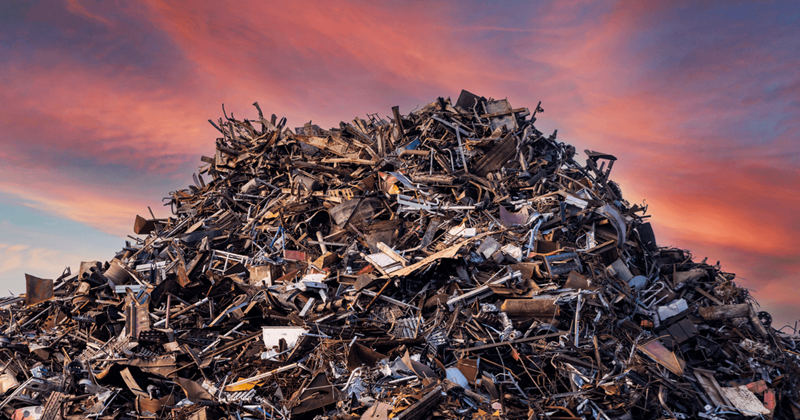
According to a special report by SteelRadar; despite the rising costs of scrap collection with the onset of winter, scrap prices in Türkiye cannot sustain an increase. In many global scrap metal markets, raw material offers are decreasing due to a decrease in demand for steel.
In Türkiye, one of the largest importers, demand for scrap is observed to be quite weak. Scrap suppliers had to lower prices before they could see an upward trend.
High production costs in Türkiye, coupled with energy price hikes, have severely impacted competitiveness. It is reported that many producers are focusing on maintenance work, reducing shifts. - In the Türkiye steel market, which is one of the world's important markets, export demands are very weak. In order for producers struggling with current costs and inflation to maintain their strength in the market, protective decisions are being considered. Turkish producers are also significantly affected by the stagnation in the domestic market.
Inflation, increased construction costs, and the tight monetary policies of the Central Bank of Turkey have made cash flow difficult. Due to all these reasons, scrap purchases have slowed down. Although scrap suppliers are trying to keep prices tight, trends indicate that a decrease is inevitable.
It was reported that a European company sold 80:20 scrap to a producer in the İskenderun Region for $365. Subsequently, a slight decrease in scrap connections was felt between October 10-12.
A connection between Venezuela and a producer in the Marmara Region was heard at $358/mt CFR for HMS 1/2 (80:20).
A connection reported between a Canadian producer and a producer in the Black Sea Region mentioned prices of 372 for 10k 90:10, 389 for 18k Shredded, and 389 for 2k bonus. The total was 30k (done on Friday).
This week, sharper declines in imported scrap connections were felt. According to an unconfirmed market rumor, a Canadian supplier and a producer in the Marmara Region had a price offer of $355 CFR for 80:20 scrap.
Two other connections heard this week were as follows:
A connection of $359 for 80:20 scrap between a U.S. supplier and a producer in the Aegean Region. It was believed that the decrease had stopped compared to the previous connection, and there was a slight momentum gained.
An Iskenderun Region producer in the market placed an order for Hms 80/20 at $348.5 per ton and $368.5 for Bonus from a European-based supplier, proving that an increase is still difficult.
On October 19 and 20, 2023, two new scrap offers were heard. It was reported to SteelRadar that a U.S.-based metal company received an order for 80:20 at $355 CFR from a producer based in the Marmara region. While there was no rejection from the producer or seller regarding the connection, different interpretations were circulating in the market.
From a European terminal to the Aegean Region, an offer of $345 for 80:20 and $365 for Bonus was heard. Although the producer and seller remained silent on the matter, officials from major companies in the market conveyed that the connection did not take place.
What developments occurred in global markets regarding scrap in October?
The U.S. achieved the largest supply with approximately 955,000 tons, showing an annual increase of about 6%.
Japan ranked second with an annual increase of 79.4%, reaching approximately 739,000 tons.
Taiwan's scrap iron imports in September increased by about 34.4% compared to the previous month and approximately 56% compared to the same month of the previous year, reaching around 308,400 tons. In the first nine months of this year, Taiwan imported a total of approximately 2.6 million tons of scrap iron, with an annual increase of 18.5%.
According to statistics from Vietnam, scrap imports in September were approximately 303,000 tons, showing a decrease of about 2.4% compared to the previous month and about 8% compared to the same month of the previous year, due to weak final steel product purchases.
Brazil's scrap exports in September increased by about 51.9% compared to the previous month and about 153% compared to the same month of the previous year, reaching approximately 98,000 tons. In terms of imports, Brazil's scrap imports in September increased by 9.2% monthly and decreased by 71% annually, reaching approximately 1,300 tons.
The UAE decided to extend the export ban on scrap iron until the end of December this year for another three months. In order to support the domestic steel industry by providing raw material supply, the country had imposed a four-month ban on scrap iron exports on May 15 of this year, and the ban was extended until December 19, 2023.
India may face difficulties in scrap supply due to banning or initiating prohibitive measures for scrap exports by more than 60 countries. The Indian authority continues to encourage domestic producers to increase the use of scrap in steel production. The Indian Steel Minister stated that unlike Western countries, the use of scrap in steel production in India is lower, but it is expected to increase in the future. However, increased scrap usage still cannot reach the government's ideal carbon emission level.




Comments
No comment yet.