


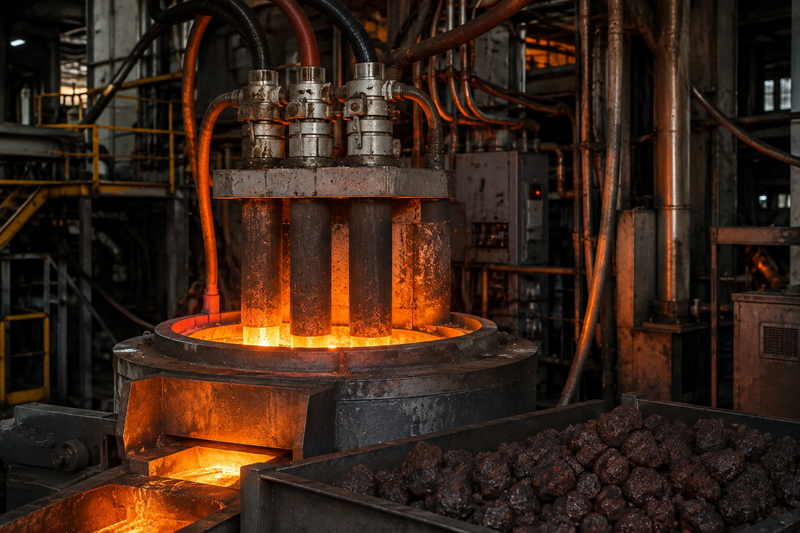
However, significant uncertainties remain regarding the commercial viability and scalability of the technology.
In its assessment titled Electrifying ironmaking: The potential of direct electrolysis of iron ore, the Institute for Energy Economics and Financial Analysis (IEEFA) stated that although electrochemical technologies have long been used in metal production, they have only recently begun to attract greater attention in the steel industry.
The study, prepared by Soroush Basirat, IEEFA’s Global Steel Energy Finance Analyst, noted that direct iron electrolysis has the theoretical potential to produce iron with near-zero emissions if powered by clean electricity.
Three electrolysis methods stand out
IEEFA evaluates the electrochemical methods being developed for iron production in three main categories. Low-temperature electrowinning operates at 20-120°C, molten salt electrolysis (MSE) at 800-1,100°C, and molten oxide electrolysis (MOE) at temperatures below 1,600°C.
Depending on the technology used, iron ore is dissolved in a solution or suspended in an electrolyte. Electricity is then used to reduce the ore and produce pure iron.
Basirat noted that MOE and electrowinning in aqueous solutions are better understood due to real-world applications, while MSE technology remains less developed. He emphasized that significant technical and commercial challenges must be resolved before these technologies can be deployed at scale.
Boston Metal project experienced technical setback
US-based Boston Metal is one of the leading companies in iron electrochemistry, with major steel and iron ore producers such as BHP, Vale, ArcelorMittal and Tata Steel among its investors.
However, a serious technical setback at Boston Metal’s facility in Brazil in January 2026 highlighted that the technology is still at an early stage of development.
According to IEEFA’s assessment, Electra and Volteron are also testing different direct iron electrolysis technologies at pilot plants. In Australia, Fortescue and Element Zero are working on different versions of similar processes, although these projects remain at earlier stages of development.
Electricity costs key to commercial viability
IEEFA highlighted electricity as the main cost component in electrolytic iron production. Therefore, access to abundant, low-cost clean electricity is expected to be critical to the commercial viability and wider adoption of electrochemical iron production.
The intermittent nature of renewable energy generation also presents an additional technical challenge for decarbonization through electrochemical methods.
Basirat noted that some electrochemical ironmaking technologies may offer greater operational flexibility in terms of electricity consumption. He said some studies view the ability of direct iron electrolysis to operate directly on renewable power as a potential advantage, adding that certain processes may be more tolerant of intermittent electricity supply.
Production remains at tonnes-per-day scale
Electrochemical iron production is still at an early stage of development. According to IEEFA, current production capacity remains limited to tonnes-per-day levels at best.
For the technology to compete with more mature low-emission production methods such as hydrogen-based direct reduced iron (H2-DRI), production capacity will need to increase significantly.
IEEFA noted that, beyond the technical challenges of scaling up, integrating the new technology into existing steelmaking systems and securing industry adoption could also pose significant challenges.
Basirat said resolving the technical issues associated with direct electrolysis represents only part of the transition, noting that adoption of an entirely new system would require a different ironmaking value chain with which the steel industry is largely unfamiliar.
Potential advantage with lower-grade iron ore
According to IEEFA, one area where direct iron electrolysis differs from other low-carbon production methods is the quality of iron ore that can be used.
The technology may allow lower-grade iron ore to be used with limited processing or, in some cases, without extensive preparation. The report noted that magnetite ores with iron content as low as 35% could potentially be processed by certain technologies.
The ability of some low-temperature electrolysis methods to operate more compatibly with intermittent renewable power generation was also identified as a potential advantage.
Could reduce the need for coking, sintering and pelletizing
The fact that direct electrolysis does not require coal, natural gas or even hydrogen as a reducing agent can reduce the energy and logistics infrastructure requirements at steel plants.
According to IEEFA, the method can reduce the need for bulk material handling systems, pipelines, storage facilities and associated port infrastructure, while also eliminating certain stages of the production process.
Basirat said direct electrolysis could simplify the overall production structure by eliminating the need for various upstream processes, including coking as well as agglomeration processes such as sintering and pelletizing.
IEEFA assessed that these characteristics could enable direct iron electrolysis to play a role in small-scale green iron production, particularly in regions with abundant renewable energy resources and lower-grade iron ore, even where an existing steel industry is not present.
However, the report emphasized that in both low-carbon ironmaking routes—through electrolysis or green hydrogen—significantly greater investment in reliable and continuous renewable electricity supply will be required to decarbonize primary steel production.



Comments
No comment yet.