


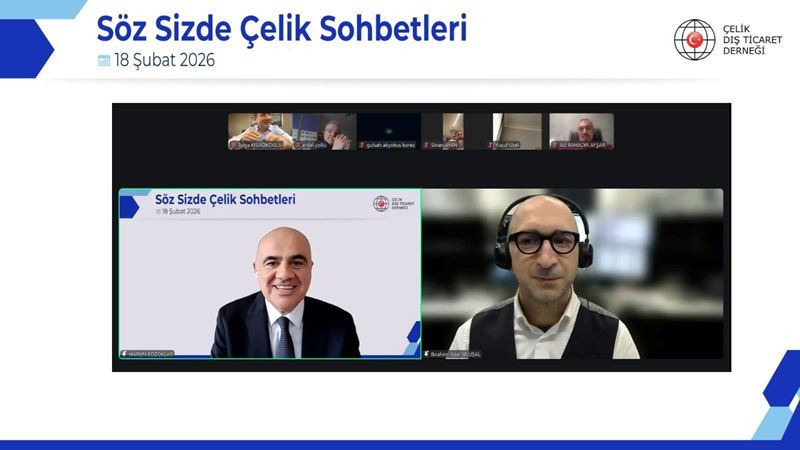
Speaking at the program moderated by Harun Bozoklar, İbrahim “Abe” Ulusal shared insights from his 25 years of experience in international raw material markets, explaining why risk management is not yet widely used in the steel sector and how it can create added value.
Ulusal noted that he has been active in international commodity markets for around 25 years. He explained that, as an intermediary affiliated with the London Metal Exchange (LME), the company’s primary focus is corporate risk management in base metals. Their services cover copper, aluminum, zinc, nickel, and tin, among other base metals, and they also provide international risk management solutions for iron ore, steel products, coking coal, gold, silver, and aluminum. While the number of clients in Türkiye is limited, Ulusal emphasized that their services are designed to mitigate producers’ risks.
He highlighted that iron ore contracts are currently the most liquid products in the steel sector, with daily trading volumes on the exchange around 20 million tons. Steel scrap is also traded, but actual transaction volumes are limited to approximately 10,000 tons. Ulusal noted that risk management in copper has a history of roughly 150 years, stating, “You cannot price even one ton of copper without risk management.”
Ulusal pointed out that the main reason risk management tools are underutilized in the steel sector is that physical transactions are mostly conducted via negotiated phone prices, and index prices are rarely used. In other raw material markets, physical sales of aluminum or copper typically reference the LME index with added discounts or premiums. In contrast, the lack of widespread index use in steel limits hedging practices.
In Türkiye, the primary products suitable for risk management include scrap steel, rebar, and hot-rolled coil (HRC) contracts. While the number of iron ore users is limited in Türkiye, the country is one of the largest spot buyers of steel scrap globally. Despite the daily 20-million-ton exchange volume for iron ore and the relatively low 10,000-ton volume for steel scrap, these products can still be effectively used for risk management.
Ulusal provided examples of how risk management tools can create added value. For instance, if a Turkish rebar producer or trader wants to offer a fixed-price quote for a 15- or 22-month construction project in Dubai, this can only be achieved by locking in prices on the futures market. He explained that by purchasing at a fixed price of USD 380 and adding a USD 200 profit margin, a 15-month fixed-price quote of USD 580 could be offered, differentiating the firm’s sales with a service competitors cannot provide.
In another scenario, Ulusal described a distributor facing slower physical sales in HRC or rebar. One option is to do nothing, which effectively represents a speculative capital position. Alternatively, if the product cost is USD 550 but the market price is USD 520, a portion could be sold on the futures market, then closed when the physical sale occurs, managing risk while potentially adding a USD 20 margin. He emphasized that doing nothing is itself a position and that proactive risk management represents resilience.
Ulusal noted that steel scrap contracts are the most suitable products for risk management in Türkiye, but recent global market shifts have been dramatic. He highlighted that the transfer of capital from West to East over the past 25 years is on a scale rarely seen in 500 years, and in the past year, capital markets experienced movements unprecedented in 50–60 years. For example, copper is no longer traded solely as an industrial metal but increasingly as a monetary asset, resulting in sudden market fluctuations.
In this environment, risk management tools provide firms with protection. Ulusal concluded that developing a culture of hedging and index-based pricing in the steel sector will enable both producers and traders to operate in a more sustainable and predictable trading framework.



Comments
No comment yet.