


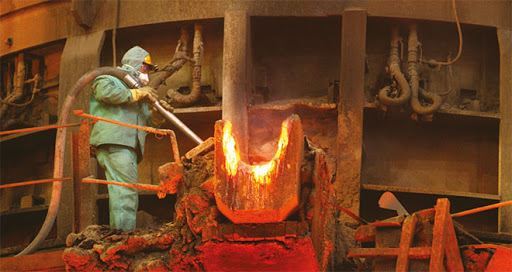
Supported by the end-use industries and the positive outlook in both advanced and emerging economies, steel demand is expected to increase in 2021 and 2022.
The industry is likely to profit from the eventual stabilization of the ongoing waves of COVID-19 along with vaccination programs and facilitate a gradual return to normal for primary steel-consuming countries. The steel industry has experienced a faster-than-expected recovery from the impact of lockdowns and production cuts during the COVID-19 pandemic.
The rebound can be attributed to the strong contribution of major end-use sectors such as construction and automotive. The global construction industry, which represents the primary steel consumer, reported a drop in production in 2020, well above the 2% drop experienced during the 2009 financial recession. However, the sector is expected to recover rapidly and reach 2019 levels.
In the midst of the COVID-19 crisis, the global Iron Ore market, estimated at 2.1 Billion Metric Tons in 2020, will reach a revised size of 2.7 Billion Metric Tons by 2026, at a CAGR of 3.7% over the analysis period. is expected to grow.
Penalties, one of the segments reviewed in the report, are expected to grow at a 4% CAGR to 1.3 Billion Metric Tons at the end of the analysis period. After a comprehensive analysis of the business effects of the pandemic and the economic crisis it caused, growth in the HBI/DRI segment was readjusted to a revised 3.4% CAGR for the next 7-year period. This segment currently accounts for 27.3% of the global Iron Ore market.
US Market Estimated at 32.7 Million Metric Tons in 2021, China Estimated to Reach 1.6 Billion Metric Tons by 2026
The Iron Ore market in the USA is estimated to be 32.7 Million Metric Tons in 2021. The country currently has a 1.5% share of the global market. China, the world's second largest economy, is expected to reach an estimated market size of 1.6 Billion Metric Tons in 2026, after a CAGR of 4.1% over the analysis period.
Other notable geographic markets include Japan and Canada, which are each forecast to grow 1.6% and 1.9%, respectively, over the analysis period. In Europe, Germany, a CAGR of about 2.9% is predicted while the European market will reach 1.7 Billion Metric Tons by the end of the analysis period (as defined in the study) at rest.
Traditionally, China has been the main driver of growth in the iron ore industry worldwide and is expected to remain so for the next few years. Any change in the country's steel production will significantly affect the global iron ore trade. China's iron ore demand is primarily driven by rapid urbanization and industrialization, and strong GDP growth that has surpassed the growth rates of most western countries.
Pellet Segment to Reach 426.3 Million Metric Tons by 2026
In the global Pellet segment, the USA, Canada, Japan, China and Europe will drive the estimated 3% CAGR for this segment. Having a combined market size of 244.9 Million Metric Tons in 2020, these regional markets will reach a projected size of 329.6 Million Metric Tons at the end of the analysis period.
China will continue to be one of the fastest growing in this cluster of regional markets. The Asia-Pacific market, led by countries such as Australia, India and South Korea, is projected to reach 81 Million Metric Tons by 2026, while Latin America will expand with a CAGR of 3.6% over the analysis period.






Comments
No comment yet.