


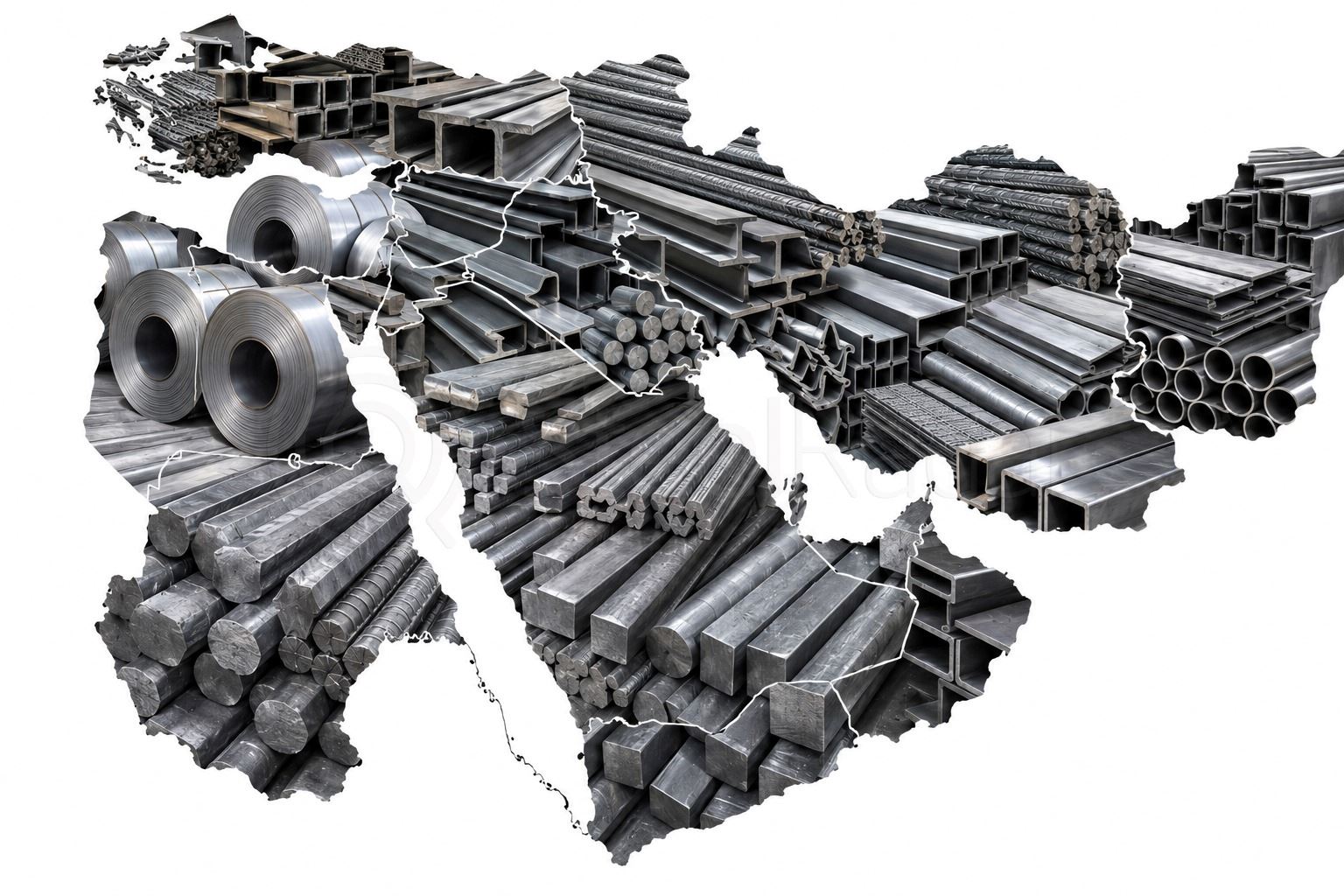
The Middle Eastern steel market remained dominated by geopolitical developments this week rather than price movements. Escalating tensions between the United States and Iran, coupled with growing security concerns around the Strait of Hormuz, have once again injected uncertainty into regional shipping activities, while steel producers continue to struggle with weak demand fundamentals.
Rising geopolitical risks surrounding Iran are beginning to affect not only energy markets but also regional steel trade. Beyond serving as one of the world's most important oil shipping routes, the Strait of Hormuz is a critical corridor for exports of steel raw materials, DRI, HBI, and scrap from Iran, the UAE, Qatar, and Oman.
Market participants report that the recent increase in military activity has prompted some shipowners to impose additional war-risk premiums, while marine insurance costs have also risen. Although no major disruptions to physical steel shipments have been reported so far, sources agree that risk perception has increased significantly. The situation is particularly affecting the competitiveness of Iranian exporters by raising logistics-related costs and uncertainty.
Demand in Iran's domestic steel market remains subdued, forcing producers to cope with rising cost pressures and limited sales volumes. Domestic rebar prices are currently assessed at $420-430/t EXW, while wire rod is trading at $465-475/t EXW.
Iranian DRI export offers remain at $225-230/t FOB, although market sources indicate that buyers remain reluctant to conclude new transactions due to weak demand. In addition to the seasonal slowdown during the summer months, financing difficulties, banking restrictions, and freight-related uncertainties continue to weigh on the country's export performance.
Meanwhile, Iranian steelmakers are increasingly shifting toward direct iron ore procurement instead of purchasing semi-finished materials in an effort to reduce production costs. Market analysts note that the recent decline in iron ore prices could lower billet production costs, potentially improving the export competitiveness of Iranian producers. This could gradually support a recovery in the currently sluggish steel market if demand conditions improve.
In contrast to Iran's weak market outlook, the Gulf scrap market has remained firm.
In the UAE, processed HMS (80:20) scrap is currently trading at $269/t DAP Abu Dhabi, while shredded scrap is assessed at $278-286/t DAP and end-cut scrap at $299-305/t DAP.
Saudi Arabia's scrap market also remains well supported by purchasing activity from Hadeed. The producer's latest buying prices stand at $533/t DAP for HMS 1&2, $551/t DAP for sheared scrap, and $552/t DAP for premium scrap.
However, market participants say that the pricing strategy adopted by major producers is putting significant pressure on third-tier steelmakers. According to sources, large producers are simultaneously increasing scrap purchasing prices raising raw material costs while reducing rebar selling prices, thereby squeezing the margins of smaller manufacturers. The strategy is believed to be aimed at weakening the competitiveness of independent and lower-capacity producers.
Competition among local steelmakers in Iraq has intensified, particularly in ex-works rebar pricing, as producers compete aggressively for limited domestic demand.
In Egypt, EZZ Steel left its export offers unchanged during the week, maintaining prices at $600/t FOB for rebar and $620/t FOB for wire rod.
Meanwhile, Libya's LISCO reportedly concluded the sale of approximately 30,000 tonnes of HBI to Saudi Arabia at $367/t FOB.
In Algeria, domestic rebar prices remain stable at $738/t EXW, while wire rod continues to trade at $745/t EXW.
In Lebanon, imported rebar is currently offered at approximately $560/t CFR.
In Yemen, Turkish-origin rebar continues to be sold at around $700/t, including approximately $50/t in freight costs and $96/t in customs duties.




Comments
No comment yet.