


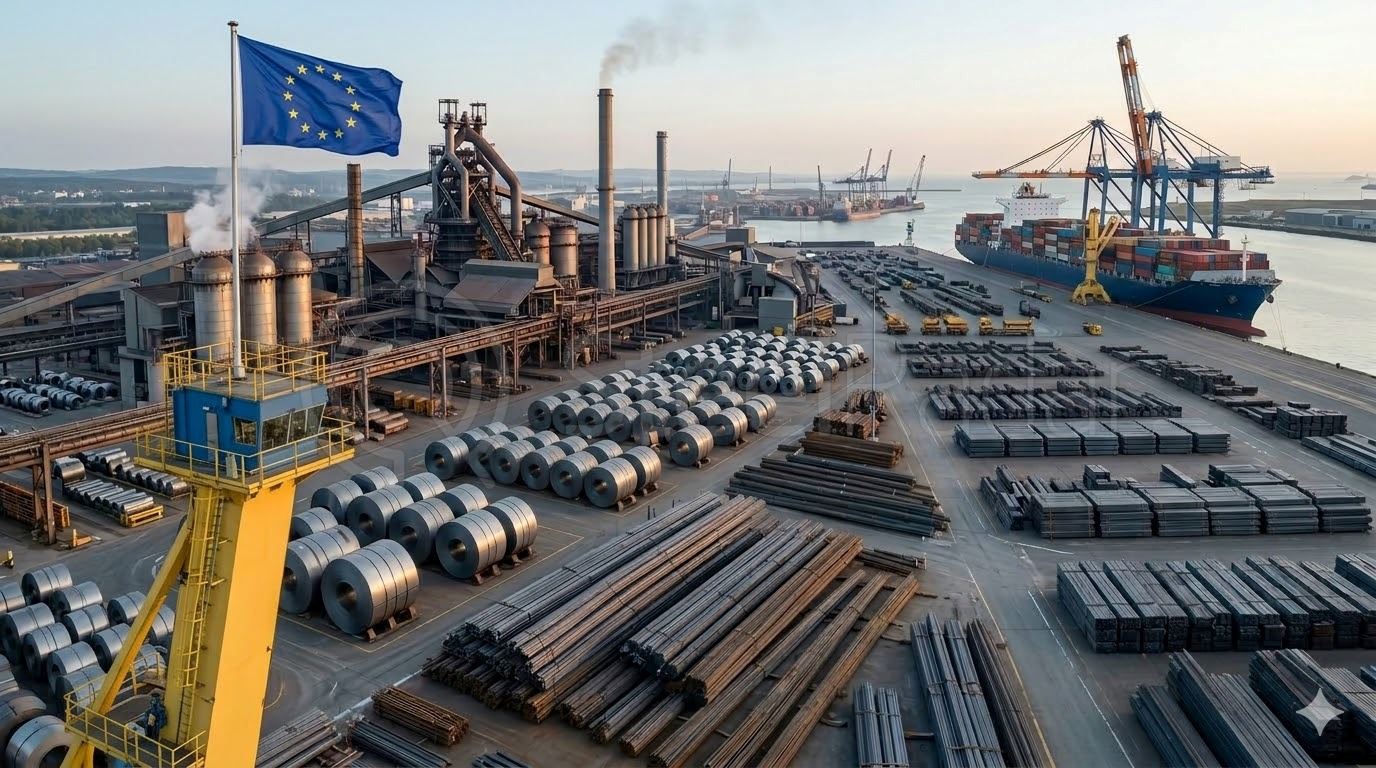
Although supply-related concerns in the regional steel market have slightly increased purchasing appetite, actual trading volumes have not surpassed the anticipated threshold. At the core of this market structure lies the “strong seller” position maintained by producers, whose order books remain well filled, limiting price concessions to secure additional sales volume.
European producers have largely closed their May quotas and have already begun offering volumes for June. In the HRC market, domestic dynamics reflect cautious activity shaped by expectations of further price increases. In Germany and Italy, HRC is trading in the 690–710 €/t (EXW) range, while in the UK market levels of 575–590 GBP/t (DDP West Midlands) have been reported.
Import offers for HRC from Türkiye and India on a DDP basis are reported at 640–680 €/t. These imports are said to be influenced by concerns that shipments may not arrive in time ahead of the expected 50% quota reduction in July, prompting buyers to turn more toward the domestic market.
Demand for imported CRC has remained weak and cautious due to uncertainty surrounding the outcomes of ongoing anti-dumping investigations concerning products originating from India, Japan, Türkiye, Vietnam, and Taiwan. Meanwhile, domestic HDG prices are reported to be targeting levels of 840–860 €/t.
In the rebar market, rising energy, fuel, and freight costs across Europe stand out as the primary upward price drivers. In addition to these cost increases, weaker import competition has strengthened the position of local producers. Furthermore, ArcelorMittal Europe has announced price increases of +120 €/t for wire rod and +70 €/t for rebar.
Regionally, in the Balkans, Albania stands at 510 €/t (EXW) as the most competitive level, while North Macedonia is at 550 €/t, and Kosovo and Serbia are trading at 560 €/t (EXW).
In Germany, rebar prices vary between 600–650 €/t depending on delivery terms. In France and Austria, prices start at 600 €/t (EXW) and reach up to 650 €/t on a CPT basis. In Poland, rebar trades in the 615–625 €/t (CPT) range, while wire rod is reported at 645–660 €/t (CPT). Spain, supported by a strong economic outlook and favorable weather conditions for construction activities, continues to stand out as the most active market in the region despite prices in the 650–690 €/t range. The Italian market remains in a balancing phase within the 590–620 €/t (EXW) range.
On the import side, the number of coil offers has remained limited due to rising freight and other costs, along with logistical challenges. Asian suppliers, previously shipping via the Suez Canal, are now required to use the Cape of Good Hope route, resulting in higher freight costs and longer delivery times. Indeed, the first vessels have already begun using the alternative route.
In discussions regarding sales from the Far East to Europe, shipments are generally continuing at previous levels; however, some customers are reluctant to place orders as they wait for freight rates to decline. Currently, a 30% advance payment is required for new orders, with the remaining balance paid upon delivery. This structure is reported to provide a more balanced and secure framework for both customers and suppliers.
Additionally, a producer from India has announced that an agreement has been reached with customers in the Middle East and Europe, and that most shipments and cargo operations have been temporarily suspended. The situation is being closely monitored, and alternative routes are being evaluated to ensure continued supply.
As domestic European steel prices continue to trend upward, customers are acting on expectations of further price increases in the coming period. Accordingly, long-term clients continue to place orders as usual; however, some buyers prefer to delay purchases or deliveries until freight costs decline.
Overall, the European steel market has maintained its cautiously strengthening upward trend since mid-March. Supply-side constraints, quota measures, trade policies, and rising cost pressures continue to support prices, while transaction volumes have yet to fully recover, indicating a balanced yet tight market structure. Uncertainties in import channels, extended logistics times, and higher freight costs further enhance the pricing power of domestic producers. In the coming period, price developments are expected to be shaped by cost trends, quota utilization rates, and the progress of ongoing investigations.





Comments
No comment yet.