


Domestic Market Holds Steady
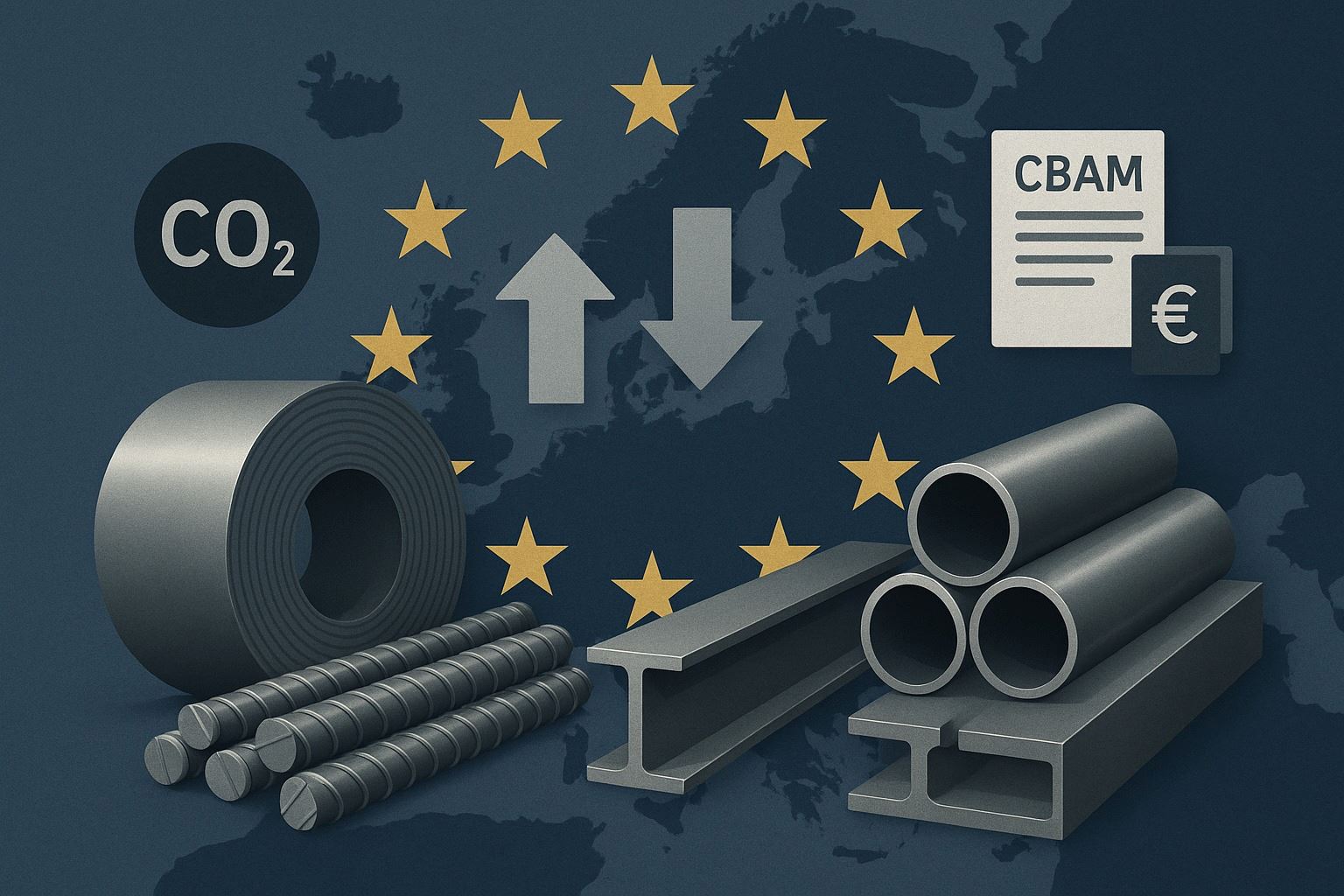
As the second week of November comes to a close, prices in Germany and Italy—Europe’s two key production hubs—have stabilized within narrow ranges. In Germany, HRC prices remain at €610–615/ton, while CRC and HDG hover around €700/ton. Long products show similar stability. Italy mirrors this trend, with HRC at €595/ton and CRC at €695–700/ton. Producers confirm that CBAM-related additional costs are gradually being reflected in prices, but weak demand is discouraging sharp increases. As a result, the domestic market remains in a controlled sideways trend despite rising cost pressures.
Import Offers Intensify the Pressure
The cautious stance in the domestic market is largely due to the continued strong flow of imports into Europe. For 2026 deliveries, Asian and Indonesian origin hot-rolled coils offered at €580/ton DDP Italy—including CBAM and all taxes—indicate that regulatory costs are already being priced in. India continues aggressive pricing, with HRC at €490–495/ton CFR Antwerp/Bilbao, CRC at €620–625/ton CFR, HDG at €670–685/ton CFR, and plate at €610–615/ton CFR.
Vietnam is adding pressure in coated products, offering 0.57 mm – Z140 galvanized coils to Spain at €640/ton CFR.
Within Europe, Spain stands out in regional supply thanks to its logistics advantage. Rebar is being shipped to UK ports at €575–590/ton CFR, while ribbed wire rod is offered to Western European ports at €595–610/ton CFR. Competitive pricing and short transit times are strengthening Spain’s position and intensifying price pressure across Western Europe, further squeezing domestic producers’ margins.
Turkey and Egypt are also contributing to strong competition. Turkish rebar is offered at €500–525/ton CFR in the Baltic region, while Egyptian rebar enters European ports at around €510/ton CFR. These mid-range CFR levels make it difficult for European mills to pass their rising costs directly into sales prices, forcing suppliers to maintain current domestic levels as buyers increasingly turn to more competitive import options.
Market Outlook: Limited Supply and New Regulations Add Medium-Term Pressure
With CBAM now in operation, the industry is attempting to reduce uncertainty by clarifying 2026 delivery prices upfront on a DDP and tax-included basis an approach that is also restraining short-term price increases. Still, industry participants warn that rising energy and raw material costs, supply-side constraints, and increasing logistics expenses are likely to generate unavoidable upward pressure in the medium term. How much of this pressure will translate into actual price movement will depend on the strength of import competition and the practical implementation of CBAM.
Europe’s steel market is currently squeezed between escalating costs and strong import competition. The ongoing sideways price trend reflects both producers’ cautious strategies and the price ceiling created by competitive import offers. As 2026 approaches, the market’s direction will hinge on how CBAM and quotas are fully enforced, how supply conditions evolve, and whether imported materials can maintain their aggressive pricing advantage.




Comments
No comment yet.