


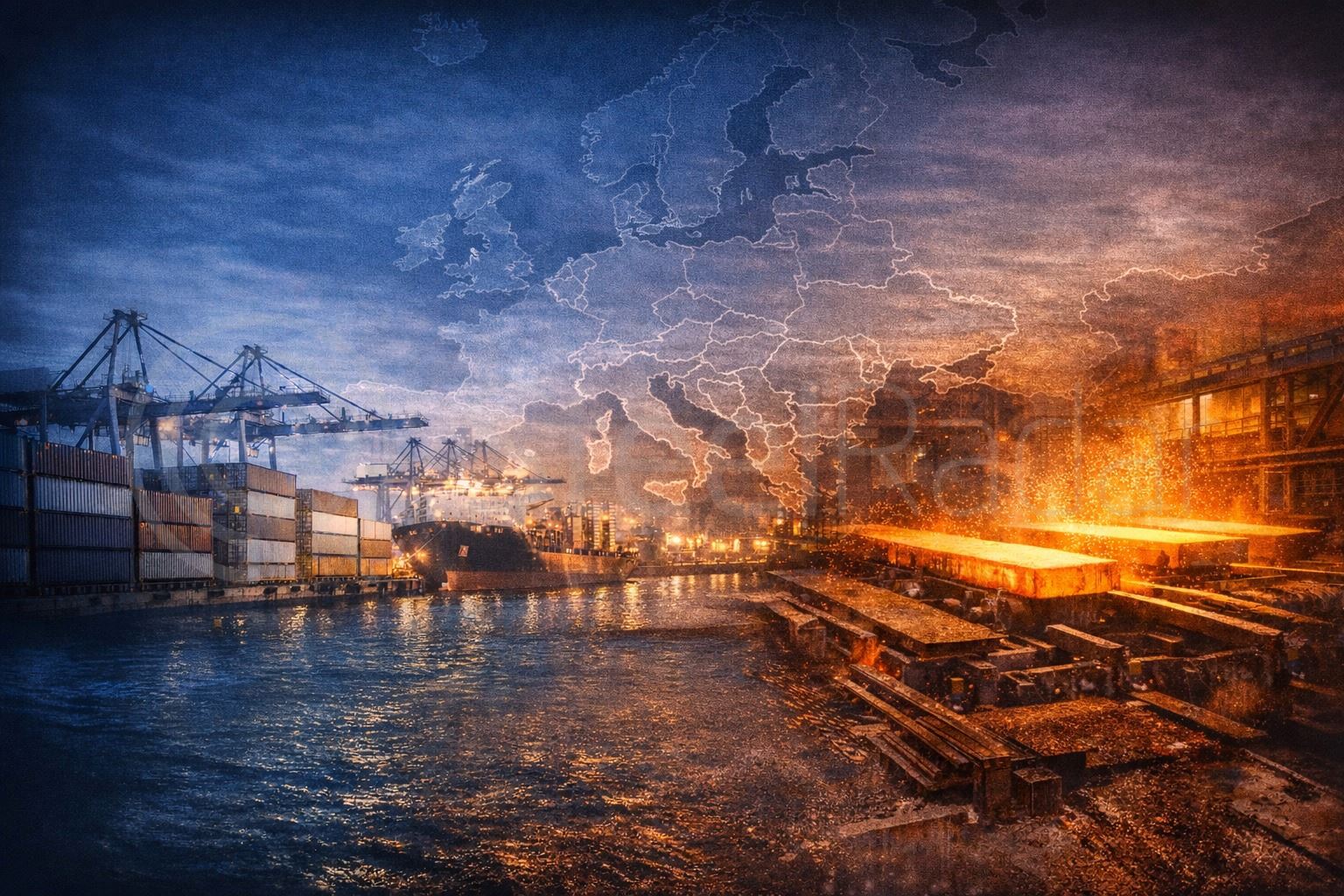
In Germany, rebar prices are currently reported at around €580/ton EXW, with CPT levels reaching up to €610/ton. Wire rod prices are hovering in the range of €590–600/ton CPT. In the flat steel segment, plate prices stand at €710–720/ton EXW, HDG at €740–760/ton EXW, CRC at €730–735/ton EXW, and HRC at €630–640/ton EXW.
A similar picture is observed in Italy. Rebar prices are trading between €545–565/ton, while IPN/IPE sections are quoted at €720–750/ton EXW. Plate prices are reported at €700–710/ton EXW, HDG at €735–750/ton EXW, CRC at €740–750/ton EXW and €770–775/ton CPT, while HRC is offered at around €630/ton.
Behind these price increases lies a clear tightening on the import side, combined with rising cost pressure driven by CBAM. Import offers into Europe indicate levels of $520–535/ton CFR for Chinese slab, $525–540/ton CFR for Indonesian slab, $590–595/ton CFR EU for Indian-origin HRC, €460/ton CFR Italy for Indonesian HRC, $520–540/ton CIF Antwerp for Chinese HRC, $520/ton DDP UK, and approximately $515/ton CIF Italy for slab from Southeast Asia.
However, these prices do not include CBAM-related costs. Once carbon charges are taken into account, particularly for carbon-intensive producers, import prices move significantly closer to European domestic levels. In several product categories, the competitive advantage of imports is effectively disappearing.
Although the trade agreement between the EU and India is being viewed as a positive political development, it does not bring tangible relief for the steel sector. CBAM remains fully in force, and no exemptions are granted to Indian-origin products. The €500 million support package announced by the EU is aimed at facilitating long-term decarbonisation rather than reducing short-term costs. Following the difficulties surrounding the Mercosur agreement, Brussels has been seeking a new trade success story, and the India deal appears to fill this role politically—without altering the fundamentals for the steel industry.
Overall, the European steel market is no longer shaped solely by supply and demand. Carbon regulation has become a defining pricing factor. While import prices may still appear attractive on paper, once CBAM costs are applied, domestic producers are increasingly regaining their competitive edge. Looking ahead, competitiveness in Europe will be determined not by price alone, but by carbon footprint.



Comments
No comment yet.