


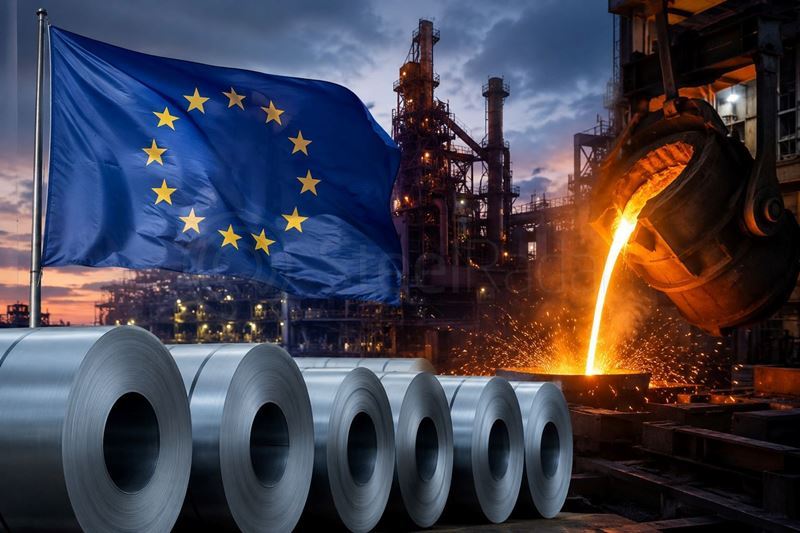
The European Steel Association (EUROFER) recalled in its assessment that, in the shadow of war, six European countries signed the Treaty of Paris in 1951, creating a common market for coal and steel. It emphasized that the founding principle at the time was that the steel sector was too strategic to be left solely to market forces and played a fundamental role in Europe’s recovery, security, and future.
It was stated that, 75 years later, this lesson has once again become highly relevant, as Europe now faces a dual challenge: managing the transition to climate neutrality while maintaining competitiveness in an increasingly fragmented and protectionist global economy.
It was noted that industrial policies in many parts of the world are once again becoming central to economic strategy, with governments increasingly intervening to secure supply chains, protect strategic sectors, and accelerate domestic industrial investment. Trade defence measures are increasing, and economic openness is being reassessed in the context of geopolitical competition.
In its assessment, EUROFER stressed that no sector illustrates the scale of these risks more clearly than steel. Steel was described as a fundamental input for infrastructure, defence, transport, automotive, and clean energy technologies in Europe, noting that achieving climate neutrality is not possible without steel. It was recalled that wind turbines, electricity grids, railways, and electric vehicles all depend on steel.
At the same time, the European steel sector has long been under severe structural pressure. Global steel overcapacity was said to exceed 650 million tonnes, steel imports into the European Union reached record levels in 2025, and imports accounted for up to one-third of the EU’s apparent steel consumption. During the same period, the United States imposed 50% tariffs on European steel exports, and trade has increasingly become a geopolitical tool.
The statement highlighted that European producers are competing in an open and unbalanced market. While other major economies protect and subsidize their industries, European steel producers face high energy costs while also undertaking one of the most ambitious decarbonisation transformations. Billions of euros are being invested in electrification and low-carbon technologies, yet producers are forced to compete with imported products manufactured under lower standards.
EUROFER stated that Europe cannot allow one of its most strategic sectors to decline and welcomed the European Commission’s Steel and Metals Action Plan. It noted that strengthened trade measures, CBAM implementation, and increased attention to scrap supply chains represent an important shift in Europe’s industrial approach.
While these measures could support European steel production and protect industrial employment, it stressed that the ultimate goal is not to close the European market but to preserve its industrial base and make decarbonisation economically viable within Europe.
However, it warned that the measures must now deliver practical results. If CBAM proves effective in steel but risks persist in downstream products, carbon leakage could shift further down the value chain. It also cautioned that uncontrolled growth in scrap exports could deprive Europe of key raw materials needed for circular production.
EUROFER called for urgent action to address Europe’s energy costs and to establish a strong domestic market for low-carbon steel. It emphasized that the industry is expected to invest in clean production technologies, but that investable market conditions must also be ensured.
The statement concluded: “Europe must create the conditions that allow industry to invest, innovate, and decarbonise with confidence; otherwise, it risks losing the industrial foundations on which its prosperity is built.”



Comments
No comment yet.