


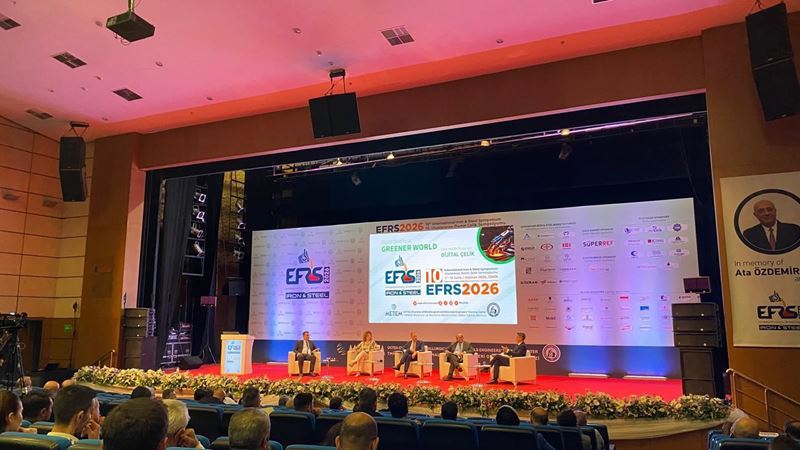
The global steel industry's green transition process and sustainability goals were discussed in depth during a special panel held at the EFRS 2026 International Iron and Steel Symposium. Moderated by Erdemir Deputy General Manager for Operations Sinan Bozkurt, the panel titled “Green Steel, CBAM and Market Dynamics” featured Clare Broadbent, Sustainability Director at the World Steel Association (worldsteel), Dimitrios Dimitriou, Group Vice President of Emsteel, Shivakumar Kuppuswamy, Director of Development and Innovation at ResponsibleSteel, and Güvenç Temizel, Deputy General Manager of Borçelik.
“Green Steel” Does Not Mean Zero Carbon
One of the key technical conclusions highlighted during the panel was that the term “green steel” does not imply absolute zero-carbon production. Based on current industrial and technological realities, steel with emissions ranging between 50 and 400 kg of CO₂ per tonne, depending on scrap content and production processes, is generally considered low-carbon steel.
Referring to guidelines from the International Energy Agency (IEA), panelists emphasized that green steel should be viewed not as a binary label but as a spectrum, or different “shades of green.” They noted that truly zero-carbon steel production is not yet feasible under current conditions and that the industry's focus should remain on near-zero and low-carbon production pathways.
Customer Demand Driven by Risk and Compliance Rather Than Voluntary Choice
Discussing demand drivers for green steel, Emsteel Group Vice President Dimitrios Dimitriou highlighted prevailing purchasing trends in the market. He noted that buyers remain cautious about paying significant green steel premiums and that traditional purchasing criteria continue to be price, quality, and delivery performance, while carbon emissions have now emerged as a fourth key factor.
The panel also emphasized that customers often purchase sustainable products not primarily as a matter of preference, but because of compliance, transparency, and risk-management requirements imposed by investors, banks, and regulators. While more proactive demand is observed in mature sectors such as automotive, a case study from the construction sector showed that the existence of multiple product labels and Environmental Product Declarations (EPDs) for the same steel beam can create confusion among customers and ultimately lead to price-driven purchasing decisions.
CBAM: Climate Tool or Trade Mechanism?
The European Union’s Carbon Border Adjustment Mechanism (CBAM) was evaluated both as a climate policy instrument and as a potential competitive or protective mechanism influencing global trade flows. While CBAM aims to establish a level playing field between EU producers and foreign suppliers by assigning a carbon cost to imports, panelists noted that its implementation involves significant practical challenges.
It was highlighted that overlapping regulations such as the EU Emissions Trading System (EU ETS), CBAM, Environmental Product Declarations (EPDs), and the Ecodesign for Sustainable Products Regulation (ESPR) rely on different accounting frameworks, creating complexity for businesses. In particular, the question of who will verify foreign producers’ emissions claims, using which methodology and internationally accepted infrastructure, was identified as one of the most critical challenges affecting credibility and implementation.
Using Türkiye as an example, panelists also pointed to ongoing efforts to establish a national Emissions Trading System (ETS) aimed at addressing global carbon-pricing disparities.
Balancing Value Chain Economics and Energy Security
Panelists stressed the importance of value chain economics in financing the green transition. Discussions focused on whether steelmakers should bear the cost of premiums paid to upstream green iron producers, with the view emerging that the ultimate downstream customer must either absorb these premiums or enable them through the broader economic system.
Recent geopolitical tensions and global energy crises were also identified as factors reshaping industrial priorities. The panel concluded that decarbonization goals can no longer be pursued in isolation; instead, they must be balanced with energy security, supply chain resilience, and competitive input costs. In this context, energy efficiency measures and short-term decarbonization initiatives were highlighted as increasingly important priorities for the industry.




Comments
No comment yet.