


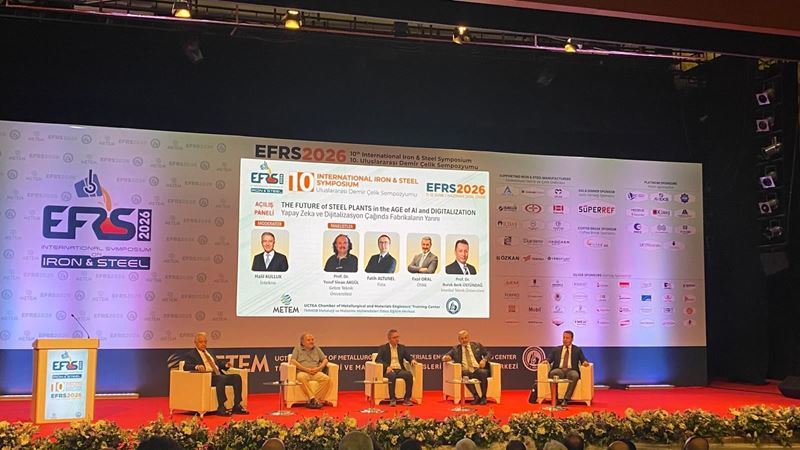
Speaking during the panel titled “Investment in factories in the age of artificial intelligence and digitalization,” organized within the scope of EFRS 2026, Üstündağ stated that digitalization has a history of approximately 30 years. The panel was moderated by Halil Kulluk, Chairman and CEO of Intekno Group.
Üstündağ stated that digitalization had a limited economic impact in the early 2000s. However, he noted that the process gained momentum during the 2010s, driven by mobile technologies and the platform economy. He added that after 2015, the potential of digitalization began to exceed its existing economic value by a significant margin.
Referring to the emergence of generative artificial intelligence in 2022, Üstündağ stated that this gap widened further. He emphasized that artificial intelligence has evolved from being merely a data analysis tool into a system that actively participates in decision making processes.
Üstündağ also highlighted the risks associated with digitalization, particularly the increasing tendency toward monopolization within platform economies. He stated that this development could affect sectoral balances and emphasized the importance of companies acting collectively throughout this process.
Addressing the historical development of artificial intelligence, Üstündağ noted that the technology dates back to the 1950s but remained largely theoretical for many years. He emphasized that artificial intelligence has recently experienced rapid progress, supported by growing data capacity and advances in hardware technologies.
The panel also highlighted that digitalization is no longer solely a data driven structure but is evolving into systems capable of managing real time decision making processes. It was noted that technologies capable of instantly analyzing production, customer relations, and financial processes are becoming increasingly widespread.
During the EFRS 2026 panel, it was emphasized that digitalization and artificial intelligence are accelerating transformation across all industries, particularly in manufacturing. Participants highlighted that organizations capable of adapting to this transformation will gain a competitive advantage, while the associated risks must be managed carefully.





Comments
No comment yet.