


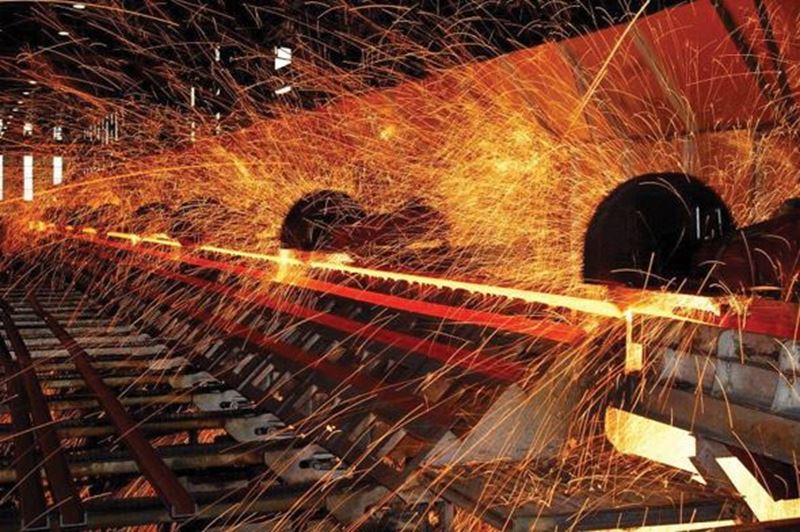
Production volumes of basic metal product types in Ukraine in 2022 decreased by about 3.5 times compared to 2021.
In particular, according to global statistical data, iron smelting volume decreased by 69.8% to 6.39 million tons, steel - decreased by 70.7% to 6.26 million tons, and rolled product production volume decreased by 71.96% to 5.35 million tons.
The reasons for this;
Loss of 30-40% of metallurgical capacities represented by PrJSC Mariupol Metallurgical Plant (MMK) on behalf of Ilyich and PrJSC Azovstal; logistical problems caused by the inaccessibility of ports and the resulting 3-4 times increase in the cost of product transportation; shortage of electricity caused by the bombing of objects of the Ukrainian energy system; and finally, unfavorable world market conditions.
Adding that at the beginning of spring 2022 only four steel enterprises remained in Ukraine's mining and metallurgical complex (MMC): ArcelorMittal-Kryvyi Rih PJSC (AMKR), Zaporizhstal PJSC, Kametstal PrJSC and Dniprovsky Metallurgical Plant PrJSC (DMZ). In December 2022, all were forced to either work within their allocated quotas or cease production, precisely because of the gradual destruction of the country's energy infrastructure. As a result, in the last month of last year compared to December 2021, the iron smelting volume in the country decreased by 85.7% to 247 thousand tons, steel - by 93.9% to 106 thousand tons. The volume of rolled products - 92.9%, recorded as 108 thousand tons.
Presumably, before the end of the special military operation (SVO), the situation in Ukraine's energy system will not only change for the better, but will even get worse. This means that if war and similar activities continue throughout this year, the production volume of basic metal product types in the country in 2023 will decrease by 2-5 times compared to 2022. That is, according to December indicators, the volume of iron smelting will be less than 3 million tons.
In addition, according to foreign sources, the steel production volume of all metallurgical enterprises that are part of the company in 2022 reached 2 million tons. Production cycles; development of new types of products; but most importantly it can be characterized by the increased demand for metal products in the regions that became part of the Russian Federation (RF) due to the need to rebuild the infrastructure destroyed during the NWO. It can also be added to its gradual integration into the Russian economy.
From the spring of 2022, the MMK DLNR includes the not yet operational MMK named after Ilyich, which will most likely be operational again in the near future.
All this means that in terms of metallurgical capacities, DLNR is already significantly superior to Ukraine. And if the mining and metallurgical complex of the republics and the Ukrainian mining and metallurgical complex will work in normal mode, the production volumes of metal products in DLNR will be correspondingly higher. Also, whatever the current circumstances, a turning point could occur as early as this year.
Thus, in 2023, according to the plans of the YuGMK management, the steel production volume of all three metallurgical enterprises of the company is expected to increase by 30% compared to 2022, to reach 3 million tons.
Today, with comparable steelmaking capacities, Ukraine's MMC is drooping more and more and DLNR's MMC, on the contrary, is developing rapidly. And by the end of 2023, the steel production volumes at the republican enterprises will be 2-2.5 times higher than at the Ukrainian enterprises are listed as the projections of the sources.



Comments
No comment yet.