


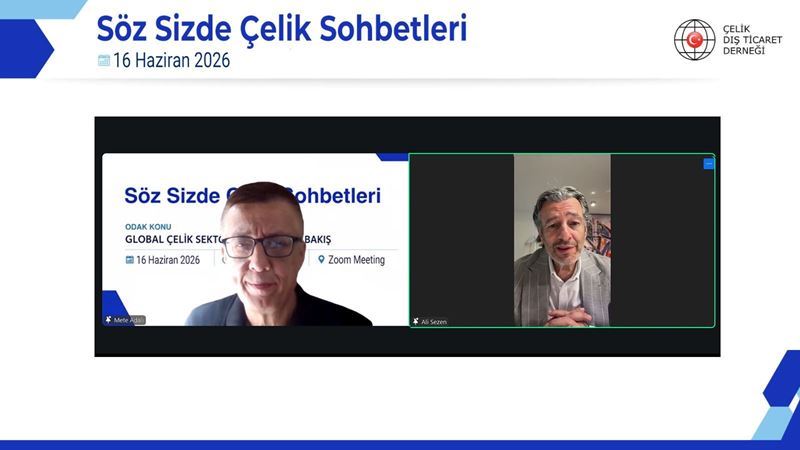
Pointing out that Ukraine has always been a strategic player in the global market thanks to its strong industrial infrastructure dating back to the Soviet Union era, its engineering know-how, and its software (IT) potential, UTİAD Chairman Ali Sezen stated that he personally visits the region every two months. Despite the tense environment where mutual bombardments continue, Sezen noted that trade volume between Türkiye and Ukraine has reached surprising levels, adding that the sectors recording the highest increase in exports include chemical raw materials, iron and steel, automotive, and machinery components.
“We Export Galvanized Sheets for Grain Warehouses”
Recalling that Ukraine ranked third in Türkiye’s steel exports last year, Sezen explained the reasons behind the country’s raw material and product demand as follows: “Due to the war, Ukraine’s massive steel plants have either been taken over by the Russian side or completely destroyed. Giant factories in the Donetsk and Mariupol regions, such as Azovstal and Illich, are completely in ruins. Having lost its production capacity, Ukraine is meeting its needs from Türkiye. In particular, the total grain capacity of the ports of Odesa, Illichivsk, and Yuzhny reaches millions of tons. Huge hangars are being built around the ports to store grains brought from the northern and eastern regions. And it is precisely for the construction of these hangars that a very large amount of galvanized sheet is being exported from Türkiye. In addition, our exports of reinforcing steel, angle bars, profiles, and hot-rolled sheet are also continuing at full speed.”
Adding that Ukrainian producers are preparing to launch anti-dumping investigations against Turkish steel in some product groups, Sezen emphasized, recalling similar barriers imposed on cement in the past, that traders and manufacturers should be prepared for this.
Is Ukraine a Threat to Turkish Steel?
Answering the question from industry representatives, “Could Ukraine, which produced five times its domestic consumption before the war and has signed a Free Trade Agreement (FTA) with Türkiye, become a threat to the Turkish steel sector in the future?”, Ali Sezen made the following assessment: “In the short and medium term, Ukraine can absolutely not be a threat to the Turkish iron and steel sector. On the contrary, it will continue to be one of our largest export markets. After the war, there will be a need for trillions of dollars in budget and millions of tons of steel to rebuild the country’s industry, cities, ports, and airports. It is impossible for the damaged factories to recover immediately. In addition, in the FTA signed between the two countries, the most contentious issues were steel quotas and export taxes; however, these issues have been resolved. The agreement has passed the parliaments of both countries. It will come into force once the leaders meet in the near future. My message to Turkish companies is: they should already go and establish their structures in Ukraine, opening offices and warehouses there.”
Ukraine Completely Closed Scrap Exports
Referring also to Ukraine’s domestic raw material policies, Sezen stated that despite the dominance of steel giant Metinvest in the region, the Ukrainian government recently completely closed scrap exports. He noted that they want to keep this critical raw material in the country for the post-war period, adding that the previously high export taxes imposed on Türkiye have now become irrelevant due to the complete halt in exports. He also shared as a recent development that the European Union’s Carbon Border Adjustment Mechanism (CBAM) has provided flexibility for Ukraine, with reductions in per-ton tax rates.
Venezuela: Sanctions Lifted, 150,000 Tons of Scrap Exported Monthly
In the final part of his speech, opening a parenthesis on Venezuela, another area of expertise for global scrap supply, UTİAD Chairman Ali Sezen stated that they have been carrying out uninterrupted scrap exports from this country since 2018. He noted that after the United States established control in the country, nearly all sanctions from the Maduro era were lifted, and that the SWIFT international money transfer system will soon be reopened. Sezen said, “As a company, we export around 150,000 tons per month and nearly 2 million tons per year of scrap from Venezuela. We were concerned for our ships at the port on the day of the political change, but there was no disruption; on the contrary, banking and financial blockages were lifted. I strongly recommend that all businesspeople who want to operate in this country, which has the world’s largest oil and natural resource reserves, visit the region.”



Comments
No comment yet.