


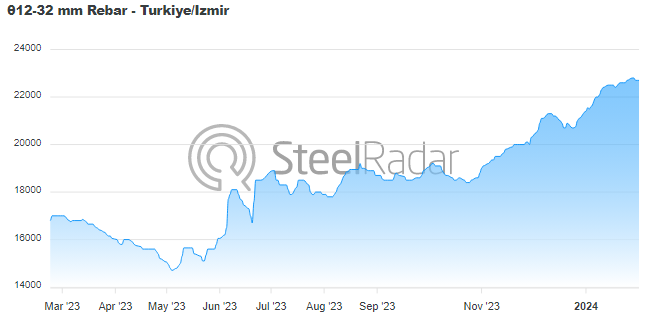
The addition of the February 6 earthquakes to the stagnation observed in the world steel industry due to the Russia-Ukraine War in 2023 and the subsequent rapid rise in energy prices had a negative impact on the Türkiye steel industry.
On top of all this, the Israeli-Palestinian war, which started in the last quarter of the year, dealt a blow to the steel industry again. While Israel was in the top three in Türkiye's export market, this situation negatively affected iron and steel sales. While shipments were stopped, some orders were cancelled.
Especially the sales of Izmir producers to Israel and Yemen have stopped. However, producers and sellers in the Izmir region, trying to survive with domestic sales, are trying to ensure continuity with aggressive price policies. Izmir rebar prices, which were at the level of 15,350 TL at the beginning of 2023, increased by 40 percent during the year and reached 22,700 TL at the end of the year. As of the end of January 2024, it increased by 6 percent monthly and reached 22,700 TL.
When we examine the dollar-based price change in 2023, rebar prices, which were at $695-700 at the beginning of the year, increased rapidly after the February 6 earthquake and reached $765, the ceiling price of the year, in the first week of March.
While the global market was shrinking, the hope of revitalizing the domestic market due to the negative impact of the earthquake shed light on the sector. However, the expected investments could not be made due to high inflation, rapid increase in exchange rates and weakening of monetary policies.
The overlapping negative conditions in the industry caused rebar prices to drop to $545 in October. Factories are trying to keep prices in the range of $620-640 while decreasing their production capacity by reducing supply due to the contraction in demand.
While Izmir rebar prices, which were at $710 in February 2023, increased in Turkish lira, they decreased by 12 percent (an average of $90) in dollar terms and fell to $620.



Comments
No comment yet.