


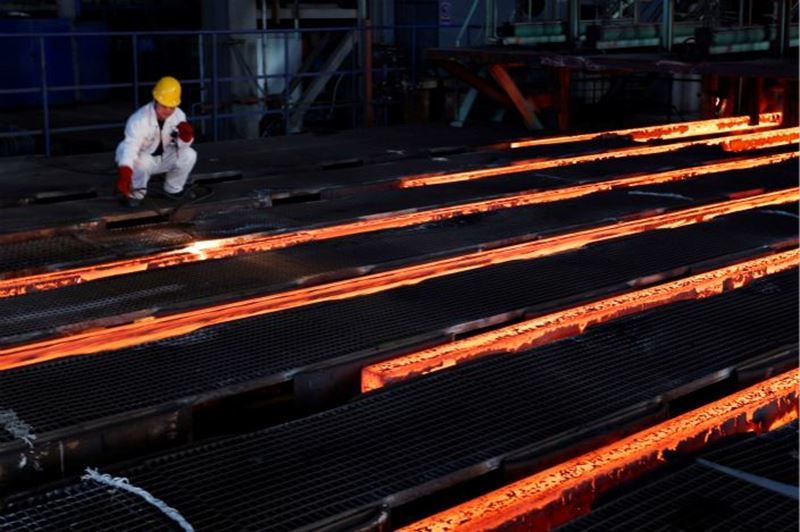
Germany’s crude steel production rose by 9% in the first quarter of 2026 compared to the same period last year, reaching 9.3 million tonnes. In March 2026, production increased by 7.5% to 3.3 million tonnes.
Blast furnace (BOF) production increased by 11.1% in the first quarter to 6.4 million tonnes, while electric arc furnace (EAF) production rose by 4.6% to 2.9 million tonnes. Pig iron production grew by 10.4% to 5.9 million tonnes, and hot-rolled steel products output increased by 4.9% to 8.0 million tonnes. In March, BOF production stood at 2.2 million tonnes, EAF production at 1.1 million tonnes, pig iron at 2.0 million tonnes, and hot-rolled products at 2.9 million tonnes.
Kerstin Maria Rippel, CEO of the German Steel Federation, stated that the slight recovery in crude steel production does not mean the sector has returned to a healthy level, saying: “Despite the increases in production, the situation in the steel sector remains tense. When projected against a figure of 37 million tonnes, we are still below the minimum threshold of 40 million tonnes, which represents healthy capacity utilization for our industry.”
Rippel noted that Germany’s crude steel production remained at a historically low level of 34.1 million tonnes in 2025, comparable to the 2009 global financial crisis. She added that the weakness in the sector stems from a long-term structural decline in demand, with steel demand falling since 2017 and decreasing by around 30% (approximately 12 million tonnes) by 2025.
It was reported that demand remains weak in major customer industries such as the automotive sector and mechanical engineering, and that stability in market supply is driven not by rising demand but by stock accumulation. Germany has also dropped two places among the largest steel-consuming countries since 2017, ranking eighth in 2025.
Import pressure has increased, and according to the OECD, global steel overcapacity could exceed 700 million tonnes by 2027—more than five times the EU’s crude steel production in 2025. Therefore, it was emphasized that EU institutions must implement an effective steel trade defense instrument.
Although slight increases were observed in domestic and external orders, levels remain low. Geopolitical tensions have had a limited impact, and the ifo Business Climate Index has remained below its long-term average since 2022.
While the sector aims to generate new momentum by focusing on low-emission steel produced in the EU, it was noted that prioritizing climate-friendly steel in public procurement could boost demand. The Public Procurement Acceleration Act adopted by the German Bundestag was described as an important foundation, but it needs to be implemented quickly.
On energy costs, it was noted that the Iran conflict has increased the need for energy stability due to its impact on gas and electricity prices. Competitive energy prices were emphasized as critical for the sector, with a target electricity price of around EUR 50/MWh including all taxes. The European Commission’s AccelerateEU package was highlighted as an important step in this regard.


Comments
No comment yet.