


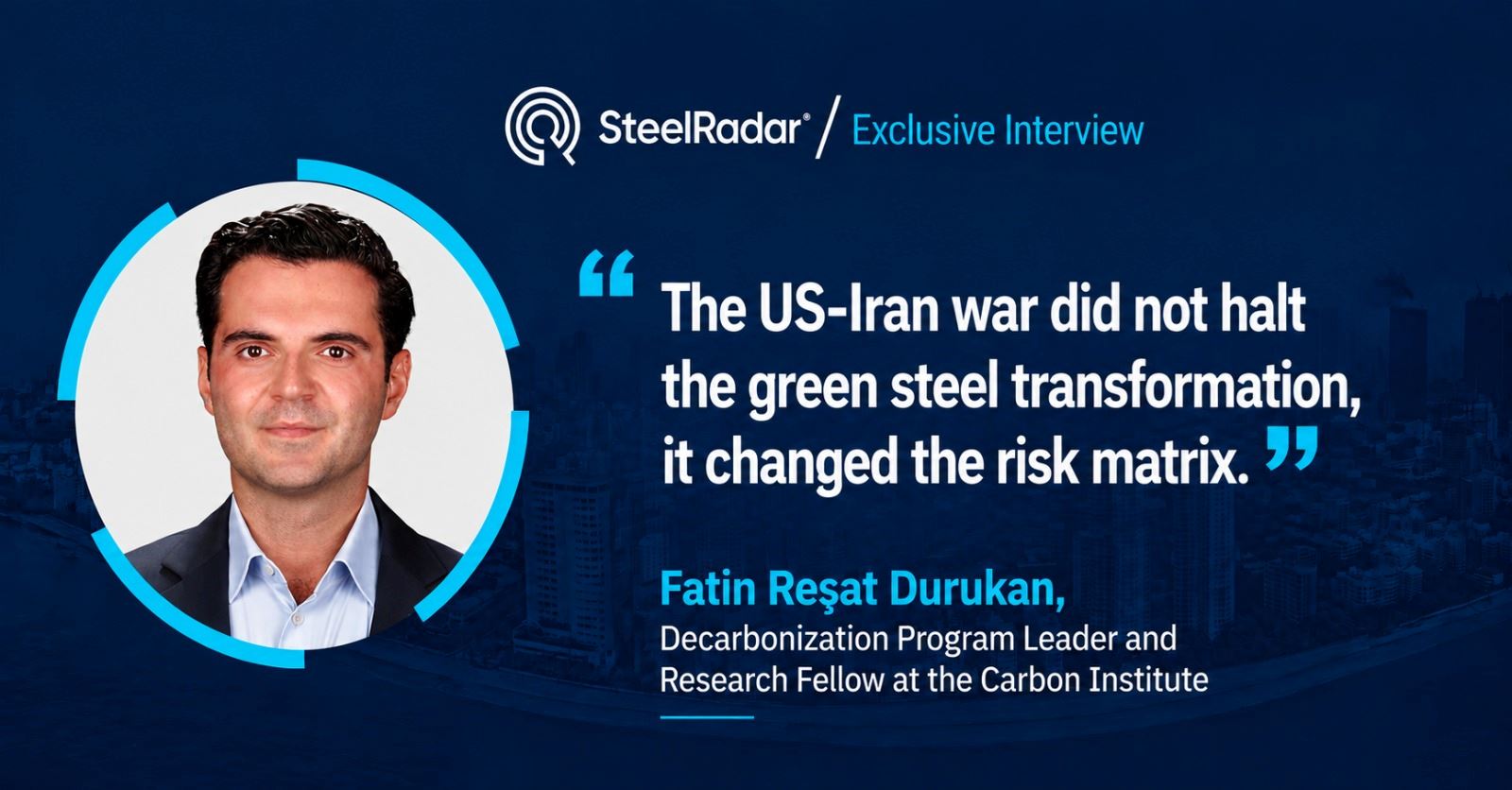
Durukan stated that competition in the steel industry in the coming period will not be shaped solely by production costs, but will increasingly be determined by a combination of energy sources, carbon intensity, raw material access, financing, logistics security and market access.
First of all, could you tell us a little about yourself and your work in the steel industry?
I work as the Decarbonization Program Lead and Research Fellow at the Carboun Institute, an independent think tank focusing on climate, energy and sustainable development issues in the Middle East and North Africa. My work focuses particularly on iron and steel, hydrogen and low-carbon industries across the MENA region. My main area of expertise lies at the intersection of industrial policy, international trade and the energy transition.
I also provide consulting services to companies in the private sector, supporting them with investment, market entry, political risk, due diligence and strategic partnerships across the EMEA (Europe, Middle East and Africa) markets.
“Disruptions in the Strait of Hormuz do not have the same price impact everywhere”
How have the US-Iran war and developments in the Strait of Hormuz affected the steel industry across the MENA region?
I think the impact is much greater than it appears at first glance. The Strait of Hormuz is initially perceived as mainly an oil and LNG issue, but it also directly affects the logistics of steel, aluminum, iron ore, DRI/HBI and other heavy industries. Disruptions at major Iranian producers such as Mobarakeh and Khouzestan have temporarily affected around 15 million tonnes of annual steel production capacity. It has also been estimated that approximately 23 million tonnes of seaborne iron ore demand are at risk.
The important point here is that this shock has not hit a comfortable global market. Global crude steel production declined to 1.85 billion tonnes in 2025, while global excess capacity reached approximately 600 million tonnes. China’s steel exports also reached a record level of around 134 million tonnes. In other words, the system was already under significant pressure from excess supply and trade diversion.
The second impact is on financing and trade routes. When you speak with companies and industry players, the question is no longer simply whether a product can pass through the Strait of Hormuz. Companies are now asking whether insurance is available, how high war-risk premiums are, what the force majeure provisions say, whether alternative ports are available, and whether banks are willing to finance the associated risks over the long term. Under such conditions, disruptions in the Strait of Hormuz do not have the same price impact everywhere. While supply may tighten in one region, excess supply redirected toward another market may create additional downward pressure on prices. So this is not merely a logistics issue; it is also a question of insurability, financing costs and the reorientation of trade flows.
“Geopolitical risks are changing the financing conditions for green steel investments”
How do you assess the impact of the war in Iran on green steel and decarbonization investments?
I do not think the war has stopped the green steel transition, but I do think it has changed the risk matrix considered by investment committees. A few years ago, the competitiveness of a project was mainly discussed in terms of hydrogen costs, renewable energy prices and proximity to Europe. Today, geopolitical risk, insurability, alternative export corridors and the physical security of energy infrastructure have also become part of the equation.
The technological pathway is actually becoming increasingly clear. The greenhouse gas intensity of BF-BOF production is approximately 2.66 tCO2e per tonne, compared with 1.66 tCO2e/t for DRI-EAF and 0.71 tCO2e/t for scrap-based EAF production. With hydrogen-based DRI, it is technically possible to reduce emissions to below 0.25 tCO2 per tonne. Therefore, the fundamental question is no longer simply whether the technology exists, but rather under what risk structure we can finance that technology.
The most vulnerable projects are those still at the MoU or feasibility-study stage. The technology often exists; the real challenge is determining who will supply the hydrogen, at what price, who will purchase the product over a 10–15-year period, and who will carry the political and logistical risks on their balance sheet.
A price premium for low-carbon steel has started to emerge in Europe, with premiums of around €120–180 per tonne being discussed in some segments. However, it is also clear that buyers remain reluctant to pay this premium consistently unless they are required to do so. Therefore, a green premium alone does not make a project bankable.
For this reason, I believe hydrogen-ready DRI/HBI projects, which can initially operate on natural gas and gradually transition to hydrogen, are more likely to secure financing in the region than projects designed to operate on 100% green hydrogen from day one.
What steps should the Turkish steel industry take to maintain its competitiveness in the face of the EU’s CBAM?
I believe the biggest mistake Turkish companies should avoid is treating CBAM simply as a “carbon tax.” Türkiye actually has an important technical advantage to begin with. Around 72% of crude steel production in Türkiye comes from electric arc furnaces. This means Türkiye has a lower-carbon production structure compared with producers relying predominantly on integrated blast furnace routes.
However, this advantage is not automatic. As of 2025, the carbon intensity of Türkiye’s electricity grid was approximately 398 gCO2e/kWh, compared with around 230 gCO2e/kWh for the EU average. As a result, part of the EAF’s advantage in terms of lower direct emissions can be lost through electricity-related Scope 2 emissions.
Producing a low-carbon product technically is not enough either. If you cannot demonstrate this through a robust MRV system, EPDs, verifiable electricity sources and product-level data, you may lose your commercial advantage.
In other words, data infrastructure is becoming part of the steel plant itself. PPAs, renewable energy investments integrated into industrial operations, and Türkiye’s Emissions Trading System will also be critical. Strengthening MRV and reducing the carbon intensity of the electricity grid are among the key steps required to maintain Türkiye’s position in terms of CBAM costs.
Türkiye also needs to look beyond CBAM and consider the EU’s broader steel protection policy. As of July 1, 2026, the EU has limited duty-free steel import quotas to 18.3 million tonnes annually, with a 50% tariff applied to imports exceeding the quota. This means Europe is no longer considering carbon regulation separately from quotas, trade-defense measures and domestic industrial policy.
Therefore, the strategy of Turkish producers cannot simply be “let’s reduce our emissions.” Emissions, energy costs, product quality, certification, market access and customer relationships in Europe all need to be managed together.
“The roles of MENA, the EU and Türkiye in green steel will become increasingly differentiated”
How do you see the positions of MENA, Türkiye and the EU in global green steel production over the next 5–10 years?
I do not think the three regions will pursue the same model. I believe the value chain will become increasingly differentiated, and the main competition will be about where each stage of the production chain can be carried out most efficiently and with the lowest carbon intensity, rather than keeping the entire production chain within a single country.
MENA’s biggest opportunity, at least initially, is not necessarily to export millions of tonnes of finished green steel, but to become a production hub for DRI and, in particular, transportable HBI. The region already accounts for approximately 44% of global DRI production. This is significant because while many European producers are trying to build DRI infrastructure from scratch, the Gulf and North Africa have decades of operational experience in this area. Low-cost energy, natural gas infrastructure, renewable energy potential and access to ports also support this model.
Despite high energy costs, the EU will remain the center of technology, regulation, financing and premium low-carbon steel demand. However, Europe’s own production base is under pressure. Crude steel production declined from approximately 152 million tonnes in 2021 to 126 million tonnes in 2025.
At the same time, apparent steel demand in the EU and UK increased by 3.8% in 2025, with a significant portion of this growth driven not by automotive demand but by defense, infrastructure and energy investments.
This means Europe is simultaneously developing both industrial protection policies and a new low-carbon demand base. Therefore, for example, converting iron ore into low-carbon DRI/HBI in Oman or Saudi Arabia and then processing it into finished steel in Europe could be an extremely rational model.
Türkiye occupies a particularly interesting position between these two systems. With crude steel production of 38.1 million tonnes in 2025, Türkiye was Europe’s largest and the world’s seventh-largest steel producer. Its 72.2% EAF share provides a significant decarbonization advantage.
However, this model also has a vulnerability. Türkiye imported approximately 18.7 million tonnes of scrap in 2025 while exporting only 0.2 million tonnes. In other words, there is significant external dependence on a key input for low-carbon steel production.
In my view, this is precisely where Türkiye’s opportunity lies. Rather than choosing between “the EU or the Gulf,” Türkiye can position itself as a hub connecting low-carbon DRI/HBI and capital from MENA with European demand through its own production capabilities and customer network.
“Looking for an investor is not the same as looking for a strategic partner”
How has the appetite for direct investment in Turkish industry from the Gulf countries, particularly Saudi Arabia and the UAE, changed in recent years? Where does steel and heavy industry stand within this interest?
I believe there has been a significant change in the behavior of Gulf capital. In the past, when Gulf investments in Türkiye were discussed, finance, real estate and portfolio investments were much more prominent. Today, particularly in Saudi Arabia and the UAE, capital is taking a much more strategic and industrial approach.
The question of “What technology, market or supply chain does this investment give me access to?” has become increasingly important. More broadly, we are also seeing a recovery in global investment appetite. In other words, capital is available, but it has become more selective.
Steel and heavy industry are important in this context because Gulf countries no longer want to simply export energy; they want to use that energy to export higher-value industrial products.
The fact that Hadeed is part of Saudi Arabia’s PIF portfolio and EMSTEEL is part of the ADQ ecosystem in the UAE is not a coincidence. These structures differ from conventional private-sector investments, as industrial policy and capital are moving together.
This is also why our report identifies Saudi Arabia and the UAE as the two strongest markets in the region in terms of sovereign financing capacity.
For Turkish companies, the opportunity is therefore not simply about “bringing Gulf money into Türkiye.” Joint ventures, technology transfer, co-production, localization in MENA and joint exports to third countries are much more valuable models.
As global excess capacity, protectionism and market-access pressures increase, partnerships that provide not only capital but also access to new markets and raw materials will become increasingly valuable.
Looking for an investor is not the same as looking for a strategic partner.
“A market-entry strategy for one country cannot simply be copied to another”
What is the most common strategic mistake Turkish industrial companies make when entering MENA markets? Is risk analysis insufficient, or are local partnership models too weak?
I think the first mistake is treating MENA as a single market. We see this frequently among Turkish companies. They say, “We want to enter the Gulf,” but Saudi Arabia, the UAE, Oman, Egypt and even Algeria are extremely different markets.
We see the same thing in global steel trade today. The issue is no longer simply how much steel is produced, but how trade flows are shifting as protectionism increases. Therefore, a market-entry strategy for one country cannot simply be copied to another.
For example, the UAE is a very fast-moving, commercial and international market. In Saudi Arabia, the scale is enormous, but localization, the right government connections and long-term commitment are much more important.
In Oman, highly specific opportunities are emerging around ports, industrial zones such as Duqm and Sohar, and energy projects. Egypt, meanwhile, offers a huge domestic market and proximity to Europe, but financing, foreign-exchange and regulatory risks need to be managed much more carefully.
The second mistake is selecting a local partner simply as someone who can introduce you to the right people. In my view, a good partner does much more than open doors. They understand regulations, know the customer’s actual purchasing process, understand tendering and payment practices, and, when necessary, are willing to put their own balance sheet or reputation on the line.
As trade-defense measures, localization requirements and supply-chain risks increase, the local partner is effectively becoming part of a company’s risk-management infrastructure.
“The number of projects that can move from an MoU to a final investment decision remains limited”
Finally, is there anything else you would like to add?
I believe the steel industry is heading toward a fundamental change. Competition will no longer simply be about who can produce a tonne of steel at the lowest cost. The energy source, carbon intensity, access to iron ore and scrap, financing costs, logistics security, certification and long-term customer contracts will all determine the price of the same product.
Global excess capacity reached approximately 600 million tonnes in 2025, and the OECD expects this figure to rise to 721 million tonnes by 2027. In such an environment, simply having production capacity is no longer an advantage. Türkiye is a good example. Production increased by 3.3% to 38.1 million tonnes in 2025, making Türkiye Europe’s largest producer. However, with installed capacity of approximately 61.9 million tonnes, capacity utilization remained at only 61.6%.
In the same year, imports reached 18.9 million tonnes, exceeding exports of 15.1 million tonnes. This tells us that the issue is not about producing more, but about delivering the right product to the right market at a competitive cost and with an increasingly lower carbon footprint.
There is also no shortage of projects or technologies in the region. There are many projects. However, the number of projects that can successfully move from an MoU to a final investment decision remains limited.
For investors, a compelling green steel story alone is not enough. Energy supply agreements, raw material availability, offtake guarantees, certification and risk-sharing mechanisms all need to be in place simultaneously. Therefore, I do not view this transformation in Türkiye simply as a cost or as a regulation imposed by the EU. If Türkiye positions itself correctly, an entirely new steel and low-carbon iron value chain could emerge between Türkiye, MENA and Europe over the next decade. I believe that is where the real opportunity lies.



Comments
No comment yet.