


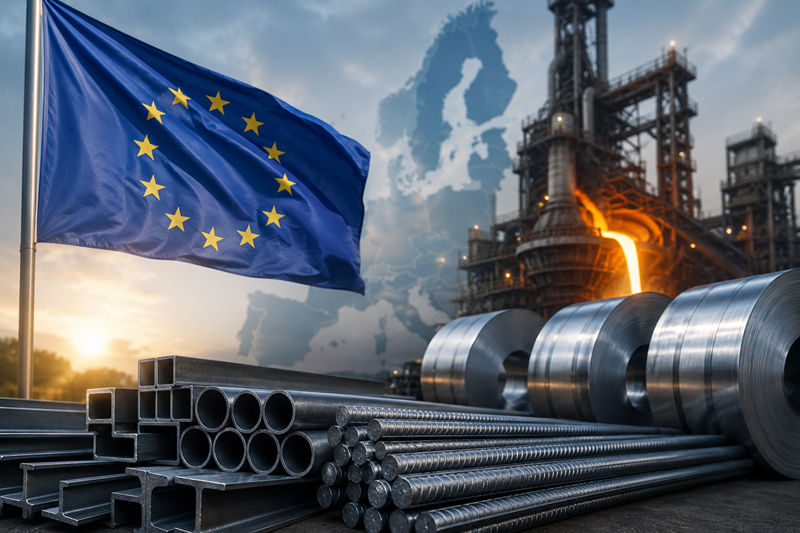
According to the report titled “European Steel Industry at a Crossroads” prepared by Dr. Alberto Claudio Tremolada, apparent steel consumption in the EU fell by 0.2% year-on-year in 2025, marking the fourth consecutive annual decline. Consumption had decreased by 8% in 2022, 6% in 2023 and 1.1% in 2024. Although a recovery of around 3% is forecast for 2026, the report noted that this outlook depends on easing geopolitical tensions and an improvement in the industrial environment.
The SWIP index, which tracks production in steel-using sectors, also declined by 0.5% in 2025 following a 3.6% decrease in 2024. Automotive production fell by 3.8% in 2025, while growth in the construction sector remained limited to just 0.1%.
Imports account for 27% of EU steel consumption
The report noted that weak domestic demand was accompanied by strong import pressure. Including semi-finished products, imports accounted for 27% of the EU’s total apparent steel consumption.
This situation was reported to have eroded the market share of EU producers and put pressure on the operating margins of service centers and regional distributors.
Following these developments, the call for action launched by EUROMETAL in April 2026 at the Tube & Wire trade fair in Düsseldorf to protect Europe’s steel and metals sector has reached around 500 signatories. The signatories include companies, more than 40 national steel associations and industrial stakeholders from across Europe.
According to the report, the coalition represents a production and distribution ecosystem supporting more than 14 million jobs across Europe.
Steel sector to head to Brussels on September 7
EUROMETAL and its coalition partners are preparing to organize the “European Convoy for Industrial Competitiveness” in Brussels on September 7, 2026, to bring the sector’s demands to EU institutions.
Under the slogan “Keep Manufacturing in Europe,” industrial vehicles and industry delegations from different European countries are expected to travel to the European Commission’s Berlaymont headquarters.
The sector’s demands include strengthening the competitiveness of European industry, protecting manufacturing employment and investment, building resilient supply chains, reducing strategic dependence on third countries and strengthening Europe’s industrial sovereignty.
Industry calls for industrial electricity prices of 5 cents/kWh
The report highlighted that electricity and natural gas prices in Europe remain high compared with major international competitors, undermining the competitiveness of energy-intensive industrial processes.
High energy costs were also said to make the transition from traditional blast furnace-basic oxygen furnace (BF-BOF) routes to renewable-powered electric arc furnaces (EAF) more difficult.
The industrial coalition is therefore calling for industrial electricity prices to be capped at no more than 5 cents/kWh.
Concerns over global steel trade being diverted to the EU
The report stated that the United States’ increase in tariffs on steel imports to 50%, along with restrictions imposed by Canada and the United Kingdom, could lead to trade diversion in global steel markets.
These measures could make access to other markets more difficult, potentially redirecting significant volumes of global production toward the European market.
According to the report, a new safeguard regime entered into force on July 1, 2026, under Regulation (EU) 2026/1384, providing for an annual tariff-free quota of 18.3 million tonnes, a 50% tariff outside the quota and “Melt & Pour” origin traceability requirements.
However, industry representatives remain concerned about whether these measures will be sufficient to address pressure stemming from global overcapacity.
Downstream product risk under CBAM
One of the key issues highlighted by the report is the competitive pressure that the current scope of CBAM could create for downstream steel-processing industries in the EU.
According to the report, CBAM, which entered its definitive phase in January 2026, imposes a carbon cost on the embedded emissions of imported crude steel and basic products, but does not cover all processed products containing steel, machinery components and finished products.
The report estimates that the additional cost of CBAM on imported steel could be around EUR 50-60 per tonne, while the ability of certain high-value-added finished products under CN codes 73-95 to enter the EU without a carbon cost could create a competitive imbalance.
The report describes this situation as the “downstream paradox” of CBAM.
According to the report, this structure could disadvantage mechanical processing chains, service centers and component manufacturers within the EU, while encouraging end users to purchase products processed or assembled outside the EU.
According to an assessment cited by the Spanish steel producers’ association UNESID, uncertainties regarding the customs classification of products covered by CBAM can also create compliance cost differences of up to EUR 300 per tonne for distributors.
Call to extend CBAM to downstream products under CN 73-95
One of the key medium-term measures proposed in the report is to expand CBAM to cover downstream steel products and metal-intensive finished goods.
The report argues that extending CBAM to downstream products under CN 73-95 is necessary to prevent service centers, pressing operations and metal manufacturing activities from relocating outside the EU.
The report also states that the pace at which free allowances under the EU Emissions Trading System are phased out should be reassessed based on the actual effectiveness of CBAM in the market.
Call to recognize scrap as a strategic raw material
To support domestic demand in Europe, the report also proposes the introduction of binding “Made in EU” preference criteria in public procurement for infrastructure, defence, electricity grids and sustainable transport.
It argues that ferrous scrap should be recognized as a “Strategic Secondary Raw Material” and that uncontrolled scrap exports to countries without equivalent environmental standards should be monitored and restricted where necessary.
Long-term target: DRI-EAF and competitive green hydrogen
For the long-term transformation of Europe’s steel industry, the report highlights the integration of direct reduced iron (DRI) plants with electric arc furnaces as being of fundamental importance.
According to the report, green hydrogen needs to be widely available at competitive prices below EUR 2 per kilogram for such investments to become economically viable.
The report also recommends using Carbon Contracts for Difference (CCfDs) and clean energy contracts to support investments, while calling for the creation of a certified European “Green Steel Label” to ensure that low-carbon European production is recognized in the market.
The report concludes that if downstream products are not brought within the scope of CBAM and structural reductions in industrial energy prices are not achieved, Europe’s environmental policies could lead to the relocation of production and emissions to third countries.



Comments
No comment yet.