


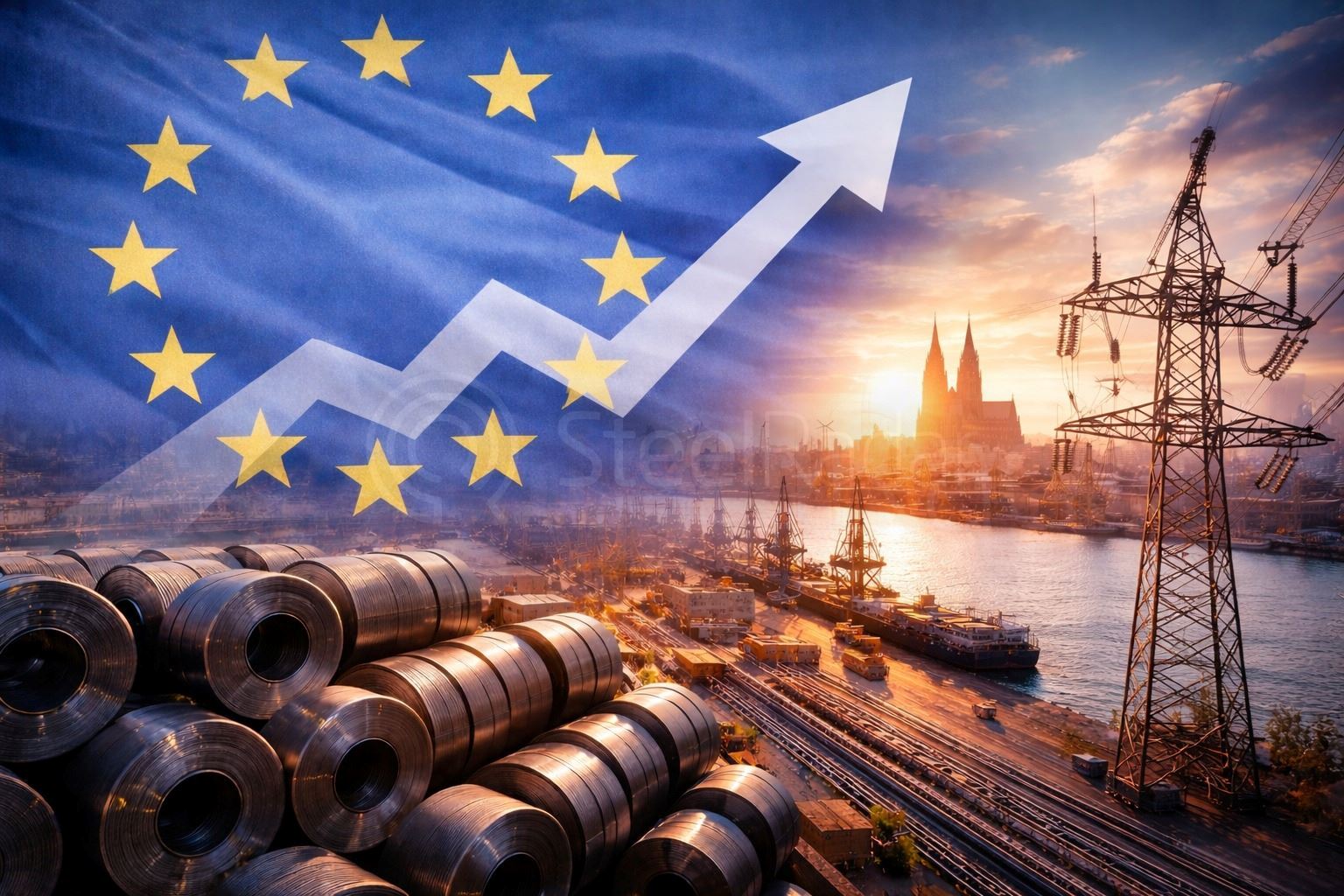
In the European long steel market, prices vary across different regions based on local market dynamics and logistical conditions. Spain currently sees the highest price levels for rebar at €665–680/t CPT, while the German market operates within the €610–640/t CPT range. Italy offers a more competitive range at €580–620/t EXW, and Poland maintains its regional position with price levels of €585–600/t (PLN 2,550–2,600) CPT. In the wire rod segment, Polish offers at €620–640/t CPT remain slightly above the €600–610/t EXW band observed in Germany and Italy.
A similar pricing discipline is evident between the two major production hubs, Germany and Italy, in the flat products segment. German-origin HRC prices are situated in the €650–660/t EXW band, while Italian offers are quoted at €645–650/t EXW. Regarding value-added products, HDG and CRC prices in Germany are concentrated between €755–770/t EXW, whereas the upper limit for these products in Italy reaches €780/t. In the plate market, Germany stands slightly higher at €730–750/t EXW compared to the €720–730/t levels seen in Italy.
Market sources stated that the sales momentum expected at the beginning of the month did not materialize and activity on the part of construction companies and distributors remained weak. Conversely, the strong scrap supply chain and high energy costs are increasing producers' resistance to price discounts. While buyers indicate that price increases are generally short-lived in the current stagnant demand environment, the permanent rise in production costs forces producers into gradual price adjustments. Speaking at Eurofer’s sectoral meeting in Antwerp, ArcelorMittal Europe CEO Geert Van Poelvoorde and Arvedi Group CEO Mario Arvedi Caldonazzo emphasized that high electricity prices directly drive up production costs, becoming the main factor limiting the competitiveness of the European steel sector.
Although some producers stated they could accept limited pullbacks in the second half of the month despite cost pressures, the general trend is interpreted as maintaining a cost-oriented upward trend rather than a downward correction. The fact that price hikes announced in long products in recent weeks have not created major jumps reveals that the market is priced on a cost basis, not a demand basis. Additionally, with the expectation that quotas will decrease by 50% in the second half of the year, European producers are expected to focus on the domestic market, which is anticipated to support internal sales.
The general outlook indicates a market structure where demand remains weak but stable, while scrap and energy costs push up production floor prices. Although import offers continue to be present in the market, it is stated that European producers are expected to increase their sales volumes by turning to the domestic market as quotas decline in the second half of the year. Therefore, while sharp price increases are not expected in the short term, the upward price trend driven by cost inflation and competition is expected to be maintained.





Comments
No comment yet.