


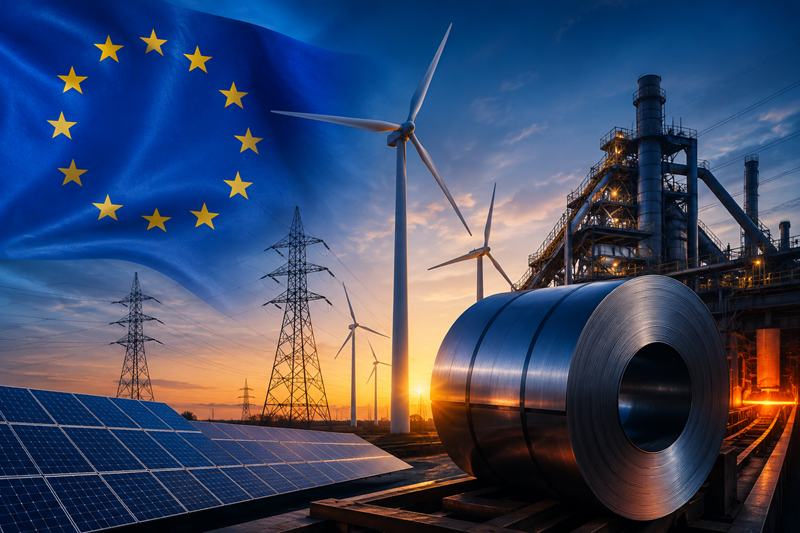
Donà stated that four years after the outbreak of the Russia-Ukraine war, the European steel sector is facing one of the most severe energy crises in its history. He noted that European steel producers are paying electricity and natural gas prices two to three times higher than their competitors in the US, India, China, and the Middle East and North Africa (MENA) region, significantly weakening the sector’s international competitiveness.
Decarbonisation investments at risk due to energy costs
Donà emphasized that the steel sector’s decarbonisation process largely depends on access to abundant and affordable fossil-free energy. He stated that the industry will require approximately 165 TWh of fossil-free electricity annually and 2 million tonnes of renewable hydrogen by 2030 to complete its transformation.
He noted that more than 60 low-carbon steel projects planned across Europe could reduce CO₂ emissions by 80 million tonnes compared with 1990 levels, aligning with the EU’s 55% emissions reduction target.
However, Donà warned that high energy costs are putting these investments at serious risk. He stated that the issue is not only related to the increase in wholesale electricity prices, which have risen from around €45/MWh in the past to an average of more than €85/MWh today.
Industrial consumers face multiple additional costs
According to Donà, energy-intensive industries are struggling not only with high electricity prices but also with several additional cost burdens.
These include:
- Indirect carbon costs under the EU Emissions Trading System (ETS) being passed on to electricity prices,
- A doubling of network tariffs due to grid operation and financing costs,
- Balancing and adjustment costs caused by insufficient flexibility in the electricity system, along with limited storage capacity,
- Rising costs related to ensuring security of electricity supply.
Hydrogen economy is developing slower than expected
Donà also highlighted that the hydrogen economy in Europe has not developed at the expected pace. He stated that hydrogen production capacity remains limited, infrastructure investments are behind schedule, and the levelised cost of renewable hydrogen is still between EUR 7-12/kg.
He noted that this situation is making it nearly impossible for many steel companies to decarbonise their production processes and reduce CO₂ emissions.
“Steel is the backbone of the European economy”
Donà stressed the strategic importance of steel for the European economy, stating that the sector is not merely another industrial branch.
He pointed out that construction, automotive, defence, packaging, and the energy transition all depend on steel. He added that wind turbines, electric vehicle structures, and electricity grid infrastructure cannot be produced without steel.
“Without a domestic steel industry, Europe will become dependent on imports for the essential materials needed to build its future,” Donà said, adding that the issue goes beyond industrial competitiveness alone.
330,000 direct jobs at risk
Donà stated that the European steel sector directly employs approximately 330,000 people and supports millions of additional jobs across downstream industries.
He warned that many of these jobs are located in regions where alternative employment opportunities are limited. According to Donà, relocating production to countries with lower energy costs could result in industrial and social losses that Europe may not be able to recover from for decades.
US-Iran tensions increase energy risks
Donà said that rising tensions between the US and Iran and the closure of the Strait of Hormuz have further increased pressure on energy prices, prompting action from the European Commission.
He recalled that the Commission has introduced initiatives such as the Clean Industrial Deal, the Affordable Energy Action Plan, and the Accelerate-EU Energy Strategy, aiming to support industry in the short term while maintaining the climate neutrality target.
However, Donà stated that although these initiatives send important political messages, they have not yet provided sufficient relief to address the immediate competitiveness challenges faced by energy-intensive industries.
EUROFER’s seven-point call to the EU
Donà stated that the European Union must urgently take the following steps to restore the competitiveness of the European steel sector and continue its low-carbon transition:
- Reduce total energy costs across the EU, including electricity prices and related costs, to EUR 50/MWh by 2030,
- Require electricity producers benefiting from two-way Contracts for Difference (CfDs) to allocate part of their production capacity to energy-intensive industries through Power Purchase Agreements (PPAs),
- Introduce targeted reductions in network tariffs for energy-intensive sectors exposed to international competition,
- Improve access conditions for temporary price support under the Clean Industrial Deal State Aid Framework (CISAF),
- Maintain and strengthen ETS indirect cost compensation mechanisms,
- Make PPAs more accessible and affordable by reducing costs related to low-carbon electricity profiling and baseload demand,
- Conduct a comprehensive review of the current European electricity market design, including alternative models such as segmented payment systems and price shock absorbers,
- Establish demand-side mechanisms using ETS revenues to support hydrogen use in energy-intensive industries.
Donà added that upcoming measures, including the EU Electrification Action Plan, new grid tariff regulations under Accelerate-EU, and the revision of the EU Hydrogen Strategy, will be decisive in restoring European industrial competitiveness, accelerating steel sector decarbonisation, and ensuring that Europe’s clean transition is built on a strong industrial foundation.



Comments
No comment yet.