


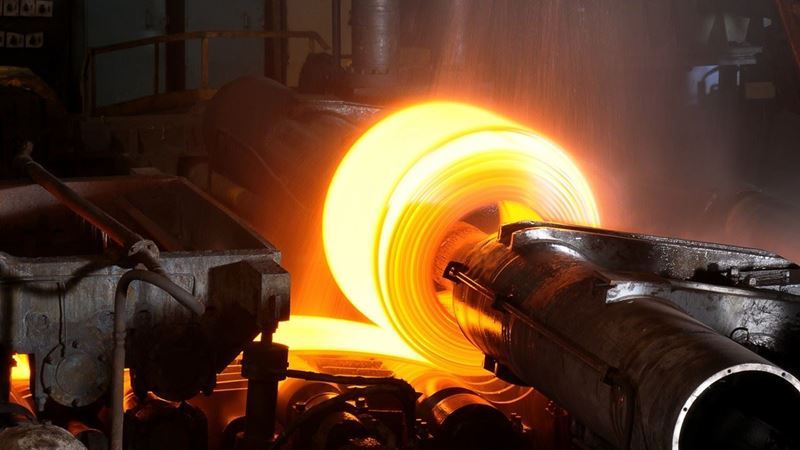
Steel, one of the important exporting sectors of Turkey, is entering a very critical situation this year. Steelmakers, who closed last year with losses in both production and exports, are worried that the picture will be more serious if the share of energy in costs maintains its current level, as well as domestic producers are not protected from steel imports.
Adnan Aslan, President of the Steel Exporters' Association (ÇIB), said, “Currently, the cost of energy in production is at the level of $100 per ton. If we cannot reduce this cost to the level of 40-50 dollars, we will lose our competitiveness, ”. ÇIB President Aslan shared the developments in the sector and the expectations for the year 2023 with the Vice President Uğur Dalbeler at a press conference.
Reminding that the sector showed a successful export performance in 2021 and ranked third in the export ranking, Aslan said that 2022 also started well, but they closed the year with losses in production and exports due to energy hikes that took place in a row in the second half of the year.
According to the information provided by Aslan, the exports of the steel sector decreased by 17.7 percent on the basis of quantity and amounted to 19.6 million tons last year, and decreased by 5.3 percent on the basis of value to 21.1 billion dollars. With this performance, Turkey's total production decreased by 12.9 percent to 35.1 million tons in steel, which decreased to the fourth place in the ranking of the sectors exporting the most and was the only sector whose exports declined in the top 5, and was calculated at the level of 35.1 million tons.
The cost increase could not be reflected in the prices
Aslan said, “Our exports in the first half of 2022 were very good. However, as the production costs have increased since June, we have no chance of achieving the export target we initially announced. "We had to revise the targets," he said. Underlining that the energy costs per ton have gone from 35-40 dollars to 100 dollars after the price hikes, Aslan noted that they had to reduce production as they could not reflect these cost increases to the prices.
Emphasizing that the energy cost per ton should decrease to the level of 40-50 dollars, Aslan pointed out that only in this way the industry can regain its competitiveness, otherwise there is a risk of losing the advantage against the competitors in the market completely.
While the EU is the most important export region of the steel industry, it was learned that Algeria, United Arab Emirates and Saudi Arabia started to enter Turkey's export markets. Aslan said, “Energy costs are much lower than us in these countries. While our export offers are around 700 dollars per ton, the delivery price of Algeria is currently 660 dollars," adding that the competition in the market is developing against Turkey.
Export target is 20 million tons
Aslan, who spoke cautiously about the export targets for the coming year, said, “It's good if we increase the exports to 20 million tons, which are currently 19.6 million tons. We think that the first half of this year will also be difficult. There is a 21 percent decrease in January exports now. However, we anticipate that energy costs will not decline in the continuation of the year after June.
For this reason, things may accelerate in the second half,” he said. Currently, capacity utilization rates in the sector have also decreased to dangerous levels. According to the information provided at the meeting, the capacity utilization rate of the sector decreased from 80 percent to 51 percent and saw the lowest level in the history of the sector.
Export target is 20 million tons
Speaking cautiously about the export targets for the next year, Aslan said, “It is good if we increase the current 19.6 million tons export to 20 million tons. We think that the first half of this year will also be difficult. There is a 21 percent decrease in January exports at the moment. However, we anticipate that energy costs will not decrease in the rest of the year after June.
For this reason, things can accelerate in the second half.” Capacity utilization rates in the sector are also at dangerous levels at the moment. According to the information given at the meeting, the capacity utilization rate of the sector decreased from 80 percent to 51 percent, the lowest level in the industry's history.
35% loss in value
Giving information about the sub-items of the sector, Aslan explained that the sector has surplus production in long steel, also called construction steel. Noting that 25 million tons of long steel is produced in Turkey, Aslan stated that 12-15 million tons of this is used in Turkey and the rest is exported. Stating that the prices of construction steel have remained the same in TL terms since April, Aslan said, “When we consider that the official inflation is at the level of 64 percent and the increase in foreign exchange is at the level of 35 percent, we can say that we have a 35 percent loss in value.
We say 'it is very good if we make a profit of 10 percent', but now we are in a regression. Uğur Dalbeler, Deputy Chairman of ÇİB, shared the developments in flat steel. Stating that there was a 20 percent decrease in exports in flat steel, and that the policies to protect the domestic steel industries in the EU and the USA, the two biggest markets of the industry, were effective, Dalbeler said, “There have already been measures against Turkish steel for 4-5 years. In addition, we see a decrease in demand due to the increase in energy prices after the Russia-Ukraine War.
Dalbeler: Domestic producers should be protected against unfair competition
Despite the measures to protect the domestic steel industry in the EU and the USA, domestic steel producers in Turkey argue that they are exposed to unfair competition due to steel imports. Regarding the issue, ÇİB Deputy Chairman Uğur Dalbeler said, “There is serious support for the steel industry in Europe. The Border Carbon Regulation will be put into effect in 2026. In addition, a waste legislation is also on the agenda. Scrap output from the EU will be banned. Both of these are initiatives that try to keep the industry strong.”




Comments
No comment yet.