


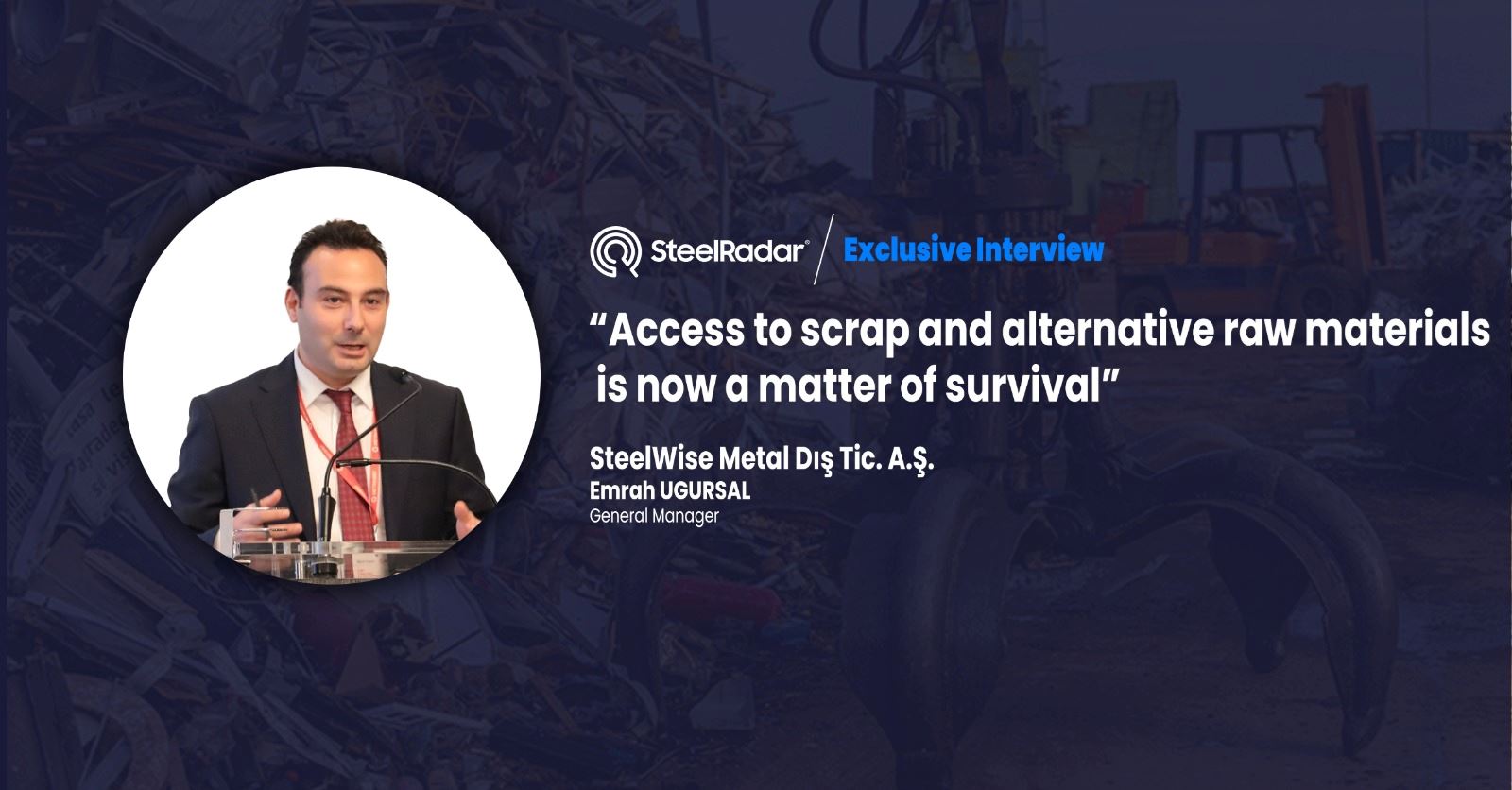
Uğursal stated that the global steel industry has entered a period of structural transformation with the implementation of the Carbon Border Adjustment Mechanism (CBAM), adding that steel scrap has become a strategic resource in low-emission production. He emphasized that in order for Türkiye to overcome this bottleneck, the country must diversify supply channels for scrap and alternative raw materials, turn to alternative inputs such as HBI and pig iron, and rapidly implement horizontal and vertical integration models.
How do you evaluate the recent fluctuations in steel prices? What are the impacts on Türkiye and global markets?
Prices in the steel industry, like all commodities, are inherently volatile. Until recent years, however, these fluctuations were much more predictable through long- and short-term trend analyses. Today, the world is shaped by political polarization, regional conflicts and growing protectionism. Especially during the Trump administration, this process gained significant momentum. Movements that could once be predicted through the internal dynamics of the free market have now given way to sudden tariff wars and political uncertainty.
This situation has not only made technical forecasting more difficult, but in many cases almost meaningless. For instance, if I had answered these questions before the escalation of tensions with Iran, my response might have already become outdated by the time it was published. For this reason, I prefer to comment from a broader global perspective.
The fundamental reality we should not forget is that the global steel industry suffers from a chronic oversupply. China, the world’s largest producer, is trying to navigate its domestic real estate crisis through a “soft landing,” while simultaneously needing to export its excess production to global markets. This reality is unlikely to change in the short term.
You might say: “We can increase tariffs and block Chinese influence.” However, experience has shown many times that the situation is not that simple. Even if we raise tariff barriers, low-priced products still find ways to enter global markets and ultimately reach our end customers. Therefore, the pressure created by global supply-demand imbalances is likely to persist for some time.
In this increasingly polarized world, it has become essential for Türkiye’s steel industry to develop a strategic state policy and receive political support alongside improvements in efficiency, innovation and financial strength.
In the short term, rising geopolitical risks and uncertainties surrounding CBAM have suppressed demand for finished products and pushed inventories downward. Although I expect demand-driven pressure to continue in the medium and long term, I believe a short-term recovery and a seasonal “spring rebound” may occur with the need for restocking in both raw materials and finished products.
How do additional tariffs and anti-dumping measures implemented by the US and the EU affect the export strategies of Turkish steel producers?
Turkish steel exporters have always demonstrated a remarkable ability to find new markets and create opportunities even under the most challenging circumstances. However, restrictions and barriers in steel exports are increasing every year.
The issue has now gone beyond what individual companies or qualified managers can resolve on their own. The two largest importing blocs the US and the EU are effectively trying to push Türkiye out of the game through new tariffs and CBAM measures. This challenge can only be addressed through a coordinated strategy developed by the political authorities in cooperation with the industry.
Türkiye must reposition itself as a reliable and strategic partner supplier for both the EU and the US in terms of geographical proximity, capacity, quality and regulatory alignment.
How do you see green steel and low-carbon production technologies transforming the sector over the next five years?
Green steel and emission reduction processes will undoubtedly increase costs for end consumers. For the Turkish steel industry, which already has excess capacity relative to domestic consumption largely focused on low-margin commercial products, this will make restructuring unavoidable.
Most companies in the sector do not currently have the financial capacity or the investment appetite required for large-scale green steel investments. In fact, such investments may not always be economically viable for smaller players. For this reason, the consolidation process that we have already begun to see in Türkiye as in many other countries is likely to accelerate.
Groups that achieve economies of scale will be able to invest in green steel technologies and pursue horizontal integration strategies.
“Scrap has become a ‘national resource’”
How do rising prices and supply constraints in scrap and iron ore affect your production costs and product pricing?
The global steel industry has entered an irreversible structural transformation with the full implementation phase of the Carbon Border Adjustment Mechanism (CBAM) as of January 1, 2026. In this new era, steel scrap the key input for low-emission production has evolved from a simple recycling material into a strategic “national resource.”
At this point, however, a critical risk emerges for Türkiye. Under the revised Waste Shipment Regulation (WSR) of the EU, expected restrictions on scrap exports particularly to non-OECD countries are likely to tighten further by 2027, effectively narrowing global supply chains.
Since approximately 70% of Türkiye’s steel production infrastructure is based on Electric Arc Furnace (EAF) facilities, even the smallest disruption in scrap supply from Europe directly affects our production costs and competitiveness.
In the medium and long term, the tendency of developed economies to retain scrap domestically for their own green steel transformations will make raw material price volatility a permanent feature of the market. Unfortunately, some parts of our sector still view this situation merely as a speculative commodity trend to be monitored on a daily basis.
However, in this new system where carbon costs are integrated into pricing, access to scrap and alternative raw materials has become not just a matter of profitability but a matter of survival.
To overcome this bottleneck, we must rapidly implement horizontal and vertical integration models that guarantee supply security. At the same time, we should diversify procurement channels for alternative inputs such as HBI and pig iron to balance our dependence on scrap.
For Türkiye’s steel industry, the green transition is not simply about emission reporting it is a process of strategically restructuring raw material resources.
“Increasing steel supply becomes a risk if it is not matched by demand”
Do rising steel production capacities and export competition from China, India and other Asian countries represent an opportunity or a risk for Turkish producers?
An increase in steel supply becomes a risk unless it is matched by demand. However, the situations of China and India are different.
China’s steel production has already entered a downward trend and is undergoing a structural transformation. India, on the other hand, has not yet reached saturation in steel production and still needs additional capacity growth.
If we look at the statistics, China produces more than 600 kg of crude steel per capita, while India is still at around 100 kg well below the global average. These countries operate on a scale that cannot be directly compared with Türkiye.
Therefore, Türkiye can turn this risk into an opportunity by optimizing its approximately 50-million-ton capacity, focusing on the right products, and building long-term strategic partnerships with major importing markets supported by political backing.
“The steel world has entered a process of ‘reverse globalization’”
Considering the risks and opportunities in the sector, how do you see the future of the global steel industry?
As a professional who has devoted more than two decades to the steel industry, I firmly believe that such a dynamic and vital sector will continue to generate new opportunities despite all challenges. However, the current global environment is putting the foreign trade capabilities of our industry under serious pressure.
Today, the steel world has entered a phase of “reverse globalization,” where production-consumption balances are increasingly shifting toward localization.
The greatest risk of this trend is the formation of regional monopolies and the decline of efficiency as a priority. This new environment where competition weakens could lead to higher costs for end users and push smaller and medium-sized producers out of the market, creating an oligopolistic structure.
Historically, protectionism and monopolistic tendencies have always reduced overall value creation and eventually weakened innovation while distorting income distribution.
Nevertheless, companies and individuals who correctly interpret these macro trends and maintain high flexibility will still be able to seize significant opportunities within this structural transformation. In the future, the winners will not simply be those who produce steel, but those who can manage this complex global equation with strategic insight.




Comments
No comment yet.