



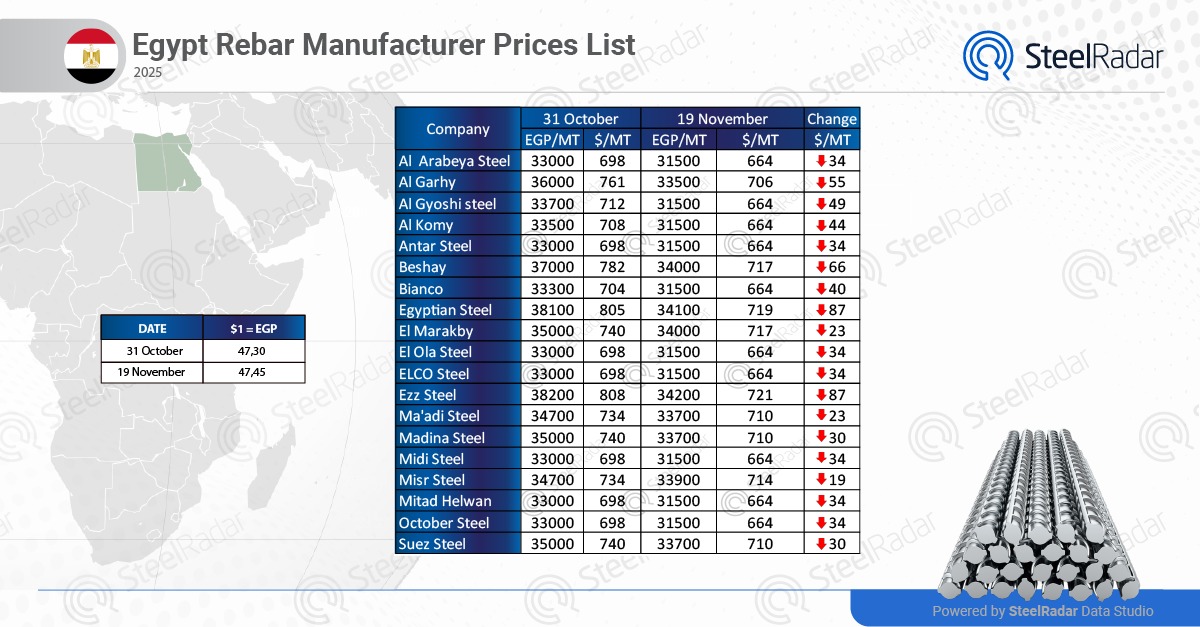
Egypt’s rebar market experienced a significant and broad-based price shift in late October 2025. Between 31 October and 19 November, nearly all major producers recorded substantial declines. This sharp downward trend reflected mounting pressure within the domestic steel sector, driven by weakening demand, intensifying competition, and shifting global commodity dynamics.
According to SteelRadar, the average rebar price among the 18 listed producers fell by approximately EGP 1,600 per metric ton (MT) over the three week period. The steepest drops were seen at Ezz Steel, Suez Steel, and Egyptian Steel, each recording a sharp decrease of 4,000 EGP/MT. Other large producers including Beshay, Al Marakby, and Madina Steel also posted reductions of EGP 3,000/MT or more.
In USD terms, using the exchange rate of EGP 47.45 = USD 1 as of 5 November 2025, these reductions correspond to declines of roughly USD 80–87 per ton for the most affected producers. The overall average drop was around USD 35–45/MT. This indicates a market-wide adjustment rather than company-specific issues.
The widespread nature of the price cuts suggests that systemic market forces, not just individual producer strategies, were at play.
Although the Egyptian pound weakened slightly against the US dollar between 31 October (EGP 47.30) and 5 November (EGP 47.45), this minor depreciation was not enough to offset the large nominal price drops. USD-denominated prices still fell significantly, demonstrating real price erosion.
The data also shows a narrowing gap between top-tier and mid-tier producers. For example, although Ezz Steel remains the highest-priced producer, its price difference compared with companies like Misr Steel or Mitad Helwan has decreased notably. This indicates that producers may be absorbing cost pressures instead of passing them onto consumers, or that they are facing severe margin compression.
Lower rebar prices may stimulate the launch of new projects and boost short-term demand. However, persistent price declines could also signal underlying weakness in construction activity or a supply surplus that may pressure producers’ profitability. Industry analysts warn that further volatility may occur in the coming weeks as producers reassess stock levels, raw material costs, and the pace of new government and private-sector project tenders. The approaching winter months are also expected to influence demand trends.
Price Inc.14% Vat





Comments
No comment yet.