


General Overview
The negative trend that began in the second quarter of 2023 persisted throughout the year and extended its impact into 2024. However, a brief recovery was observed in the first half of 2024, driven by rising production and demand expectations in the steel sector. Nevertheless, unfavorable conditions dominated again starting in the third quarter, and by year-end, global steel consumption was projected to fall to 1.75 billion metric tons. This figure represents approximately 16 million metric tons less than the consumption level of 2023.
This decline in steel consumption is attributed to several factors, including global economic uncertainties, geopolitical tensions, weak production volumes, and reduced construction activities. According to the World Steel Association, one of the main obstacles to global recovery has been the slowdown in China's real estate market and the subsequent decline in the country's steel demand.
Regional Production and Consumption Trends
-
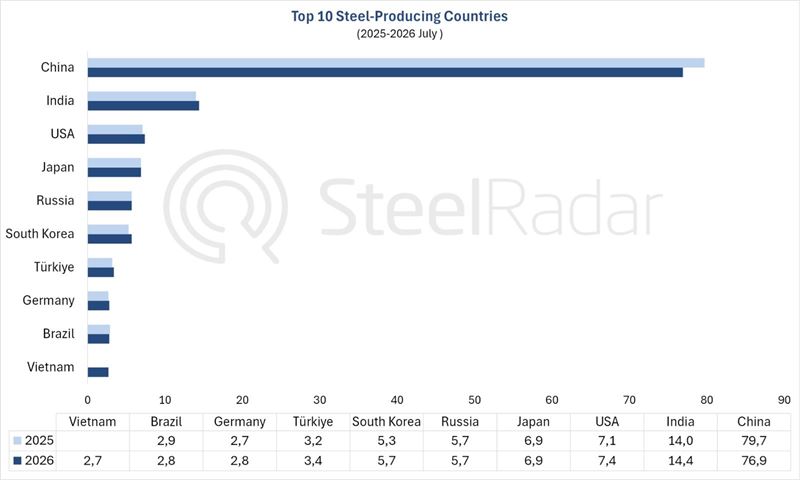
China: In 2024, China's crude steel production fell by 4.2% y-o-y, amounting to approximately 1 billion tons. Although infrastructure projects supported domestic demand, the weak housing market and declining real estate investments negatively impacted consumption rates.
-
EU-27: Steel production in European Union countries declined by 10.8% y-o-y in 2024. Weak economic performance and decreasing demand were the primary causes of this downturn.
-
India: India stood out with a 9.5% increase in production, driven mainly by growing domestic demand.
-
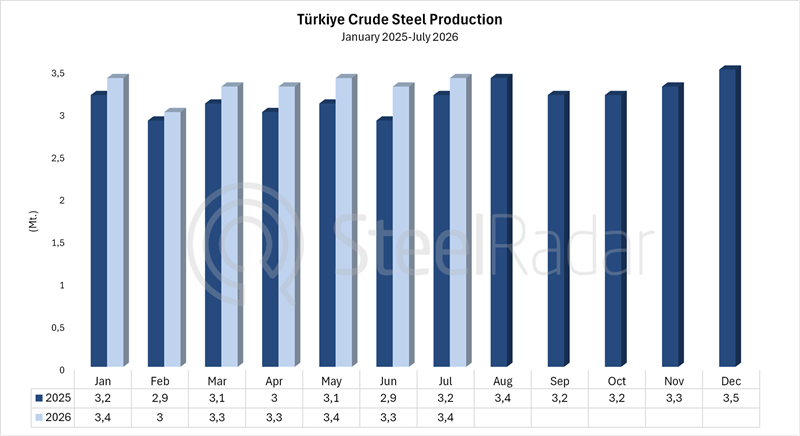
Türkiye: Türkiye's steel production grew by 13.9% y-o-y, supported by robust export performance. However, declining domestic demand negatively affected overall market dynamics.
Sustainability in the Steel Sector
In 2024, green transformation remained a significant agenda item for the steel sector. Many countries, especially China, promoted sustainable production technologies to achieve carbon emissions reduction targets. Low-carbon production methods, such as electric arc furnaces (EAF), brought about transformative changes in steel manufacturing. Under its "14th Five-Year Plan," China’s goal to reduce carbon emissions by 30% increased interest in green steel production.
Assessment of Türkiye's Steel Market
The year 2024 was marked by global economic uncertainties, fluctuating demand, and rising costs for Türkiye's steel sector. During this period, shaped by shifts in both local and international markets, producers and exporters implemented strategic moves to maintain their market positions. Factors such as the balance between local production, exports, and imports, as well as fluctuations in scrap prices, were among the most critical elements influencing the sector's overall performance.
Rebar
Türkiye’s steel production remained stable throughout the year. However, low domestic demand prompted producers to focus more on exports, albeit with weaker profit margins. The slowdown in the construction sector and general economic stagnation suppressed domestic steel demand. Rebar demand, in particular, fell significantly below expectations, causing local prices to trade within a narrow range. Factory prices for rebar typically ranged between $565 and $585 per ton, but buyers considered these levels high and mostly opted for lower prices.
On the export front, challenges persisted throughout 2024. Reduced demand in traditional export markets such as Europe and the Middle East adversely affected Türkiye's steel export performance. Rebar exported from Türkiye was priced at $570-$575 per ton FOB. However, low demand and global competition created downward pressure on prices for exporters. Despite these challenges, exports remained a vital outlet for some producers, with notable sales to the African market.
Overview of Flat Steel
For the global flat steel market, the potential impact of former U.S. President Trump's protectionist trade policies remains uncertain. Exchange rate fluctuations between the dollar and the euro will also play a critical role. Decisions that disrupt the parity balance could challenge countries exporting to the Eurozone.
Some experts emphasize the risks associated with the U.S. adopting aggressive strategies to regain economic dominance. Meanwhile, concerns about China’s slowing growth persist. Speculations about a potential yuan devaluation suggest that such a move could double the pressure on global markets, intensifying competition.
In the Middle East, optimistic forecasts for Syria have been overshadowed by renewed tensions, including Israeli actions and their ripple effects on Iran. Amid these geopolitical challenges, rising scrap prices have not significantly supported flat steel prices in Türkiye. Factory prices for flat steel fell as low as $560 per ton, one of the lowest levels on record.
If buyers remain cautious in the first quarter of 2025, demand may not prevent a decline, and sharp price increases are unlikely. However, more optimistic expectations are anticipated for the second quarter, with the Central Bank of Türkiye’s policies projected to influence prices for various goods and commodities.
In the spot market, flat steel was available for as much as $600 per ton. Optimistic observers suggest that further price reductions are unlikely. Meanwhile, coated and galvanized steel saw continued price easing. Hot-rolled coil (HRC) prices experienced a faster decline alongside slowing demand. Improved demand in the automotive sector in the second quarter of 2025 could bring more positive outcomes. Anti-dumping investigations on flat steel imports may also directly impact prices, though no measurable effects have been observed yet.
Imported Scrap
Türkiye's imported scrap market experienced significant volatility throughout the year. Scrap prices ranged from $380 to $390 per ton during the summer, dropping to $333 per ton in the fourth quarter. Prices hit their lowest levels in November but recovered slightly to $347 per ton in December. These fluctuations complicated efforts by Turkish producers to manage costs effectively. While declining scrap prices provided a cost advantage, they also heightened uncertainties in global markets.
Imported Billet
The billet market was dynamic in 2024. Increased local suppliers narrowed price ranges and heightened competition in the domestic market. However, imported billets, particularly those sourced from the CIS region, retained their importance. Billets from the Donbas region were priced at $495 per ton CFR, enabling Turkish producers to access cost-effective raw materials.
Rising energy costs and higher production expenses were among the other key challenges for the sector. Producers found it difficult to reflect these increased costs in prices, prompting buyers in local markets to act more cautiously. Additionally, aggressive pricing strategies by major producers like China and India weakened Türkiye’s competitiveness in export markets.
Outlook for 2025
As Türkiye enters 2025, the steel sector faces significant challenges, including weak domestic demand, increased global competition, and cost pressures. Developing sustainable production and cost management strategies will be essential for the industry to navigate these obstacles. Identifying new export markets and strengthening ties with existing ones will also play a crucial role in the sector’s recovery. In the coming period, rising demand in regions such as Africa and Southeast Asia may present new opportunities for Türkiye's steel industry.




Comments
No comment yet.