


The measure will be implemented under the powers granted by the Taxation (Cross-border Trade) Act 2018, as amended. Since announcing the proposal, the government has maintained close engagement with industry stakeholders and worked closely with EU authorities to agree on a coordinated approach, taking into account the highly integrated supply chains between the UK and the European Union.
Previous Measures End As New Quotas And 50% Tariff Take Effect
As of July 1, 2026, the current steel safeguard quotas and the additional 25% safeguard duty applied under those measures will be fully revoked after June 30, 2026.
Under the new regime, the total quota volume has been set at approximately 3.2 million mt, around 21% higher than previously proposed. At the same time, the government has reduced total duty-free steel import quotas by 51% compared to the previous steel safeguard measure. Imports exceeding the allocated quotas will be subject to a 50% customs duty, calculated on the value of the product before any other import duties are applied.
Market Feedback and Commodity Code Changes
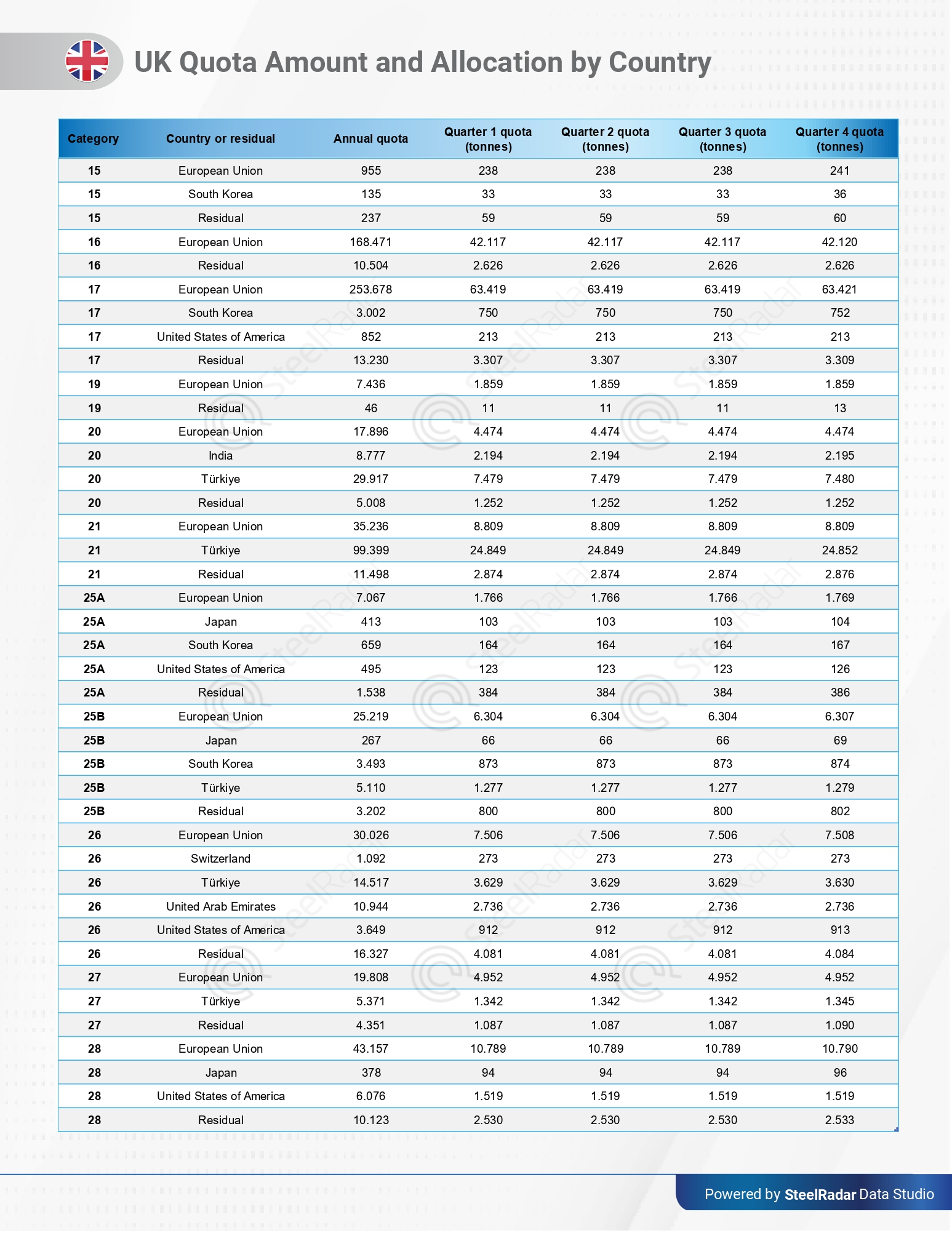
The UK government announced that 11 commodity codes have been removed from the new trade protection regime in response to feedback from steel market participants. As a result, no customs duties will apply to these 11 steel products, which are not produced domestically in the UK. The removed codes cover Category 14 (stainless steel bars and light sections), Category 26 (other welded tubes and pipes), and Category 28 (non-alloy wire). In addition, two new codes have been introduced under Categories 12A (alloy merchant bars and light sections) and 12B (non-alloy merchant bars and light sections).
Major Changes in Tariff Quotas
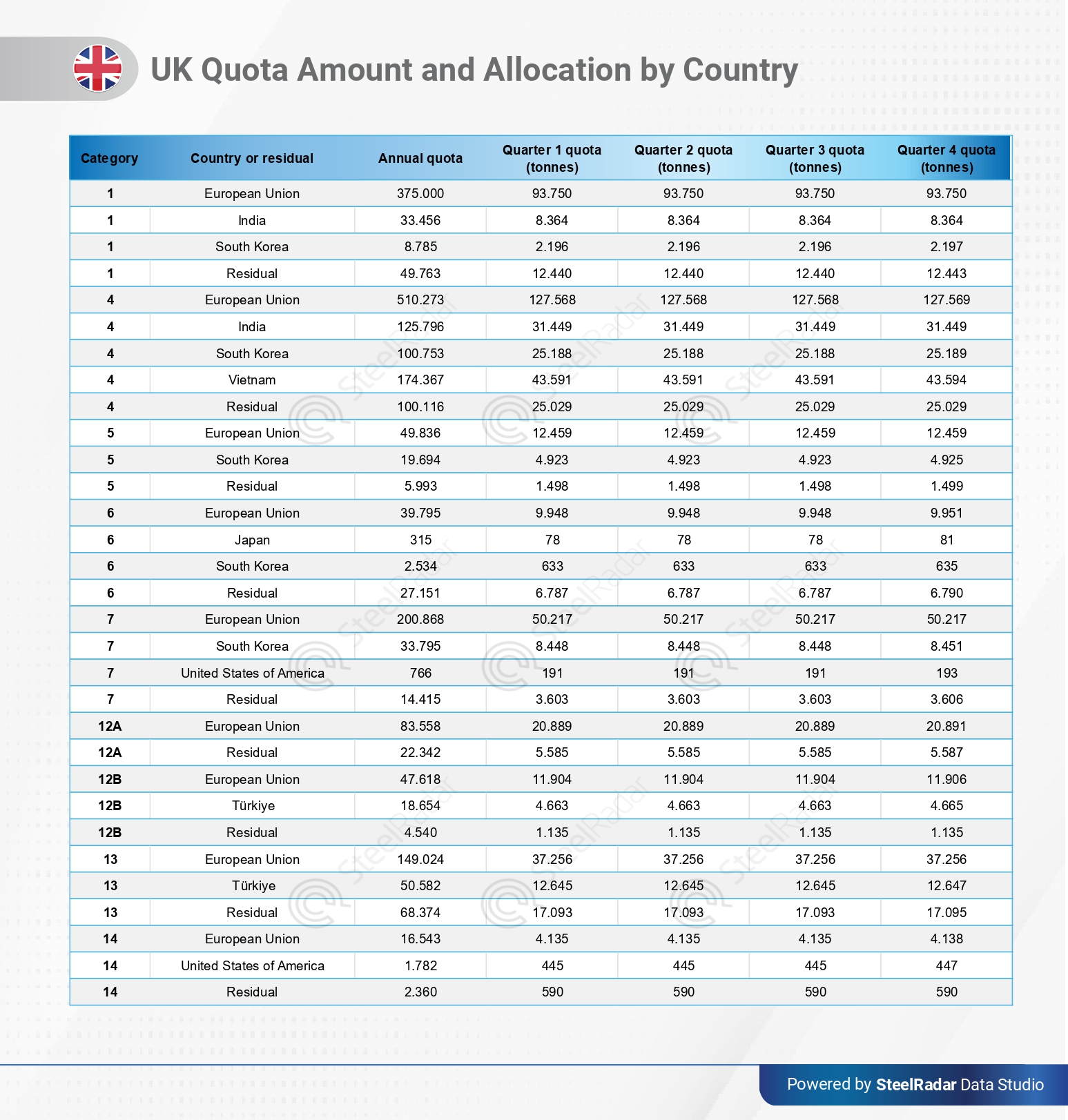
One of the most significant changes concerns UK pre-allocation volumes, particularly following the sharp decline in EU hot rolled coil prices. The new annual duty-free quota for EU-origin HRC has been set at 375,000 mt, representing an increase of nearly 450% compared to the preliminary allocation announced in March.
By contrast, the EU quota for hot-dip galvanized coils has been reduced. The tariff-rate quota (TRQ) for Category 4 metallic coated flat products has been lowered from 634,773 mt to 510,273 mt annually.
India's annual hot rolled coil quota has also been increased from 12,405 mt to 33,456 mt.
Economic Rationale Behind the Measure
According to the OECD Steel Outlook 2025 report, the gap between global steelmaking capacity and demand continues to widen and is expected to reach 721 million mt by 2027. This surplus exceeds the combined crude steelmaking capacity of all OECD countries, which stands at 640.4 million mt, by approximately 13%.
Due to global overcapacity and high operating costs, UK crude steel production has fallen by more than 50% over the past decade, declining from 10.9 million mt in 2015 to 4 million mt in 2024, according to World Steel in Figures. The government stated that without intervention, the UK's domestic steelmaking capability—critical for sectors such as defense, transport, and energy—would face serious risks. It emphasized that the new trade measure forms a key part of its long-term national steel strategy aimed at revitalizing the sector and restoring sustainable domestic production.
Quota Allocation and Transitional Arrangements
Tariff-rate quotas will be allocated by HM Revenue and Customs (HMRC) to UK importers on a first-come, first-served basis. Importers must declare the relevant order numbers when applying to HMRC to access the quotas.
Unused country-specific, regional, or residual quotas will be carried forward to the next quota period but will not be transferred into the following quota year. Further implementation details were published in the Transitional Relief Application Notices issued on June 2, 2026.
Transitional Relief
Under a limited transitional arrangement, eligible goods covered by contracts concluded before March 14, 2026, will be fully exempt from the 50% out-of-quota customs duty during the transition period. Importers are required to provide documentary evidence to prove eligibility. HMRC also stated that penalties will apply in cases of non-compliance or deliberate fraud.
Ukraine Exemption
As part of the UK's continued support for Ukraine following Russia's military intervention, steel products originating in Ukraine will remain exempt from the new measures. The preferential tariff treatment and rules of origin under the UK-Ukraine Political, Free Trade and Strategic Partnership Agreement will continue to apply.
Category 1 Authorized Use (Industrial Processing) Special Measure
An additional dedicated quota has been introduced for Category 1 steel products intended for downstream industrial processing. This quota will operate under a single global quota, with exports from any individual country or region capped at 40% per quota period.
Under the Customs (Special Procedures and Outward Processing) (EU Exit) Regulations 2018, this quota applies only to Category 1 steel products imported for processing into specified downstream steel products. Once the global quota is exhausted or a country's individual quota limit has been reached, imports from that country will automatically be subject to the 50% customs duty, regardless of any remaining quota available to other countries.





Comments
No comment yet.