


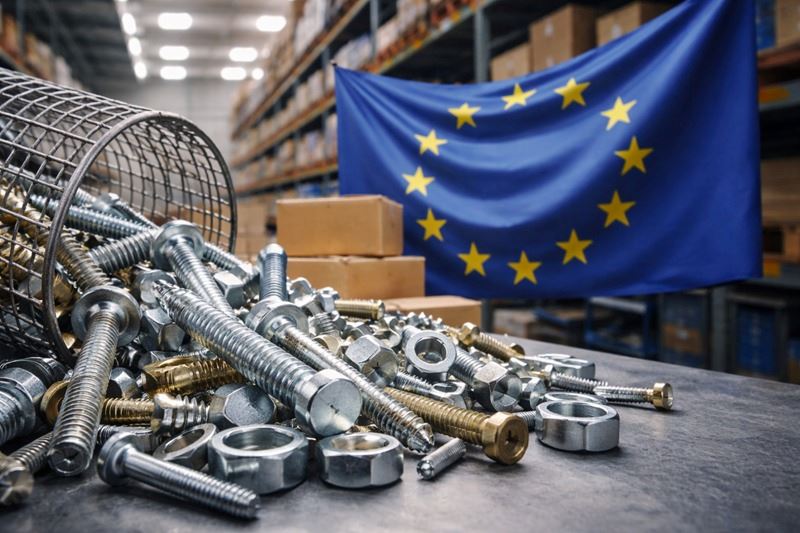
EFDA President Andreas Bertaggia, in an appeal to EU Commissioner for Climate Action, Net Zero and Clean Growth Wopke Hoekstra on 9 March 2026, stated that the CBAM mechanism has made screws, nuts and other fasteners significantly more expensive than expected.
Bertaggia said: “The rapid implementation of CBAM without a proper verification system is making imported fasteners considerably more costly. At the moment, European fastener distributors are unable to calculate CBAM costs using real emission data and are forced to rely on the Commission’s high default values, despite having no fault in this situation. This increases the cost of fasteners and all products in which they are used, reducing the global competitiveness of ‘Made in EU’ goods.”
European fastener distributors were only vaguely informed about the basic provisions required for CBAM cost calculation shortly before Christmas. EFDA has presented three requests to the Commission to allow the use of real emission data for imports in 2026: aligning CBAM system boundaries for fasteners with those of the EU Emissions Trading System (EU ETS), allowing verified emission values to be considered beyond 30 September 2027, and immediately correcting the inaccurate and unrealistic default values assigned to fasteners.
According to EFDA, the biggest obstacle preventing the use of real emission data for 2026 imports is that the limited number of qualified verifiers cannot audit thousands of manufacturers worldwide within such a narrow timeframe. In addition, the inclusion in CBAM of emissions unrelated to the EU ETS puts EU importers at a disadvantage compared to domestic producers.
President Bertaggia stressed that the current default values are incorrect and unrealistic, and that fastener costs could increase by 30–50% in the first year of CBAM implementation. “The complexity of CBAM is challenging thousands of small and medium-sized fastener manufacturers worldwide and is already creating a de facto non‑tariff trade barrier. Forcing EU importers to rely on these excessively high default values undermines the climate policy goal of CBAM and turns the mechanism into a protectionist tool,” he said.






Comments
No comment yet.