


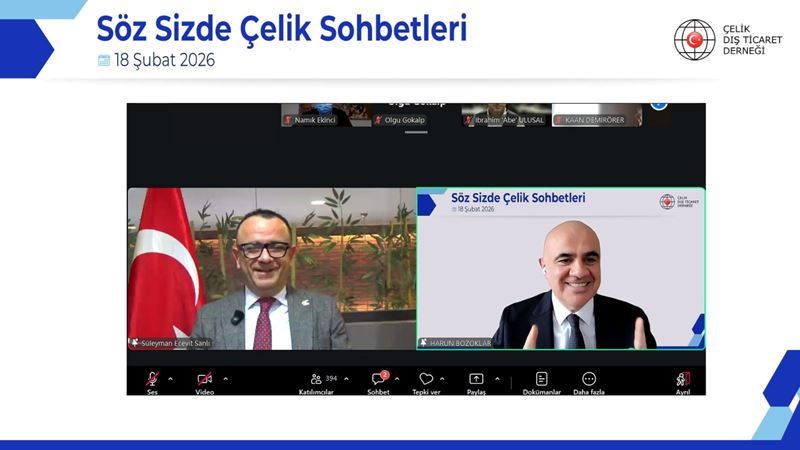
Süleyman Ecevit Sanlı began his speech by outlining his professional background. He stated that he founded his own companies in 2013 and currently serves as Chairman of a group operating in customs brokerage and logistics across approximately 16 provinces in Türkiye and four U.S. states. He also noted that he is serving his second term as President of the Türk Amerikan İş Adamları Derneği (AmCham) and the American Chamber of Commerce. Sanlı emphasized that AmCham was established in 1987 by a Council of Ministers decision and that its institutional roots date back to the late Turgut Özal era.
Sanlı stressed that the steel sector is passing through a critical turning point and that sound decisions require an accurate reading of current conditions. He pointed out that in global steel trade, discussions around energy and finance tend to intensify simultaneously during periods when customs barriers increase historically signaling major disruptions. He recalled that a similar environment preceded World War I and noted that the European Coal and Steel Community was established after two world wars for this very reason.
Highlighting steel’s strategic importance in the 20th century particularly for the United States Sanlı stated, “War means steel, tanks, and money.” He argued that the constant global emphasis on the defense industry indicates entry into a risky period. Historically, steel and coal have been directly linked to wars and major economic fractures, and steel holds a special position as a primary input for the defense industry.
Sanlı reported that global steel production capacity stands at approximately 2.47 billion tons, with around 76% utilization. He identified China as the country with the highest capacity at 1.14 billion tons, followed by India with 179.5 million tons and Türkiye with 59 million tons. The combined capacity of the Avrupa Birliği and the Birleşik Krallık stands at 213 million tons.
On the production side, China ranks first with approximately 1 billion tons, followed by India with 149 million tons and Türkiye with 36.9 million tons. The total production of the EU and the UK amounts to 133 million tons. Excluding The United States, Meksika, and Kanada, total capacity across other countries stands at 105.4 million tons.
Referring to the UK’s withdrawal from the EU, Sanlı noted that the country accepted a 7% GDP loss in the process and subsequently signed successive free trade agreements, particularly building its own trade network across Asian and African markets.
On the demand side, Sanlı projected approximately 153 million tons of steel demand in 2025 for the U.S. and the UK combined, while total demand across the U.S., Canada, and Mexico is expected to reach 148 million tons. Toward 2030, production in the EU and the UK is expected to rise to 138 million tons, mainly in higher-quality steel segments. In the U.S., Canada, and Mexico, growth of between 6% and 9% is anticipated. “The key question,” Sanlı remarked, “is how much of this steel we produce ourselves and how much we produce for other countries.”
Despite producing nearly 1 billion tons, China imported 8.7 million tons of steel in 2024. Türkiye’s imports, however, reached 19.7 million tons. “We import nearly two and a half times more steel than China. Türkiye is highly unprotected in this regard. We urgently need to take measures,” Sanlı stated, emphasizing the need for stronger domestic market safeguards.
On the export side, China was a net exporter in 2024 with 118 million tons, while Türkiye exported 17 million tons demonstrating a high export performance relative to its production capacity. However, Türkiye remains a net importer overall. The U.S., Canada, Mexico, as well as the EU and the UK collectively are also net importers.
In 2024, the U.S. imported USD 33 billion worth of steel. Of this, 23.3% (USD 7 billion) came from Canada, 15% (approximately USD 5 billion) from Brazil, and 10% (USD 3.3 billion) from Mexico. Imports from India accounted for 1.30% (USD 487 million), while Türkiye’s share stood at 0.7%, totaling USD 231 million.
Sanlı noted that global steel imports reached USD 497.4 billion in 2023. The U.S. accounted for 6.7% (USD 33.2 billion) of this total, while the EU represented 34.6% (USD 172 billion). A significant portion of EU imports consists of intra-EU trade, with Germany and France accounting for roughly USD 50 billion of that internal volume.
Sanlı emphasized the importance of the free trade agreement signed between the EU and India, noting that negotiations resumed in 2022 and concluded with an agreement in 2026. In 2024, the EU was India’s largest trading partner. Under the agreement, customs duties were eliminated or reduced on over 96% of EU goods exports, removing approximately USD 4 billion in annual tax burdens. India’s 22% tariff on EU goods was reduced to zero, while automotive tariffs previously as high as 110% will gradually decrease to 10%.
However, due to India’s relatively low share of electric arc furnace production and high carbon intensity, Sanlı argued that India would not gain a cost advantage under the EU’s Carbon Border Adjustment Mechanism. Therefore, the direct impact of the agreement on the Turkish steel sector may be limited, though indirect effects particularly through the automotive industry could be more pronounced.
Turning to the bilateral trade agreement between the U.S. and India, Sanlı stated that the U.S. reduced its reciprocal tariff on India from 25% to 18%, while applying a 15% tariff to Türkiye. India, in turn, committed to purchasing over USD 500 billion worth of energy, information and communication technologies, and other products from the U.S., underscoring the importance of reciprocal obligations in global trade.
Sanlı highlighted that under the Customs Union with the EU, Türkiye is not a decision-maker but rather an implementer of EU trade policies. He argued that free trade agreements signed by the EU with third countries create structural challenges for Türkiye. If the EU–Mercosur agreement enters into force, products from Mercosur countries would enter Türkiye duty-free, while Turkish goods would face tariffs when entering those markets.
Finally, addressing the steps needed for the steel sector, Sanlı stated that additional tariffs on imports from India could be swiftly enacted by presidential decree. He recalled a similar process in the textile sector in 2012, when effective lobbying led to the introduction of additional customs duties. He stressed that the steel sector must conduct stronger lobbying activities in Brussels and that this process should not be left solely to the government. Exporters’ associations and relevant institutions, he concluded, should work with professional experts to safeguard the sector’s interests.





Comments
No comment yet.