


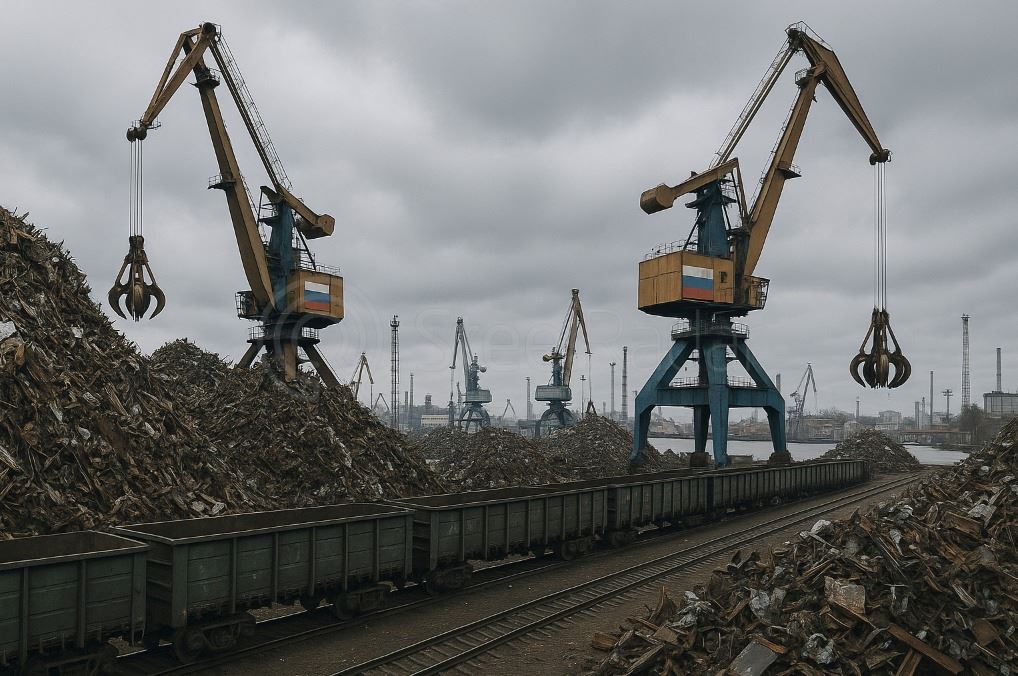
Kovshevny commented on the proposal:
“I recently suggested that we sit down and calculate everything together, because you yourselves will suffer later from rising scrap prices, as there will be no one left to collect it. Independent scrap collectors will not survive: the less competition there is, the higher scrap prices will be. Full liberalization of exports is in the interest of all mills, because today exports do not generate profit due to expensive logistics, but simply allow survival. And even that is not true for everyone: due to rising railway tariffs, most regions are effectively excluded from exports. There is no economic rationale for exporting when domestic prices exceed 9,000 rubles.”
A second important point concerns the structure of demand. Suppose the market begins to recover. Which mills will actually return? Integrated steel plants have learned to operate without scrap. In 2026, the trend of replacing scrap with iron ore feedstock and hot briquetted iron (HBI) has continued. Some former major consumers, such as MMK, have not only reduced scrap purchases to zero but have also become suppliers themselves, selling off remaining inventories from their scrap processing shops. Economically, this has been successful: they have effectively tested steel production from hot metal. It is no longer accurate to call this electric steelmaking, as electricity is not required—the energy from hot metal is sufficient for oxygen blowing. The technology itself is not new; it has simply been taken off the shelf.
A similar path was previously followed by Severstal, which has long left the list of the largest scrap consumers. In 2010, it purchased more than 3 million tonnes of scrap, but by 2025 this figure had fallen 19 times to just 0.16 million tonnes. This suggests that, among major players, only pipe producers and electrometallurgical plants may eventually return to the market. Pipe producers can consume up to 5 million tonnes of scrap annually in strong market conditions. However, even here trends are shifting: OMK is launching the Ecolant direct reduced iron plant this year, which will reduce its scrap consumption. That leaves TMK, where scrap is still essential mainly for seamless pipes used in the oil and gas sector. In other segments, the share of welded pipes made from primary raw materials is increasing.
Ultimately, only mills such as AEMZ, Balakovo Metallurgical Plant, Amur Steel, DMZ, and several smaller facilities with capacities of up to 300–500 thousand tonnes per year remain. In total, their demand does not exceed 7 million tonnes annually. Even here, scrap will gradually be replaced by HBI and other forms of direct reduced iron. Even after market recovery, unless new plants are built, total demand for ferrous scrap is unlikely to exceed 15 million tonnes.
The fact that primary raw materials are more cost-effective than scrap in Russia is natural, given that the country ranks among the top three globally in iron ore reserves. Export-oriented steelmakers are increasingly forced to rely on iron ore feedstock to remain competitive in Asian markets, where the high-price segment is inaccessible. This situation is expected to persist for at least three to four years, until carbon taxes rise to levels comparable to scrap prices. At that point, export batches will need to include at least 30 percent scrap by weight.
This is where a potentially dangerous situation may arise: steelmakers could return to the market, but there may be no one left to collect scrap. In 2025, ferrous scrap generation in Russia amounted to 51.3 million tonnes and is expected to continue growing, while maximum domestic consumption is only about 15 million tonnes, three times lower. It is impossible to collect all scrap, but realistically 65–70 percent can be collected, which equals around 35 million tonnes annually. Like the United States, Russia could export 17–20 million tonnes without harming domestic supply.
However, this is currently not feasible. More than half of scrap collection sites have already shut down, and rebuilding them will take years. Railway tariffs are so high that 67 regions are effectively excluded from export activity. Even if all restrictions were lifted, exports would not exceed 3 million tonnes. For reference, in 2004–2005 Russia exported 12–13 million tonnes of scrap annually, while domestic consumption stood at around 18 million tonnes. Unfortunately, the outlook for the coming years remains unpromising.




Comments
No comment yet.