


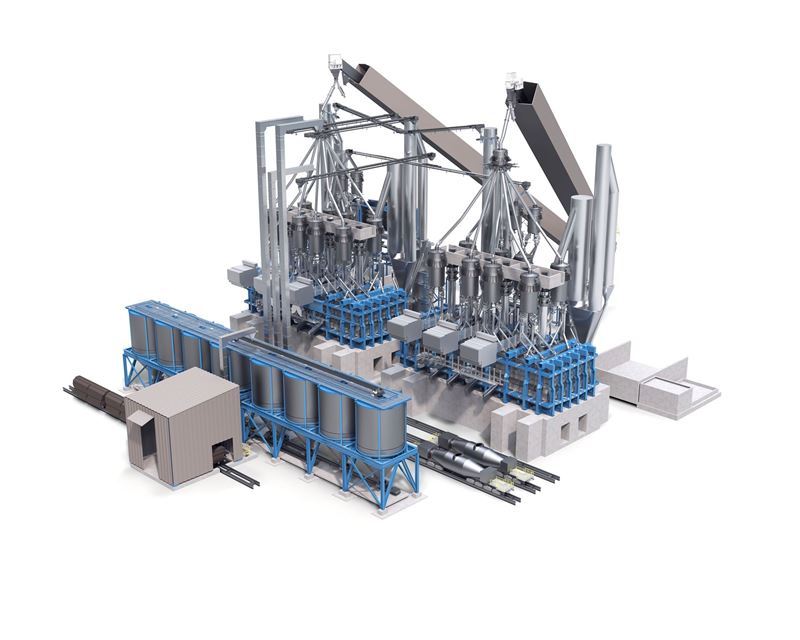
The concept and economic study completed by Primetals Technologies found that each of the three production routes that could be integrated with MagIron’s existing infrastructure is technically feasible for producing approximately 2 million tonnes of granulated pig iron per year.
Primetals Technologies has completed a concept and economic study for MagIron on the development of large-scale granulated pig iron production in the US. The study assessed the integration of production with MagIron’s existing mining, processing, pelletizing and logistics infrastructure.
Three different production routes evaluated
The study examined three alternative production routes for granulated pig iron production. These include direct reduction using MIDREX Flex followed by electric smelting, direct reduction using MIDREX Flex followed by an electric arc furnace (EAF) and ladle furnace (LF) processing, and conventional blast furnace production.
According to the Primetals Technologies study, each of the three production routes offers a technically feasible option for producing approximately 2 million tonnes of granulated pig iron per year.
The study was also said to support MagIron’s goal of becoming a key supplier of high-quality iron units to the US steel industry while supporting the sector’s decarbonization.
First hot metal production could begin 2-3 years after investment decision
As part of the project, MagIron plans to utilize its existing mining, processing, pelletizing and logistics infrastructure in Minnesota and Indiana.
The company expects that, following a final investment decision, initial commissioning could be completed and first hot metal production could be achieved within approximately two to three years.
MagIron Chairman Julian Treger described the study conducted by Primetals Technologies as an important milestone for the company, noting that it confirmed the availability of multiple technically feasible and economically attractive production routes for establishing large-scale domestic merchant pig iron production.
US imports nearly all of its merchant pig iron requirements
According to MagIron, the US currently relies on imports for nearly all of the merchant pig iron required by its steel industry. The country’s annual merchant pig iron consumption has historically ranged between approximately 4 million and 6 million tonnes.
If MagIron’s planned annual production of approximately 2 million tonnes is realized, the company could supply between roughly one-third and one-half of the US’ current merchant pig iron requirements.
Treger said the US’ dependence on merchant pig iron imports represents a significant risk for the automotive, defense, infrastructure, aerospace and advanced manufacturing sectors.
Flexibility between DR-grade pellets and merchant pig iron production
MagIron aims to supply the US steel industry with both direct reduction-grade (DR-grade) iron ore pellets and merchant pig iron.
While advancing the development of domestic pig iron production, the company also plans to retain the flexibility to produce and sell DR-grade pellets when market conditions are favorable.
This would allow MagIron to use the same raw material source and existing processing and pelletizing infrastructure to shift between DR-grade pellet and merchant pig iron production depending on customer requirements and market conditions.
More than USD 660 million invested in existing facilities
MagIron is focused on restarting an iron ore concentrator near Grand Rapids, Minnesota, and a pelletizing facility in Reynolds, Indiana.
The two facilities, which previously operated commercially and are described as modern assets, have received more than USD 660 million in investment to date.
The facilities previously operated at an annual production rate of approximately 2.2 million tonnes of blast furnace (BF)-grade concentrate. The existing facilities were designed so that annual production capacity could be increased to 3 million tonnes relatively quickly and with limited capital requirements.
Friedemann Plaul, Senior Vice President of Iron and Steelmaking and ECO Solutions at Primetals Technologies, said the study evaluated three alternative technologies for granulated pig iron production. Plaul noted that the results demonstrated that large-scale production could be achieved through multiple technically feasible routes, while MagIron’s existing industrial infrastructure and domestic raw material base provide a strong foundation for advancing the project to the next stage.




Comments
No comment yet.