


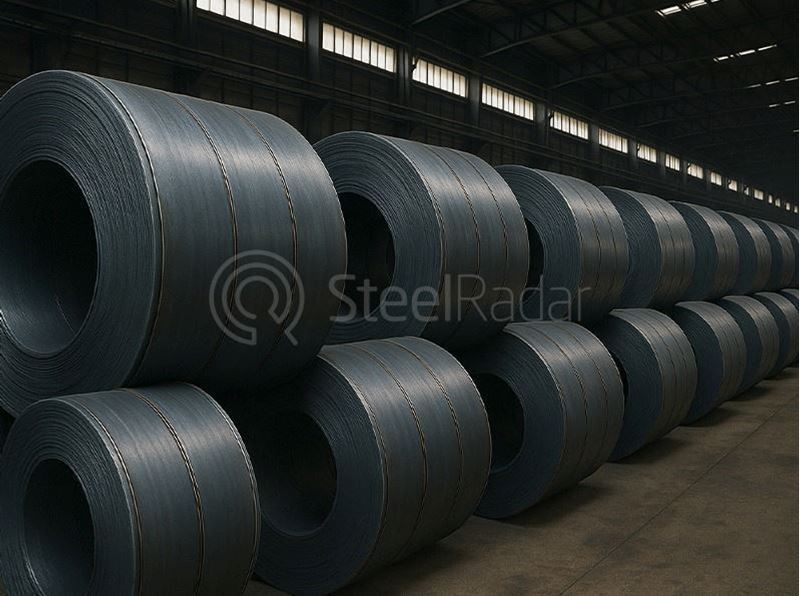
The price is updated weekly and applies to spot transactions until the next Monday publication. Nucor also stated that lead times for spot orders are currently offered between three and five weeks, depending on availability at individual mills.
Nucor’s CSP announcement is closely watched across the industry because the company often sets the tone for pricing in the U.S. sheet market. Service centers, distributors, and manufacturers frequently use the CSP level as a reference point when negotiating spot purchases.
Steady increases since the start of the year
During the first quarter of 2026, Nucor has gradually moved its HRC base price higher through a series of weekly adjustments. Earlier in the year, HRC prices were already strengthening and moving through the high $900s per ton. The company then lifted its base price step by step until it moved above the $1,000 per ton mark.
The latest increase to $1,015 per ton continues that pattern. For California Steel Industries, the base price remains higher at $1,065 per ton, which is typical for West Coast supply because transportation costs and regional demand tend to push prices above Midwest levels.
This approach allows the market to absorb each increase gradually. Smaller but frequent adjustments often encourage other mills to move their own offers higher at a similar pace.
Comparison with broader HRC market levels
Buyers usually compare Nucor’s price with spot market assessments and competing mill offers. Recent market indications for U.S. hot rolled coil have generally been reported in the high $900s per ton, with some variation by region and order size.
Nucor’s CSP level, therefore, sits slightly above many market benchmarks. That position is common for the company, which often quotes prices near the top end of the prevailing range.
Because Nucor frequently announces increases before other producers, its pricing decisions often influence the direction of the broader market. Competing mills may match the increase soon afterward, while service centers adjust resale prices to end users.
Trade policy developments in focus
Trade policy has become another factor shaping expectations in the steel market. The Office of the United States Trade Representative recently began new investigations under Section 301 of the Trade Act of 1974 involving several trading partners, including China, Mexico, and the European Union.
Section 301 investigations allow the United States to examine whether foreign trade practices harm domestic industries. If the investigation concludes that such practices exist, the government can respond with tariffs or other restrictions.
Steel market participants are watching these developments closely because new tariffs could increase the cost of imported steel. If that happens, domestic producers would face less competition from overseas suppliers.
Import levels remain low
Imports have already been playing an important role in the current market environment. U.S. steel imports have increased slightly in recent months, but volumes remain significantly lower than they were a year earlier.
Flat rolled products such as hot rolled coil, cold rolled sheet, and coated steel are particularly important in this context. When imports of these materials decline, domestic buyers have fewer alternatives outside the U.S. market.
Lower import competition allows domestic mills to maintain stronger pricing. Even moderate changes in demand can then have a larger effect on market prices.
Strength in coated steel prices
Another development in the sheet market is the strength in coated steel products. Galvanized and other coated materials are widely used in construction, automotive manufacturing, appliances, and infrastructure.
Market reports indicate that imports of coated products remain very limited, while domestic demand has improved. Lead times for some coated materials have also extended.
Several mills have already announced increases for coated products. These moves often occur after HRC prices rise because mills seek to maintain the traditional premium between base hot rolled coil and higher value coated products.
Considerations for buyers
Rising prices present several challenges for service centers and manufacturing companies that rely on sheet steel.
Many buyers are using phased purchasing strategies. Instead of committing to their entire volume at once, they secure part of their requirements and leave the rest open in case market conditions change.
Lead times are another indicator that buyers monitor closely. Longer lead times can indicate strong demand and tighter supply. Shorter lead times sometimes appear when the market begins to slow.
Some buyers also explore additional supply options. Depending on transportation costs and availability, sourcing from different mills or regions can sometimes help manage overall purchasing costs.
Outlook for the remainder of the year
The direction of steel prices through the rest of 2026 will depend on several factors. Trade policy decisions, import volumes, and industrial demand will all influence the balance between supply and demand in the sheet market.
If imports remain limited and demand continues at current levels, domestic mills may keep prices near the current range above $1,000 per ton. A larger return of imports or weaker manufacturing activity could eventually place pressure on prices later in the year.
For now, Nucor’s latest CSP announcement places the benchmark for U.S. hot rolled coil at a higher level, and the rest of the market will be watching closely to see how other producers respond in the coming weeks.





Comments
No comment yet.