


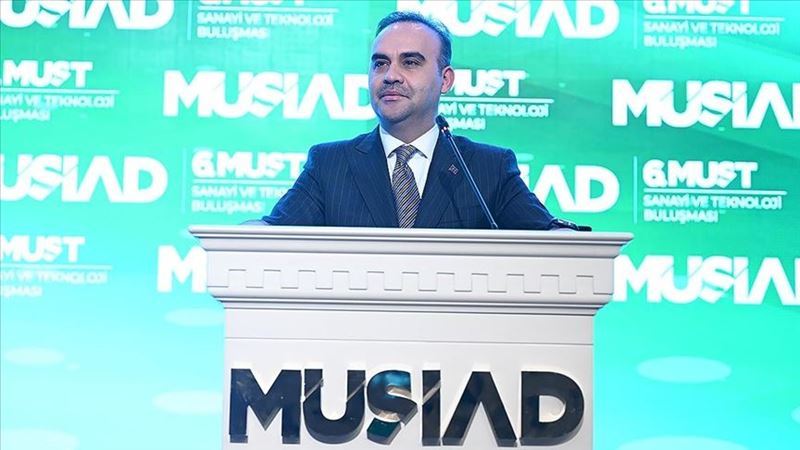
Minister of Industry and Technology, Mehmet Fatih Kacır, addressed the 6th MUST Industry and Technology Summit, organized by the Independent Industrialists and Businessmen Association (MÜSİAD) at its headquarters, commending MÜSİAD’s technology-driven initiatives and its valuable contributions to Turkey’s industry, employment, production, and development.
Reflecting on the progress achieved over the past 23 years under the leadership of President Recep Tayyip Erdoğan, Kacır highlighted Turkey’s transformation from an era constrained by limited assembly-based manufacturing, bureaucratic barriers hindering entrepreneurs, and inward-looking industrial policies—to a nation asserting its economic and technological independence.
He emphasized that those who sought to obstruct the nation’s future, prosperity, and development had also undermined its collective capability and self-confidence—until President Erdoğan’s leadership enabled Turkey to break free from this restrictive mindset, overcome instability, and achieve remarkable growth:
- Annual merchandise exports surged from USD 36 billion to USD 270 billion,
- Manufacturing value-added rose to USD 24.1 billion,
- Turkey now ranks 1st in Europe in military UAVs, commercial vehicles, solar panels, buses, flat glass, white goods, textiles, wood products, cement, and steel production,
- In the vast corridor stretching from China to Central Europe, Turkey is the country exporting the widest range of products to the largest number of countries.
Kacır underscored that these accomplishments were realized during a period of global transformation while leading European nations still struggle to restore industrial production to pre-pandemic levels.
We continue opening new pathways for investors”
Kacır affirmed Turkey’s commitment to sustaining industrial momentum, citing robust investments in R&D and innovation under the National Technology Initiative:
- Over 1,700 R&D and design centers established within the private sector,
- 113 technoparks hosting more than 12,000 firms engaged in innovation-driven activities,
- R&D expenditures increased 16.5-fold over 23 years—reaching USD 19.9 billion,
- The national R&D workforce expanded 11-fold to 311,000 personnel.
He stressed that Turkey continues to remove barriers for visionary entrepreneurs and investors through investor-friendly policies, continuously updated incentive schemes, and strategic infrastructure—cementing its role as a high-tech manufacturing hub.
“We launched 4 new calls to action”
Under the HIT-30 High-Tech Investment Program, Turkey has initiated efforts to attract USD 4.5 billion in advanced-technology investments in electric vehicles, solar cells, and biotechnology within a single year.
Four new strategic initiatives have been launched to:
- Strengthen national data infrastructure,
- Accelerate AI-driven transformation in industry,
- Integrate quantum technologies into the national innovation ecosystem,
- Position Turkey as a global hub for the design, production, and export of industrial robots.
Through the Advance Loan Program with Investment Commitment, implemented jointly with the Central Bank, Turkey has unlocked TRY 39.7 billion in investments. Under the Momentum Program, 69 additional projects in circular economy, biotechnology, and next-generation ICT were supported this year.
Kacır noted:
“Once the 224 ongoing investments under this program are completed, they will contribute USD 11.4 billion annually to our foreign trade balance. We will continue strengthening our industry and production infrastructure with a high-tech focus—ensuring no sector is left behind.”
Recalling the Employment Protection Program launched last year to support labor-intensive SMEs in textiles, ready-to-wear, leather, and furniture sectors, Kacır reported:
- 416,000 jobs preserved,
- 22,000 new jobs created,
- Monthly support amount to rise to TRY 3,500 in 2026,
- Program now extended to large-scale enterprises.
To address regional labor-cost disparities—especially in western provinces—the government is facilitating intra-country relocation of enterprises. Investments moving from Region 1 (most developed) to Regions 4–6 (less developed) now qualify for employment incentives—even if they are not new greenfield investments.
“We aim to protect 1.1 million jobs through this program, supporting both workers and industrialists. We are also accelerating measures to enable enterprises to relocate efficiently within the country.”
Kacır announced the meticulous preparation of the Industrial Zones Master Plan—a 30-year roadmap for Turkish industry—designed to ensure balanced nationwide development:
- Planned Industrial Zones (PIZs) will expand from 155,000 hectares to 350,000 hectares within 5 years,
- Industrial concentration—currently 87% of manufacturing value-added generated by ~25 cities, primarily in Marmara, Aegean, Central Anatolia, and Eastern Mediterranean—will be significantly rebalanced.
Four new industrial corridors will be established:
- Samsun–Mersin,
- Mersin–Şırnak,
- Sivas–Iğdır,
- Trabzon–Şırnak.
In the first phase (Samsun–Mersin), 16 new investment zones across 13 provinces have been identified—each up to 11 times larger than existing OSBs. These mega industrial zones will feature completed infrastructure, enriched social amenities, and operate as smart, green production hubs.
Logistics competitiveness will be enhanced through railway, port, and highway linkages, ensuring investor access with reduced transport costs. Infrastructure projects connecting existing OSBs and industrial zones to ports and rail networks are being accelerated.
Minister Kacır concluded with confidence:
“Thanks to 23 years of strong political and economic stability, we possess both the capacity and infrastructure to turn every challenge into an advantage. We will remain the foremost supporter of every step taken by those who believe in, invest in, and produce for Turkey—transforming opportunities into value, and vision into reality.”
At the event, MÜSİAD also introduced its “Turkey Industry and Technology Report.”





Comments
No comment yet.