


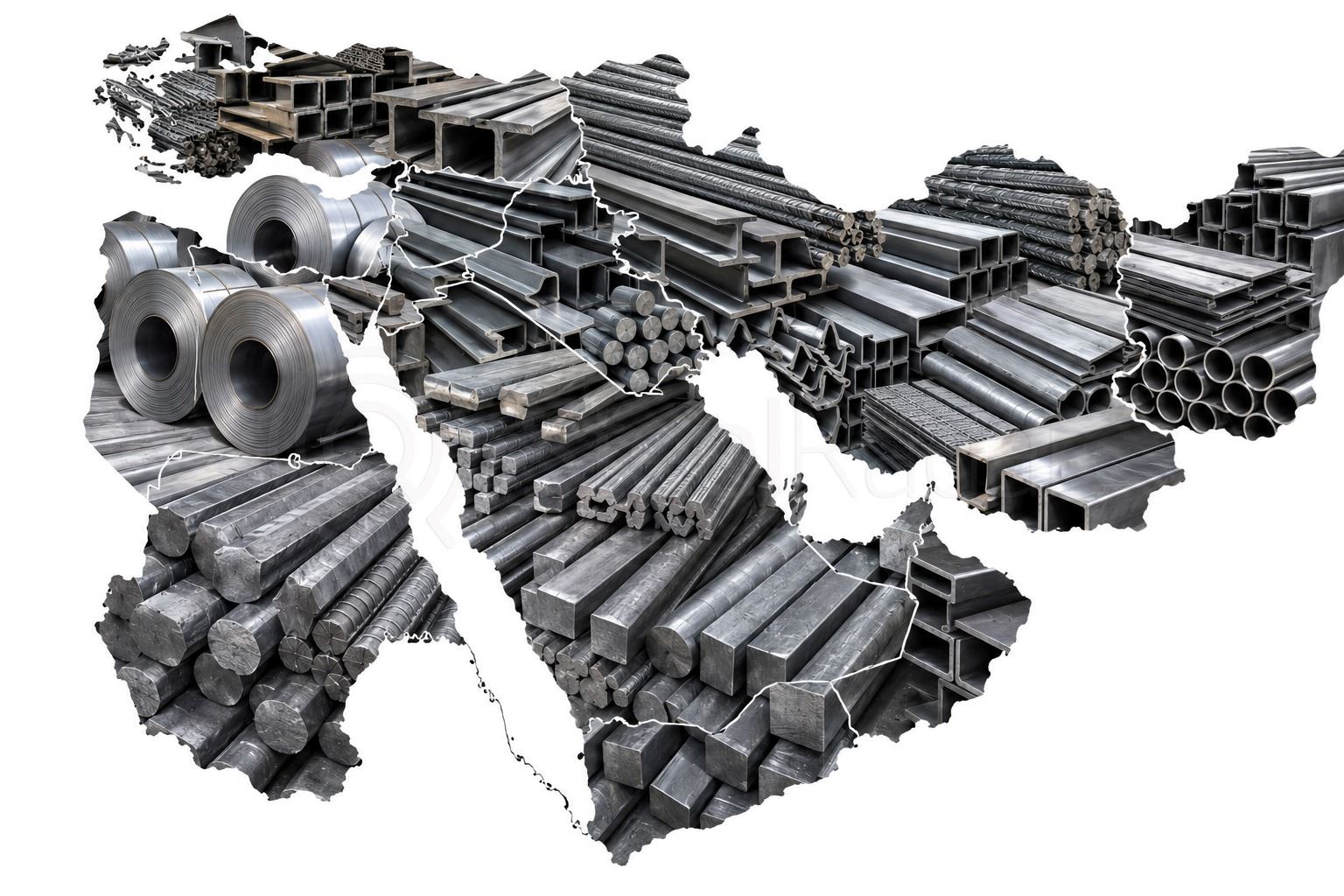
Steel prices across the Middle East and North Africa markets have generally remained stable, while trading activity across the region continues at a steady and cautious pace. Recent market information indicates that producers and buyers do not expect major changes at current price levels. Meanwhile, restrictions on the shipment of Iranian-origin products through third countries under alternative countries of origin have emerged as a key issue on the regional trade agenda.
According to the latest market data compiled by SteelRadar, rebar prices in the United Arab Emirates stand at $795/ton EXW, while Algerian rebar is assessed at $738/ton EXW and wire rod at $745/ton EXW. In Egypt, rebar prices are at $580/ton FOB, while HRC is assessed at $707/ton EXW. Egypt is reported to be maintaining its competitive position in the region's export market.
In Saudi Arabia, domestic market prices stand at around $560/ton for billet and $586/ton for rebar. In Yemen, rebar offers are currently in the range of approximately $695-710/ton.
Prices remain stable in Iran
Prices in Iran have also remained broadly unchanged. According to the latest market data, Iranian rebar is assessed at $435/ton EXW, wire rod at $470/ton EXW, billet at $408/ton FOB, slab at $420/ton FOB and DRI at approximately $240/ton FOB.
However, developments concerning trade channels have attracted attention in the Iranian steel market alongside price movements.
Egypt maintains its competitive position
Egypt, another major producer in the region, continues to maintain a competitive position in export markets. Rebar prices at $580/ton FOB indicate that Egyptian producers remain capable of offering competitive prices, particularly in regional and overseas markets.
In Algeria, rebar is assessed at $738/ton EXW and wire rod at $745/ton EXW. In Lebanon, rebar offers are reported at $580-590/ton CFR Egypt and $550-560/ton CFR Iran.
Price differences persist in Iraq
Prices in the Iraqi market continue to vary by producer. Current rebar offers are generally in the range of $515-630/ton EXW.
Offers from producers including Darin Steel, Erbil Steel, Super Steel, Qaiwan Steel, Alpha Steel and Iraq Steel are around $515/ton EXW, while Med and Iqarueen are offering at approximately $520/ton EXW. Mass Steel's offer, at $630/ton EXW, remains above those of other producers in the market.
In Syria, accelerating reconstruction activity is creating significant potential for a rise in steel consumption over the medium term. The reconstruction of residential buildings, infrastructure and areas damaged by the war is expected to support steel demand. However, given the still-limited domestic production capacity, a significant portion of the additional demand may need to be met through imports.
The main obstacles preventing producers from increasing capacity utilization remain high energy costs, raw material supply constraints and existing limitations in production infrastructure. Turkey's geographical proximity, together with its ability to provide raw materials, equipment and technical support, keeps it in an advantageous position as a potential steel supplier to Syria.
Domestic steel prices remain high in South Africa
In South Africa, domestic steel prices continue to remain above MENA market levels. According to the latest data, HRC is assessed at $891/ton, CRC at $998/ton, plate at $947/ton and rebar at $725/ton. Scrap prices are estimated at $234/ton. These prices represent domestic market levels and exclude the applicable 15% VAT.
Overall, price volatility across the MENA steel market remains limited, with markets continuing to move within a stable range. As buyers continue to purchase primarily according to their immediate needs and producers seek to maintain current price levels, the market is expected to remain largely stable in the short term rather than experience sharp price movements.
Against this backdrop, one of the most notable developments has been the tightening of trade channels for the re-export of Iranian-origin products through third countries under alternative countries of origin. The tightening of practices in Oman and Pakistan is considered likely to make it more difficult for Iranian steel products to reach regional markets through alternative trade routes.
At the same time, Egypt's ability to maintain competitive export offers, the stability of prices in Algeria and Iran, and persistently high prices in the Gulf markets suggest that regional steel trade will continue to be shaped less by outright price movements and more by competition, logistics and the availability of trade channels in the coming period.



Comments
No comment yet.