


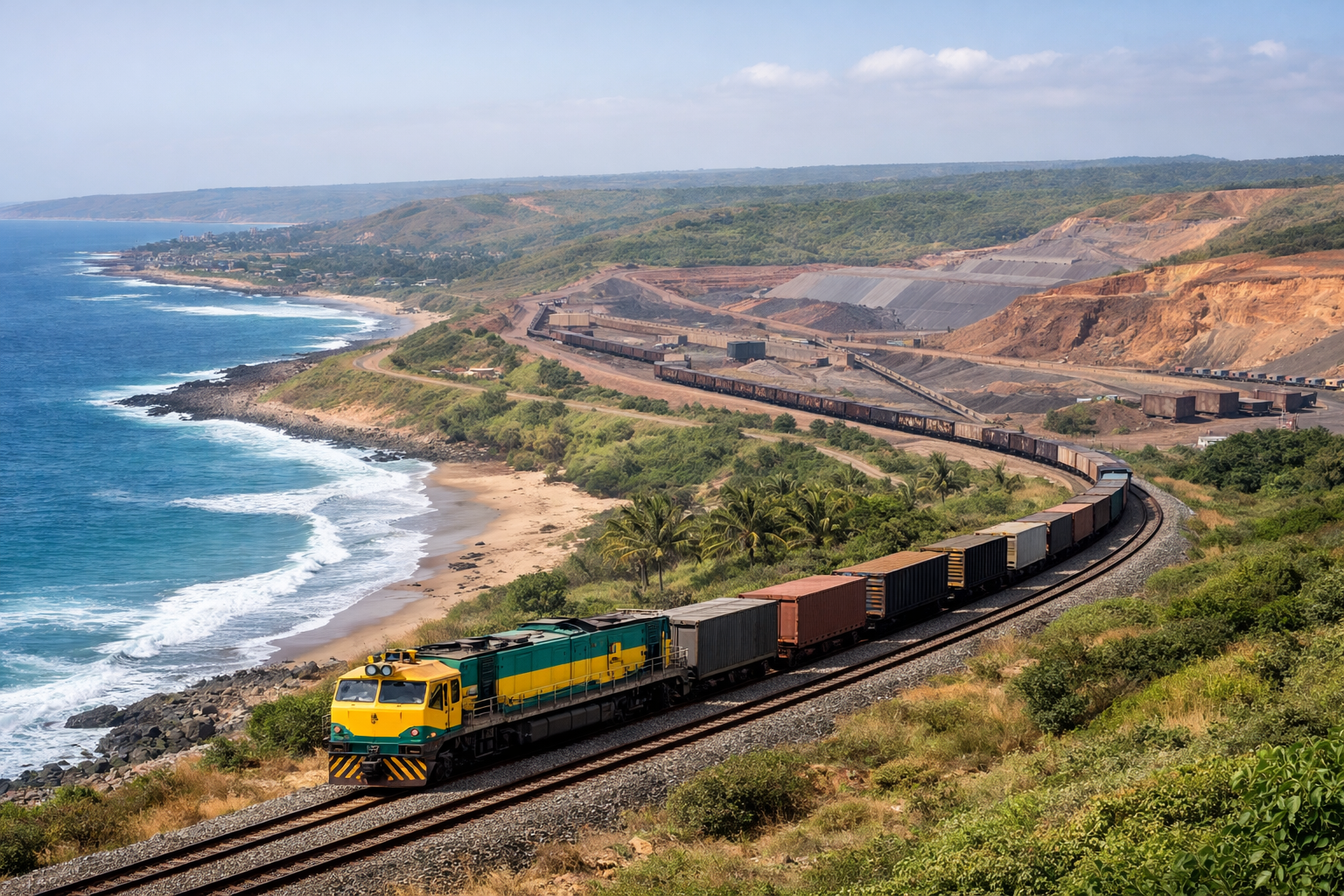
The funding will be used for the rehabilitation and capacity expansion of approximately 1,300 kilometers of railway infrastructure in Angola. The line will connect the Port of Lobito to Luau, on the eastern border with the Democratic Republic of the Congo, offering the Copperbelt region an alternative export route to the Atlantic.
Long-term operating model
The Benguela Railway, which forms the backbone of the corridor, was constructed between 1903 and 1931. Severely damaged during the civil war, the line was rebuilt between 2006 and 2014.
In 2023, a consortium comprising Swiss-based commodity trader Trafigura, Portugal’s Mota-Engil and Belgium’s Vecturis secured a 30-year concession to operate the line. The consortium committed to investing USD 455 million within Angola.
The long term concession model and structured financing framework position the project as a publicly supported yet commercially sustainability focused infrastructure investment.
A new Atlantic export gateway for copper and cobalt production
The corridor’s strategic significance is directly linked to production volumes in the Copperbelt. The Democratic Republic of the Congo and Zambia account for approximately 14% of global copper output and more than 70% of global cobalt production.
Electrification, renewable energy investments and the expansion of electric vehicle manufacturing are increasing capacity pressures across copper and cobalt supply chains. A significant portion of existing exports remains dependent on southern and eastern African routes.
By providing shorter access to the Atlantic, the Lobito Corridor offers logistical diversification for shipments destined for European and American markets. This carries strategic importance for the United States and the European Union, particularly in terms of critical mineral supply security.
Commercial question marks
The Lobito Corridor stands out as an alternative Atlantic route for critical minerals, a long term concession based commercial operating model, and a tangible example of Western backed development finance. It is also viewed as a strategic infrastructure element within the context of U.S.–China competition.
However, the corridor’s commercial viability continues to be debated. Lobito’s status as a secondary regional port may create disadvantages in terms of freight costs. Meanwhile, alternative routes such as the China backed TAZARA Railway present strong competition. Coordination gaps also persist in customs procedures and cross border infrastructure.
According to experts, the corridor’s success will depend not only on rail capacity, but also on logistics efficiency, transit times and regulatory alignment.






Comments
No comment yet.