


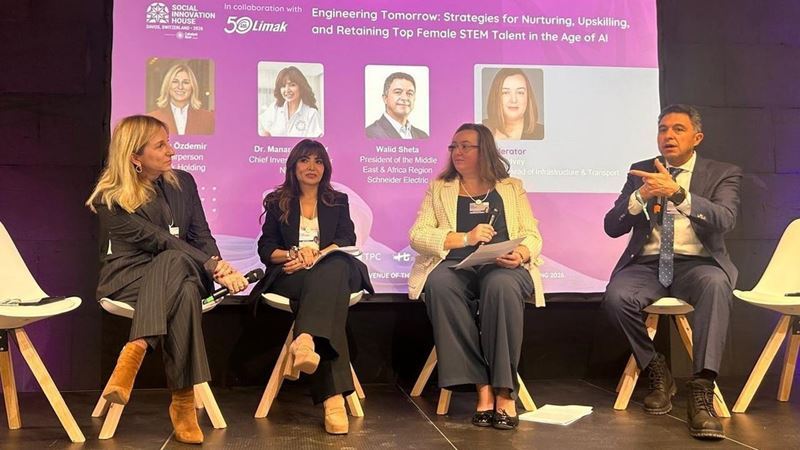
With this event, the holding company introduced its Türkiye’s Engineer Girls (TEG) project, which it has been running for 11 years, along with its international extension, the Global Engineer Girls (GEG) initiative, to a global audience.
The panel, titled “Building Tomorrow: Strategies to Nurture, Develop and Retain Women STEM Talent in the Age of Artificial Intelligence,” addressed the transformative impact of artificial intelligence on the workforce, the empowerment of women in technology-driven professions, and how this transformation can be converted into economic value. The session emphasized the importance of positioning women not only as employees, but also as key actors who design technologies and systems.
Held at TPC House in Davos, the panel featured Limak Holding Chairwoman Ebru Özdemir, NEOM Chief Investment Officer Manar AlMoneef, and Walid Sheta, President of Schneider Electric Middle East and Africa, as speakers. The event was organized in cooperation with Catalyst Now and moderated by Lisa Kelvey, Global Head of Infrastructure and Transport at KPMG.
Speaking at the panel, Manar AlMoneef highlighted the need for women to take on a more active role in decision-making and system-building processes when designing future cities and infrastructure projects. Walid Sheta discussed ongoing skills development initiatives aimed at helping women engineers adapt to the artificial intelligence transformation.
Meanwhile, Ebru Özdemir also represented the private sector in an Eurasia panel included in the official program of the WEF. The session, attended by Azerbaijan President Ilham Aliyev, Armenian President Vahagn Khachaturyan, and Serbian President Aleksandar Vučić, focused on the role of the Eurasian region in the global economy in terms of trade, energy, and strategic connectivity corridors.
In her remarks during the “Building Tomorrow” panel, Özdemir stated that educating women in big data, artificial intelligence, and green technologies, particularly in developing economies, would generate significant economic returns on a global scale. Noting that the experience gained through the TEG and GEG projects is being carried to the international arena, Özdemir emphasized that investments focused on women should be viewed not as social responsibility initiatives, but as a long-term economic necessity.
Stressing that basic training alone will not be sufficient in the age of artificial intelligence, Özdemir underlined the need for comprehensive AI literacy that translates into real careers in engineering, construction, and infrastructure sectors. She concluded that women’s participation in this technological transformation not merely as users, but as designers and decision-makers, is critical to building a more inclusive and equitable future.
Sourced by: Anadolu Agency (AA)




Comments
No comment yet.