


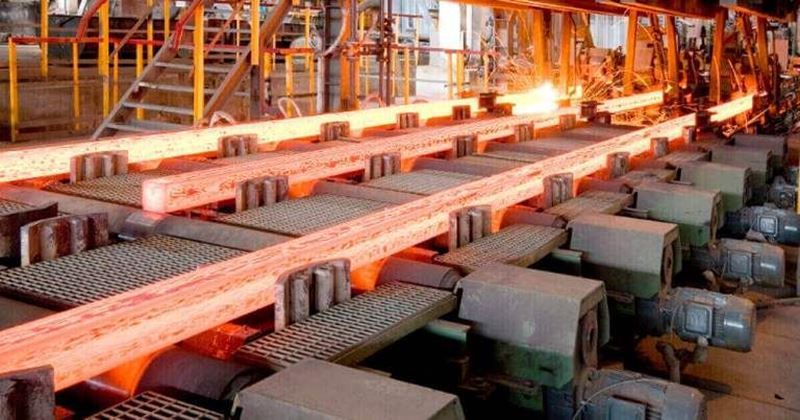
According to data released by the Italian Steel Federation, Federacciai, Italy’s crude steel production rose by 1.6% in January compared to the same month last year, reaching 1.7 million tons. These figures confirm the positive trend observed throughout 2025, during which crude steel production volumes increased by 3.7% compared to 2024.
When evaluated by the hot-rolled product category, two distinct trends emerged. The production of long products, primarily aimed at the construction sector, recorded a 13.2% year-on-year increase. In contrast, the production of flat products used in the automotive, machinery, and home appliance sectors declined by 1.8% year-on-year in January, following a recovery phase that closed out 2025.
On a global scale, crude steel production ended 2025 with a 2.3% year-on-year decline. The year 2026 also began in negative territory, with global crude steel production falling by 6.5% in January compared to the same period last year. This outcome was primarily driven by the 13.9% year-on-year decline in China's production.
Despite the decline in China, production growth was observed in the rest of the world. Crude steel production in India rose by 10.5%, while Turkey saw an increase of 5.8%, and Iran recorded a rise of 15.1%. Thus, total production in the rest of the world, excluding China, increased by 2.6%. Production in South Korea grew by 5.0%, while the increase rate in the US was 3.3%.
A different picture emerged in Europe. Although crude steel production in Germany recorded a 15.0% year-on-year increase, crude steel production across the European Union (EU-27) contracted by 2.3% in January compared to the same period last year.
Meanwhile, according to surveys by the Italian National Institute of Statistics (ISTAT), industrial production showed a 3.2% year-on-year increase in December. However, looking at the three-month average, a slight decline of 0.4% was recorded. Activities in user sectors generally presented a positive picture. While automotive production increased by 13.5% year-on-year, electric motor production rose by 9.6%, and the production of metal products showed an increase of 5.8%. Conversely, home appliance production continued to decline, falling by 8.0% compared to September.
In general, 2025 was a period marked by diverging trends among steel-consuming sectors. The index ended the year with a 0.2% decline, following a trajectory quite close to 2024 levels. Sectoral changes ranged from a 10.3% decline in automotive to a 3.9% increase in electric motors. In the construction sector, the ISTAT index entered a growth trend again. While construction activities recorded a 5.4% year-on-year increase in December, the average growth rate for the entire year of 2025 stood at 4.8%.






Comments
No comment yet.