


EU–India Free Trade Deal Set to Reshape Türkiye’s Export Landscape
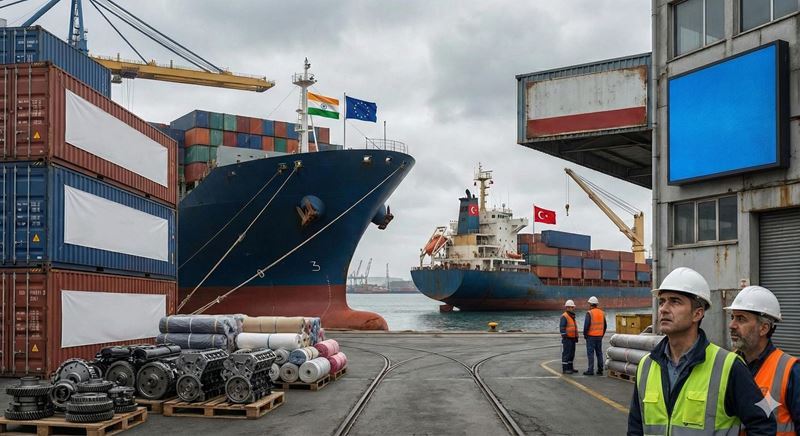
The Free Trade Agreement (FTA) signed between the European Union and India is poised to alter competitive dynamics in Türkiye’s largest export market. Gökhan Erol, Founder of Inovakademi, warned that the deal threatens not only the textile sector but also Türkiye’s flagship automotive industry, stating: “Our customs shield is coming down; the rules of competition are being rewritten.”
Gökhan Erol, founder of Inovakademi a consultancy and training firm specializing in foreign trade and digitalization assessed the potential impact of the EU–India agreement on the Turkish economy in light of recent trade data. He emphasized that the process creates a “double squeeze” for Türkiye.
It’s Not the Rules of the Game , It’s the Game Itself That Has Changed
Describing the agreement as a potential “cold shower” for Türkiye, Erol said:“For years, thanks to the Customs Union, we were treated as ‘one of the insiders’ in the EU market and enjoyed the comfort of tariff-free trade. With this agreement, however, the EU has handed the same VIP access card to India, a country of 1.42 billion people. Now we are sharing the same shelf space with a competitor that has far lower labor costs and massive production capacity. The rules of the game haven’t changed the game itself has.”
USD 5.5 Billion in Automotive Exports under Risk
Erol noted that public attention has largely focused on textiles, creating a misleading perception, while the real threat lies in industrial exports particularly automotive components.“Numbers are not emotional; they tell the truth.In 2024, Türkiye exported USD 5.57 billion worth of automotive parts to the EU. This is our stronghold. Yet even with existing tariffs, India already exports USD 1.71 billion in the same category. Once tariffs are eliminated, India’s 10–15% cost advantage will work decisively in its favor. For a major German automotive manufacturer, a 10% cost difference is more than enough reason to switch suppliers. Our automotive suppliers must urgently prepare for this scenario.”
A ‘Back Door’ Risk for the Domestic Market
Erol also warned that the danger extends beyond exports, posing a serious risk to Türkiye’s domestic market as well:“Due to the technical structure of the Customs Union, an Indian product entering the EU duty-free can also enter Turkey duty-free under the principle of ‘free circulation.’ In other words, a textile producer in Bayrampaşa or an auto parts manufacturer in Konya will be competing with Indian goods not only in Germany, but at home as well. We pay customs duties when exporting to India; they won’t when exporting to us. This is not a sustainable equation.”
The Way Forward: “Speed, Trust and Digital Branding”
Arguing that Turkish exporters should avoid competing solely on price, Erol outlined a strategic exit path:“If we try to compete with India on price, we will lose. Our winning formula is ‘Speed and Trust.’ While a container from India takes weeks to reach Europe, we can deliver within 48–72 hours. We must tell European buyers: ‘Don’t risk your supply chain let me deliver to your door with green logistics.’ To do that, we must abandon traditional marketing and invest in digital branding on LinkedIn and B2B platforms. This is no longer an era of selling products alone; it is an era of marketing trust.”




Comments
No comment yet.