


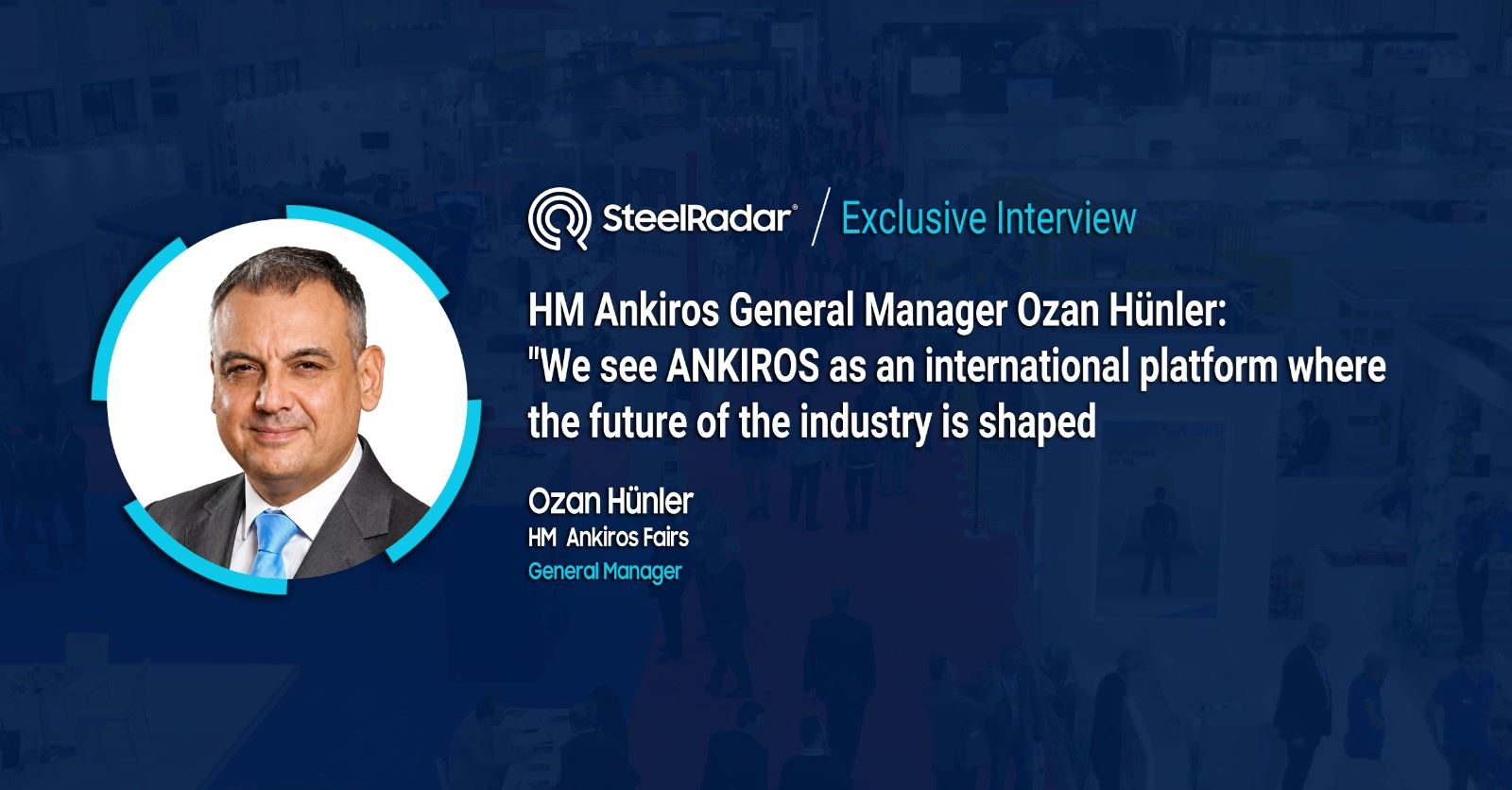
Mr. Hünler, you have more than 20 years of management experience in the industry. Under your leadership, what significant changes will we see in the short- and long-term priorities of HM Ankiros Fairs?
Throughout my career, I have had the opportunity to serve in management positions within multinational organizations in the fields of international trade, business development and marketing. The two most important things this experience has given me are corporate discipline and an international perspective. When I assumed the role of General Manager at Hannover Messe Ankiros Fairs in January 2026, I found a very strong brand that had earned the trust of the industry over the years. Therefore, I define my priorities not as "radical change," but as "taking a strong legacy further through corporate discipline."
In the short term, our priority is to deliver ANKIROS 2026, to be held at the Istanbul Expo Center on October 22-24, as a flawlessly executed exhibition that offers the highest commercial value to our exhibitors and visitors. In addition, from my very first day in office, I have placed establishing close contact with industry associations, industrialists and our stakeholders at the center of my priorities, and I want to make this closeness a permanent way of working.
In the long term, we are focusing on three pillars: systematically increasing the international impact of our exhibitions and the quality of our visitors, improving the exhibitor experience in a data-driven and measurable way, and further strengthening our ANKIROS and ALUEXPO brands as benchmark platforms for the region in their respective fields. It is easy to promise change, but my preference is to consistently build upon a structure that has been created by the industry itself and has already proven its value, and to make each new exhibition measurably better than the previous one.
"Digital tools can carry information, but they cannot build trust"
In the age of digitalization and artificial intelligence, what will be the greatest competitive advantage of the exhibition model that still brings people together physically?
I consider this a very important question because the future of the exhibition industry lies precisely in the answer to it. In my opinion, the greatest competitive advantage of physical exhibitions is trust. In industry, especially in sectors with a high level of technical complexity such as metallurgy and foundry, investment decisions are not made in front of a screen. When a company is deciding on a melting furnace worth millions of euros, a molding line, or a long-term supply relationship, it wants to see the equipment on site, touch the material, and get to know the person sitting across the table. Digital tools can carry information, but they cannot build trust.
The second advantage is efficiency. An exhibitor or visitor can hold, within three days and under one roof, the number of meetings that would normally be spread over several months. Having the entire value chain of the industry gathered in the same place at the same time also creates a unique economy of chance that no digital platform can offer. For example, a meeting you did not plan can become the beginning of a collaboration you never expected. A business partnership may not always be concluded on the exhibition floor, but it almost always begins there.
At the same time, I see digitalization not as a competitor, but as an opportunity to create additional value. When AI-powered matchmaking, data-driven visitor engagement, and digital communication tools are used to increase the efficiency of face-to-face interactions, exhibitions do not become weaker; on the contrary, they become even more efficient. The exhibitions of the future will be physical gatherings prepared and supported by digital tools.
While the metals industry is grappling with global quotas and the green transition (CBAM), do you see your exhibitions as a "sales venue" or rather as a "survival guide" for the industry?
To be frank, it is no longer possible to choose between the two, but I believe the emphasis has definitely shifted to the latter. The European Union's Carbon Border Adjustment Mechanism (CBAM) entered its definitive implementation phase as of January 1, 2026. In other words, the carbon footprint is no longer a future scenario for Turkey's export-oriented metals industry, but a tangible cost item of today. When you add global quotas, energy costs, and supply chain challenges to the equation, the industry's focus shifts from "What can I sell?" to "How can I adapt?"
This is exactly where the role of exhibitions changes. We have designed ANKIROS 2026 as a platform where the solutions to this transformation can be seen under one roof. Energy-efficient furnaces and heat treatment systems, low-carbon production technologies, automation, digital manufacturing solutions, and circular economy applications are among the key focus areas of our exhibition. I believe that, under today's conditions, being able to compare technologies that can help industrialists develop their own roadmaps within just three days represents a significant advantage.
"Türkiye Holds a Truly Unique Position in the Global Exhibition Industry"
What are the major advantages and disadvantages that Türkiye's geographical and logistical position offers to the exhibition industry?
Türkiye holds a truly unique position in the global exhibition industry. We are located at the intersection of the European, Middle Eastern, North African, Balkan, Turkic Republics and Asian markets, with access to a vast geographical area and a major industrial basin within approximately a four-hour flight from Istanbul. Istanbul's global air connectivity, accommodation infrastructure and attractiveness as a destination provide us with a significant advantage in attracting international visitors. There is another aspect that is at least as important as geography: Türkiye is also a strong manufacturing base. Visitors who come here are not simply attending an exhibition; they are entering a vibrant industrial ecosystem that is home to some of Europe's leading manufacturers.
We also need to take a realistic view of the disadvantages. First, geopolitical developments in our region sometimes require careful perception management in distant markets. In essence, the key lies in consistent communication and the confidence created by the exhibition experience itself. In fact, a significant proportion of our international visitors return to the next edition with even greater determination. Second, competition among global exhibition hubs is becoming increasingly intense. Exhibiting companies have limited budgets and are more selective than ever about which exhibitions they invest in. This obliges us to create tangible commercial value at every exhibition and to improve visitor quality in a measurable way. Frankly, I see this pressure not as a disadvantage, but as a discipline that keeps us sharp.
"What makes exhibitors happy is not the crowd itself, but the quality of the meetings at their stands."
What is your red line to ensure that an exhibiting company does not leave your exhibition dissatisfied? In other words, which operational detail do you consider absolutely essential to execute flawlessly?
My red line can be summarized in one sentence: the exhibiting company must receive a return on its investment in its stand. A company invests in the exhibition participation fee, stand rental, design, logistics, accommodation and, most importantly, three days of its team's time. The return on that investment is ensuring that the right visitors reach that stand. Therefore, the first process that must be flawless for us is visitor acquisition. In other words, ensuring that qualified professionals with purchasing authority from the right markets are present at the exhibition. A crowded exhibition may make for a good photograph, but what makes exhibitors happy is not the crowd itself, but the quality of the meetings at their stands. As HM Ankiros Fairs, we attach great importance to visitor acquisition and invest significantly in this area.
My second red line is the absence of a responsive point of contact. If an exhibitor encounters a problem before or during the exhibition and cannot find a team that responds quickly and provides solutions, all the other successes of that exhibition are overshadowed. When it comes to operational details such as stand handover, technical infrastructure, and installation and dismantling processes, my expectations from my team are clear: any issues must be resolved on site and without delay before they escalate. Exhibitors should not have to think about any operational matters throughout the exhibition and should be able to devote all their energy to their customers. We make no compromises on these two issues because the credibility of an exhibition brand is built over many years, but it can begin to be questioned because of a single bad experience.
"An exhibition loses its relevance if it does not evolve at the same pace as the industry it represents."
Having taken the seat of General Manager, what do you see as the biggest risks and opportunities ahead of you today?
We need to take a realistic view of the risks. The biggest risk is the pressure that uncertainty in the global economy and geopolitical developments place on the investment and marketing budgets of our industrial companies. Companies are scrutinizing every expenditure more carefully, and this places a responsibility on exhibition organizers to demonstrate the tangible return on investment of participating in an exhibition. I see this pressure not as a threat, but as a necessity that pushes us to do our job better. The second risk is the risk of falling behind the rapid transformation taking place in the industry. An exhibition loses its relevance if it does not evolve at the same pace as the industry it represents. That is why we closely follow international exhibitions and successful practices implemented around the world, and incorporate what we learn into our own events.
On the opportunity side, I believe 2026 will be an exceptional year for ANKIROS. The international congresses taking place alongside our exhibition will make Istanbul the global center of the metallurgy and foundry community during that week. The green transition and digitalization are creating a significant need for technological renewal across the industry, and this increases the strategic importance of our exhibitions as platforms that bring technology providers together with manufacturers. When Türkiye's position as a manufacturing base and its geographical accessibility are added to the equation, I see a strong foundation for growth ahead.
Personally, I see the greatest opportunity in this: managing a brand that has earned the trust of the industry over the years with the understanding that this trust must be earned again every single day. The openness and support I have received from every segment of the industry since taking office have been my greatest source of strength on this journey.
Finally, I would like to emphasize that today our industry needs information sharing, strong collaboration and international interaction more than ever before. We see ANKIROS exactly from this perspective—not merely as an exhibition where products are displayed, but as an international meeting platform where the future of the industry is discussed and new business opportunities emerge. We will be delighted to welcome all stakeholders of our metallurgy industry, as well as the companies exhibiting in the TURKCAST Special Section, the international showcase of the foundry industry, and our visitors to ANKIROS 2026, which will be held at the Istanbul Expo Center on October 22–24, 2026. I hope that we will come together at this event to help shape the future of our industry.



Comments
No comment yet.