



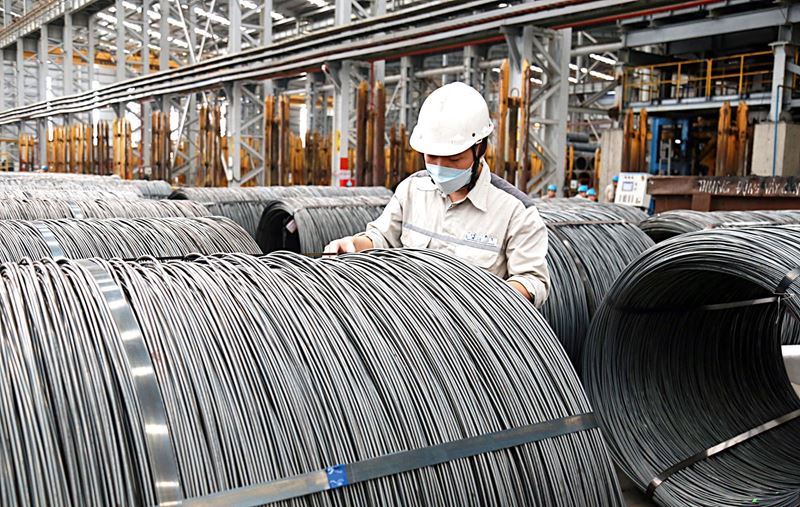
The strategy focuses on producing high quality steel in line with national and international standards, aiming to strengthen the sector’s competitiveness, diversify product range and gradually shift toward high value added and environmentally friendly production. The plan seeks to reduce import dependence in alloy steel, tool steel and special steel products, while ensuring deeper integration into the global value chain.
Under the strategy, steel products are expected to meet approximately 80-85% of domestic demand by 2030. Crude steel output is projected to reach 25-26 million tons with an average annual increase of 7.0-8.0%, while finished steel production is planned to increase by 5.5-6.5% per year to 32-33 million tons. Per capita steel consumption is expected to rise to 270-280 kg annually. The share of high value added products, including alloy steel, stainless steel and high quality steel, is also set to increase.
Targets for 2035 indicate higher production levels. Crude steel output is projected to reach 33-36 million tons with an average annual increase of 6.0-7.0%, while finished steel production is expected to increase by 4.5-5.5% to 40-43 million tons. Per capita consumption is projected at 340-360 kg, with 85-90% of domestic demand to be met by local production and a stronger export position. High quality steel is expected to take a larger share in production for automotive, shipbuilding, railway, energy and defense industries.
Under the 2050 vision, crude steel output is targeted to reach 75-80 million tons with an average annual increase of 4.0-4.5%, while finished steel production is expected to increase by 3.5-4.0% to similar levels. Annual per capita consumption is projected at 570-650 kg. The sector is expected to meet maximum domestic demand and strengthen its export position, with deeper integration of Vietnam’s steel products into global supply chains.
The strategy prioritizes the development of products not yet manufactured domestically but with strong demand potential. Green steel production, alloy and manufacturing grade steels, and modern projects with high competitiveness will be supported. Enhancing scientific and technological capacity is aimed at improving productivity and product quality in line with international standards.
In spatial planning, investment will be concentrated in large scale projects located in areas with deep sea ports, maximizing the use of renewable energy sources and strengthening the value chain from raw material supply to final consumption. Policy and implementation mechanisms will also be developed in areas such as raw material supply, energy resources, technology development, human resources, environmental protection and domestic and external market balance.
The strategy aims to stabilize domestic consumption and exports in construction steel, structural steel, galvanized and coated sheets, steel pipes and hot rolled products. In addition, domestic technology development is planned for high strength plates, prestressed steel, corrosion resistant stainless steel, ultra light steel and shipbuilding steel. Rail steel for high speed railways, special steel for energy infrastructure projects, seamless pipes for liquefied gas transportation and steel for wind turbine towers are also identified as priority areas.



Comments
No comment yet.