


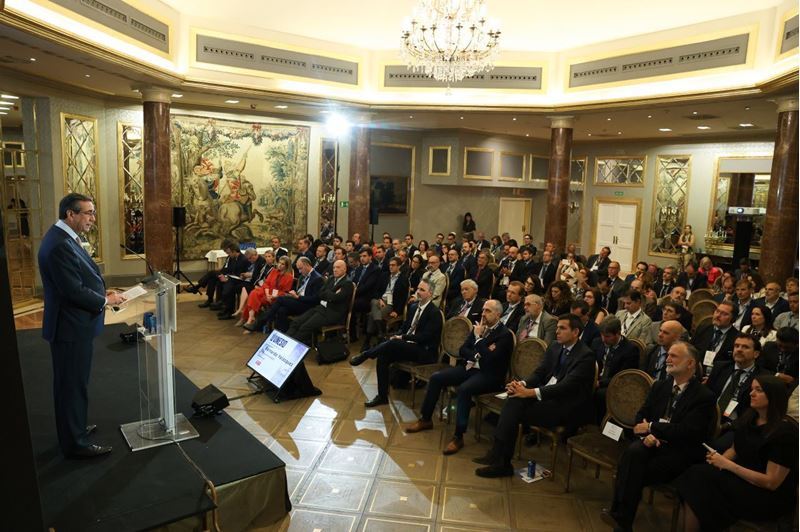
UNESID calls for stronger protection of the strategic steel industry
The Spanish Steelmakers Association (UNESID) called on Spain and the European Union to take stronger and more coordinated measures to protect the strategically important steel industry.
Speaking at a press conference, UNESID President Bernardo Velázquez and Director General Carola Hermoso stressed that Europe's energy, industrial and technological independence depends on a strong steel sector. They noted that although Spain was the fastest-growing economy in the European Union in 2025, energy-intensive industries continued to operate under difficult conditions due to high energy costs, mounting import pressure and growing international uncertainty.
UNESID also emphasized that steel is a fundamental input for strategic sectors such as energy, infrastructure, transportation, construction, defense and clean technologies, adding that Europe cannot achieve its decarbonization and strategic autonomy goals without a strong and competitive steel industry.
Production declined in 2025, exports increased thanks to the EU market
According to UNESID data, Spain's crude steel production fell by 0.4% year on year to 11.8 million mt in 2025, while apparent steel consumption declined by 0.5% to 13.4 million mt. Industry activity weakened during the second half of the year amid rising uncertainty in international markets.
Combined domestic and export deliveries decreased by 1.1% to around 12 million mt, including 6.4 million mt supplied to the domestic market and 3.9 million mt delivered to the European market. However, total steel exports rose by 3.3% to approximately 8 million mt. The increase was driven by a 6.6% rise in shipments to EU countries, while exports to third countries declined by 5.1%.
Imports remained at historically high levels, reaching approximately 10.4 million mt. Of this total, 5.5 million mt originated from EU member states, while the remainder came from third countries. As a result, one out of every three tons of steel consumed in Spain was imported from non-EU countries.
Producers continued to lose market share in the first quarter of 2026
UNESID stated that risks facing the sector persisted during the first months of 2026. Apparent steel consumption declined by only 0.1% in the first quarter, supported by the construction sector, but domestic producers continued to lose market share.
During the period, crude steel production dropped by 21.1%, while total deliveries fell by approximately 10%. Meanwhile, imports from third countries increased by 2.3%, further intensifying pressure on Spanish and European steelmakers.
According to the association, these figures indicate that European producers continue to lose market share to suppliers from third countries despite relatively stable demand across Europe.
“Trade defense measures must be strengthened”
UNESID warned that global overcapacity and increasingly restrictive international trade policies are raising the risk of trade diversion toward the European market. The association argued that the European Union should undertake a comprehensive reform of its trade defense instruments.
Among UNESID’s priorities are strengthening trade protection measures and extending them to downstream products in the steel value chain, implementing the Melt & Pour criterion, expanding the Carbon Border Adjustment Mechanism (CBAM) to cover the entire steel value chain, and reinforcing customs control mechanisms.
The association also called for public procurement policies that prioritize steel products manufactured in Europe in strategic sectors such as energy, infrastructure, transportation and defense.
“Europe needs a genuine industrial policy that ensures a level playing field. Decarbonization and strategic autonomy are impossible without a strong and competitive steel industry,” UNESID President Bernardo Velázquez said.
Energy costs continue to undermine competitiveness
UNESID stated that energy costs remain one of the main factors limiting the competitiveness of the Spanish steel industry. While welcoming government measures aimed at reducing energy costs, the association called for the extension of reductions in the electricity generation tax and the special electricity tax, which are set to expire on June 30, for as long as the current extraordinary market conditions persist.
The association also urged policymakers to make these support measures permanent, strengthen the status of energy-intensive consumers, ensure continued access to competitive electricity prices, and increase compensation for indirect CO₂ costs to the highest level permitted by the European Union.
“Europe’s steel industry is simultaneously facing high energy costs, import pressure and increasing international uncertainty. The sector urgently needs effective tools to maintain its competitiveness and continue investing,” Director General Carola Hermoso said.
Absenteeism resulted in the loss of three million working hours
UNESID highlighted growing absenteeism rates as another factor negatively affecting labor productivity. In 2025, non-work-related sick leave resulted in the loss of three million working hours, accounting for more than 60% of all non-worked hours during the year.
The association stressed the need for stronger cooperation between public institutions and social partners, describing absenteeism as an issue that directly affects industrial competitiveness.
Employment remained stable while female representation increased
Despite challenging economic conditions, Spain’s steel sector maintained direct employment for 21,720 people in 2025.
UNESID reported continued progress in diversity and talent development, with the share of female employees rising to 11.9%, women accounting for 39% of technical positions and 30% of management positions.
SteelChallenge España 2025 winners announced
As part of the UNESID General Assembly, awards were presented to the winners of the SteelChallenge España 2025 competition, which aims to attract young talent to the steel industry.
In the company category, Álvaro Ariznavarreta of Acerinox, along with David Melón and Ander Etxebarría of Roldán (Acerinox Group), received awards. In the student category, Joseph Manuel Bustillos and Javier Torres from the Polytechnic University of Madrid were honored.
The competition was sponsored by ArcelorMittal, Acerinox, Celsa and Simeprovi, in cooperation with PLATEA and with support from the European Skills4EII project.
Closing the event, Miguel Gómez-Pavón, Director General for Industrial Strategy and SMEs of Spain, stated, “Industry is at the heart of Europe. We are aware of the challenges facing the value chain and will continue to support initiatives that strengthen industry.”
UNESID also thanked ABB, the official sponsor of its 2026 General Assembly, for its contributions to innovation and digital transformation.



Comments
No comment yet.