Prices in the Turkish steel market generally moved higher during the week of August 10–14, although trading activity did not strengthen to the same extent. Producer price increases were particularly evident in the rebar market, while a more cautious trend prevailed in wire rod and section markets. In the billet market, meanwhile, rising imports and increased availability of Russian and Chinese material continued to put pressure on prices.
Across the market, producers are trying to defend prices due to high costs, while buyers are limiting purchases to immediate needs amid high inventory costs and weak end-user demand.
Rebar prices increase
The most significant price movement of the week was seen in rebar. Spot market prices for 12 mm rebar in Türkiye increased by approximately TRY 300–500/mt since August 10.
According to SteelRadar market data, 12 mm rebar prices are currently at TRY 33,800/mt in Marmara, TRY 33,200/mt in Iskenderun, TRY 33,300/mt in Izmir and TRY 33,700/mt in Karabuk.
On a dollar basis, prices are currently in the range of $578–590/mt ex-warehouse, depending on the region.
While most producers in the Marmara region kept their dollar-based prices unchanged, some producers in Izmir and Iskenderun increased their prices in Turkish lira terms. In Izmir, some offers rose to TRY 33,300–33,500/mt, while one producer in Iskenderun increased its price by TRY 500/mt to TRY 33,500/mt.
However, market sources indicate that levels above $595/mt are becoming increasingly difficult to achieve.
Export prices remain at $570–580/mt
Despite the increase in the domestic market, the export market remained relatively calm.
As of August 13, the indicative price for Turkish rebar was stable at $570–580/mt FOB Türkiye. Market offers were reported at $570–580/mt FOB, while workable transaction levels were assessed at around $575–585/mt FOB.
Market sources said Turkish producers have raised their offers slightly in response to recent fluctuations in scrap prices. However, discounts are still possible due to resistance from buyers.
One market source noted that difficulties in sourcing Russian billet have supported Turkish producers’ rebar prices, with some offers reportedly reaching $580/mt FOB.
Meanwhile, market sources reported that approximately 200,000 mt of rebar was sold to the EU at $570–575/mt FOB Türkiye. The transaction could not be confirmed by market close.
Scrap market remains in wait-and-see mode
Scrap prices remain an important cost reference for the Turkish long steel market.
The Turkish import price for premium-quality HMS 1/2 (80:20) scrap was stable at $375/mt CFR on August 13.
Market sources said both scrap buyers and sellers remain cautious about taking new positions. According to a Turkish trader, premium-quality scrap remained around $375/mt CFR, while rebar prices were around $577.50/mt FOB.
A further increase in scrap prices could strengthen Turkish producers’ willingness to raise finished steel prices, while a decline in scrap prices could raise questions over the sustainability of recent domestic price increases.
Wire rod buyers remain on the sidelines
The wire rod market, in contrast to rebar, showed a more subdued trend during the week.
Domestic wire rod prices in Türkiye remained largely unchanged throughout the week, while buyers continued to adopt a cautious approach to new purchases. Weak demand from wire, nail, mesh and welded-wire producers is keeping inventories at low levels.
On the export side, Turkish wire rod prices are currently in the range of $575–585/mt FOB.
Türkiye’s wire rod exports declined by only 0.1% year on year in the first half of the year, indicating a broadly stable overall export performance. However, significant differences were seen across individual markets.
Exports to Romania declined by 11.2%, while sales to Australia increased by 142.9%, and exports to Bosnia and Herzegovina rose by 271.2%.
Import supply puts further pressure on billet market
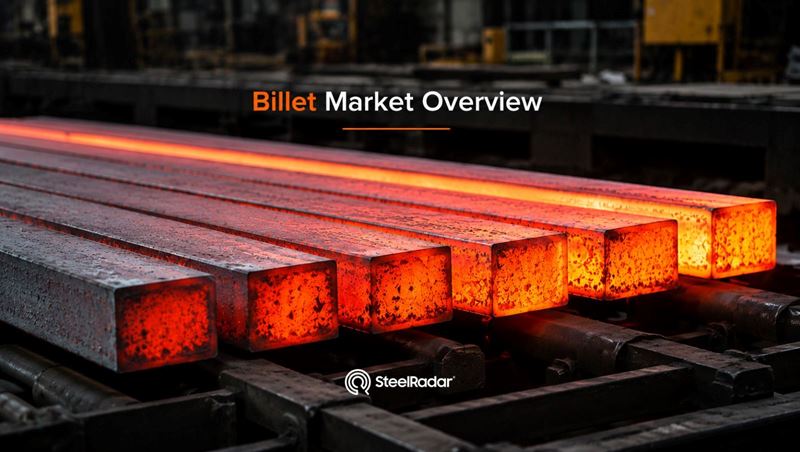
In the billet market, the main focus was less on prices and more on changes in sourcing patterns.
Türkiye’s billet and bloom imports increased by 28.6% year on year in the first half of 2026. Russia and China are becoming increasingly important suppliers to Türkiye, while the sharp increase in imports from these two origins is making competition more challenging for Turkish producers.
Türkiye’s billet imports from Russia reached 782,868 mt in the first half of the year, while imports from China reached 586,605 mt.
The increasing availability of low-cost imported billet is strengthening Turkish rolling mills’ bargaining power against domestic producers. Buyers continue to compare Russian and Chinese offers instead of purchasing higher-priced domestic billet.
However, high scrap and energy costs are preventing Turkish producers from making aggressive price cuts.
As a result, billet prices are expected to remain under sideways-to-downward pressure in the short term, although high production costs are likely to limit the scope for a sharp decline.
Demand remains the main challenge for profiles
Weak domestic demand was the main issue in the profiles market during the week.
Limited demand from construction, steel structures, machinery manufacturing and industrial investments is prompting Turkish profile producers to be more selective with new orders.
Traders are avoiding carrying high inventories, while producers are reluctant to make aggressive price cuts due to high raw material costs. As a result, the market is characterized by low trading volumes and sideways pricing.
Competition remains stronger in standard hollow profiles and structural profiles, while prices for special sizes and value-added products vary depending on order volume, delivery time and producer capacity.
With domestic demand remaining weak, exports are becoming increasingly important. The EU’s new steel safeguard measures and quota arrangements are also being closely monitored by Turkish profile producers.
Comments
No comment yet.