


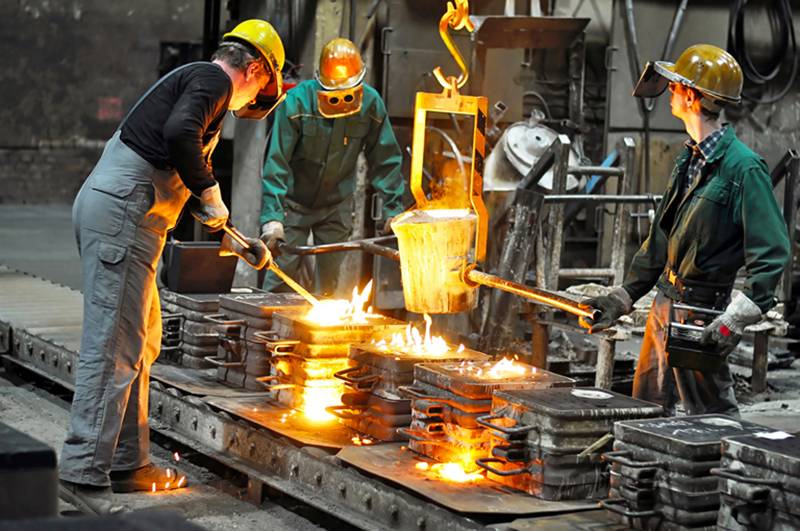
The closure of numerous foundries across Europe particularly in Germany is creating new opportunities for Türkiye. However, structural weaknesses in productivity, capital structure, and technology are emerging as significant risk factors for the sector.
The management of the Turkish Foundry Association (TÜDÖKSAD), during a visit to EKONOMİ newspaper, assessed how rising geopolitical tensions and growing protectionism in global trade are pushing the industry to a critical crossroads. Structural challenges were highlighted across a wide range of issues, from the Customs Union and “Made in EU” policies to labor costs and raw material supply.
“We must save the future, not just the day”
TÜDÖKSAD Chairman Kadir Efe stated that global trade is increasingly shifting onto a political footing, emphasizing that the Turkish foundry sector’s biggest test lies in productivity, capital structure, and strategic planning. He stressed that short-term, stopgap solutions are no longer sufficient and that long-term transformation has become unavoidable. Efe also noted that the current structure of the Customs Union fails to adequately protect Turkish industry.
Pointing out that strategic sectors such as automotive are directly affected by this process, Efe underlined that political decisions are increasingly shaping commercial balances.
Rising pressure from China and India
Efe highlighted the changing role of China in global industry, noting that the country is no longer focused solely on exports but is increasingly becoming a direct partner in the industrial sectors of other countries. Competition originating from China and India poses a significant threat to the sector, he said, adding that inefficiency remains one of the core structural problems.
He also stated that Türkiye’s previous SME-driven growth model has begun to create disadvantages, with companies operating on outdated technologies steadily losing their competitiveness.
Limited new investments, focus on transformation
Efe noted that large-scale greenfield investments in the sector remain limited, while capacity expansion, robotization, and automation investments have come to the forefront. Rather than new facilities, the sector is undergoing a transformation of existing plants.
He added that while the closure of foundries in Europe presents an opportunity for Turkey, filling this gap will require the right investments and a stronger financing structure.
Financing and labor costs intensify pressure
TÜDÖKSAD Board Member Ali Esat Kutmangil stated that the sector is facing pressure on multiple fronts. “Made in EU” practices, rising energy and carbon costs, and tightening financial conditions are weakening investment capacity, he said.
Kutmangil emphasized that labor costs have become one of the heaviest burdens on the sector, noting that labor’s share of total costs has increased from 8% in 2018 to over 25% today directly impacting profitability.
Raw material and pig iron risks
On the raw material side, Kutmangil pointed to a critical threshold in pig iron supply. He said that the planned ban on Russian pig iron entering Europe from 2026 could offer Türkiye a short-term advantage; however, if similar restrictions are imposed on Türkiye, shifting to alternative sources would significantly increase costs.
On financing, he added that industrial companies have become increasingly dependent on bank loans, with interest rate and exchange rate risks putting additional strain on firms.
Cautious outlook for 2026
Kutmangil noted that the sector contracted by 30% in 2024 and experienced only a limited recovery in 2025. Due to increasing costs and ongoing uncertainty, the outlook for 2026 remains cautious.
He also stressed that the education system is decreasing to meet industry needs, making it increasingly difficult to find qualified operators.
Call for antidumping measures
TÜDÖKSAD Board Member Ekrem Kanıtoğlu called for more effective measures against price pressure from China and India. Urging closer cooperation with public authorities, he emphasized the need for permanent and strategic implementation of antidumping mechanisms.
Flexibility over capacity
Chairman Kadir Efe argued that growth strategies focused solely on capacity expansion should be abandoned, suggesting that the Spanish and Italian models could serve as useful references for Türkiye. He stressed that flexible production structures and accurate customer selection are becoming decisive factors for competitiveness.
Unplanned capacity expansions, Efe warned, create heavy financial burdens, adding that growth without sustainable profitability is ultimately meaningless.
World Foundry Organization to meet in Istanbul
Efe also recalled that the World Foundry Organization will convene in Istanbul from 18–24 October 2026, noting that the event will serve as a major international showcase for the sector.
TÜDÖKSAD management concluded that a transformation based on productivity, a stronger financial structure, technological investment, and long-term strategic planning is inevitable if the Turkish foundry industry is to remain competitive on a global scale.




Comments
No comment yet.