


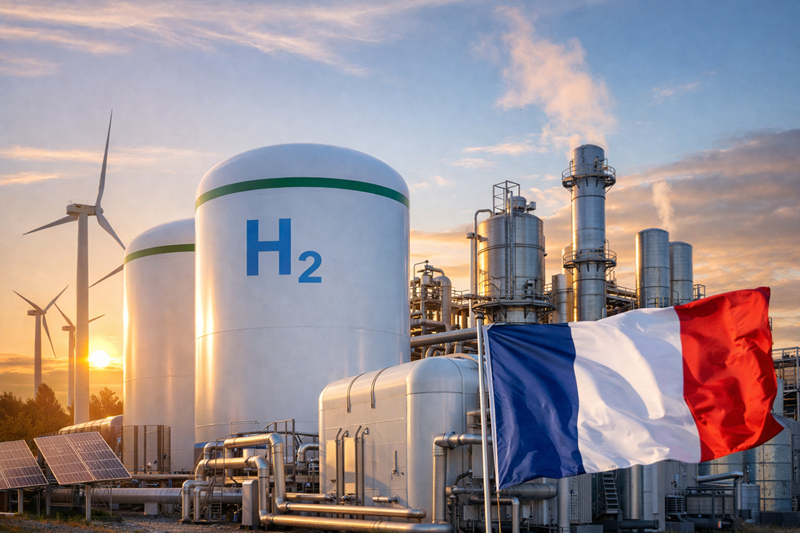
The program will contribute to the REPowerEU Plan, which aims to accelerate decarbonisation in industry and reduce dependence on Russian fossil fuels, in line with the objectives of the EU Hydrogen Strategy and the Clean Industrial Deal.
Scope of the French plan
France has developed a program that will promote the production of renewable and low-carbon hydrogen using new electrolyzers in order to reduce industrial greenhouse gas emissions. The program will support the construction of a total of 1 GW of hydrogen electrolysis capacity. The aid will be allocated through a competitive process consisting of three tender rounds; the first tender covers a capacity of 200 MW with an estimated budget of 797 million EUR. The hydrogen produced will be offered for sale for industrial use only in cases where there is no economically viable electrification alternative.
The support will be granted in the form of a fixed premium and contracts will be concluded for a period of 15 years. Beneficiaries will be required to demonstrate that renewable hydrogen and low-carbon fuels are produced in accordance with EU criteria. The aid aims to cover the additional costs arising from the production of renewable and low-carbon hydrogen compared to fossil fuel-based hydrogen.
The program will contribute to France’s targets of reaching 4.5 GW of electrolyzer capacity by 2030 and 8 GW by 2035. The program is expected to prevent approximately 1,100 kilotonnes of CO2 emissions annually, thereby supporting France’s EU climate targets.
The Commission’s assessment and findings
The European Commission assessed the program under EU State aid rules and the 2022 CEEAG guidelines. As a result of the review, it was determined that the program is necessary and appropriate to facilitate the production of renewable and low-carbon hydrogen, enable the decarbonisation of industry, and support EU policy objectives.
The Commission emphasized that the program has an ‘incentive effect’ for beneficiaries, as the projects would not be carried out without public support, and France has ensured that the tender process is conducted in a transparent, open, and non-discriminatory manner, thereby limiting its impact on competition and trade within the EU. The support has been designed in a way that ensures the environmental benefits outweigh any potential negative effects.
Alignment with the EU’s energy and climate targets
The Renewable Energy Directive, revised in 2023, aims to increase the share of renewable energy in the EU energy mix to 45% by 2030. In addition, strict criteria have been introduced for renewable fuels of non-biological origin (RFNBO) and low-carbon hydrogen, such as achieving at least 70% emission savings across the entire value chain.
The REPowerEU Plan, announced on 18 May 2022, aims to reduce the EU’s dependence on Russian fossil fuels and diversify energy supply. Under the plan, measures such as the Hydrogen Accelerator aim to increase the use of renewable energy in energy production, industry, buildings, and transport.
Importance and impact of the program
France’s hydrogen program will play a strategic role in decarbonising sectors where electrification is insufficient and will reduce dependence on imported fossil fuels. The program will support the most cost-effective projects while minimizing the risks of distorting competition in the internal market.
European Commission Executive Vice-President Teresa Ribera emphasized that the program is an important step in strengthening Europe’s clean industrial future. Ribera stated that hydrogen will play a critical role in the EU’s carbon reduction targets and that the program will provide economic, environmental, and strategic benefits.
The Commission will publish the non-confidential version of the decision in the State Aid Register under case number SA.101951. State aid decisions are also announced via the internet and the Official Journal.



Comments
No comment yet.