


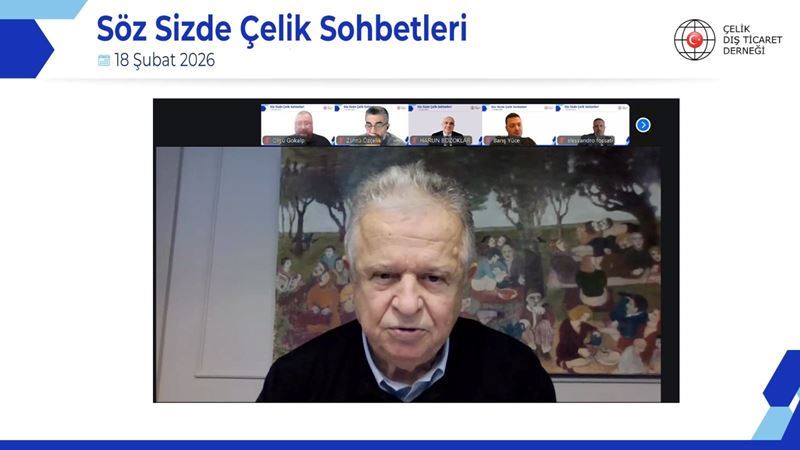
Moderated by Harun Bozoklar, the event featured Prof. Dr. Özgür Demirtaş as the guest speaker. During the program, key agenda items concerning the steel industry were discussed in a comprehensive manner.
The opening speech was delivered by Namık Ekinci, Chairman of the Çelik Dış Ticaret Derneği. Ekinci stated that 2026 brings both significant opportunities and structural challenges for the Turkish steel sector. He described the meeting as an important step toward collectively understanding rapid changes in global trade and forming a common strategic vision.
Emphasizing that the financial obligations under Carbon Border Adjustment Mechanism(CBAM) have become fully operational as of this year, Ekinci noted that producing high-quality steel alone is no longer sufficient. He stressed that production must now be presented to the world with a green and low-carbon identity. He added that competitiveness in the European Union Türkiye’s largest market will depend on how quickly this transformation is internalized. Ekinci expressed expectations from public authorities to take swift and effective steps to facilitate the transition process.
Ekinci also highlighted that extreme volatility in commodity markets and uncertainty in raw material costs are seriously testing financial sustainability. He underlined that risk management mechanisms must become an integral part of foreign trade and that the timely and correct use of financial instruments is essential for sustaining professional success.
At a time when the axis of global trade is shifting, Ekinci stressed that new trade barriers arising from the European Union’s free trade agreements must remain on the sector’s radar. He emphasized the need to develop strategies against the EU’s protective measures and to expand trade outreach toward new markets. Ekinci concluded by noting that the critical issues discussed at the meeting directly affect the global image and market share of the Turkish steel industry, adding that a strong industry survives not only through production capacity but also through its ability to transform knowledge and expertise into strategy.
In his remarks, moderator Harun Bozoklar stated that the sector is undergoing a structural transformation on a global scale. He pointed out that companies are experiencing tonnage losses, rising costs, and increasing pressure. Although the industry has faced many crises in the past, Bozoklar said the current landscape is more multi-layered and complex.
He emphasized that beyond supply and demand balances, carbon costs, regulations, policy decisions, and capital mobility have become decisive factors for the sector. Bozoklar noted that collective action is now more important than individual company performance. He added that CBAM still contains uncertainties for the industry and that further clarification is needed. Closely monitoring global developments,he stated that ''it is critical issue''.
During the event, İbrahim “Abe” Ulusal from Mitsui Bussan Commodities Ltd. delivered a presentation titled “Risk Management and Hedging in the Steel Industry,” evaluating risk management practices within the sector. Alessandro Fossati from Gamma Trade SA shared his views on Türkiye’s exports to the European Union market in his speech titled “A View from Italy on Türkiye’s EU Exports in the New Era.”
In another session, Süleyman Ecevit Sanlı from Narin Gümrük Müşavirliği addressed the potential impacts of new trade agreements on the Turkish steel sector under the title “What Awaits the Turkish Steel Industry After the EU–India/Mercosur Trade Agreements?”
The event, organized by the Çelik Dış Ticaret Derneği, provided a comprehensive evaluation of current developments in the steel sector within the framework of foreign trade, risk management, and international trade agreements.




Comments
No comment yet.