


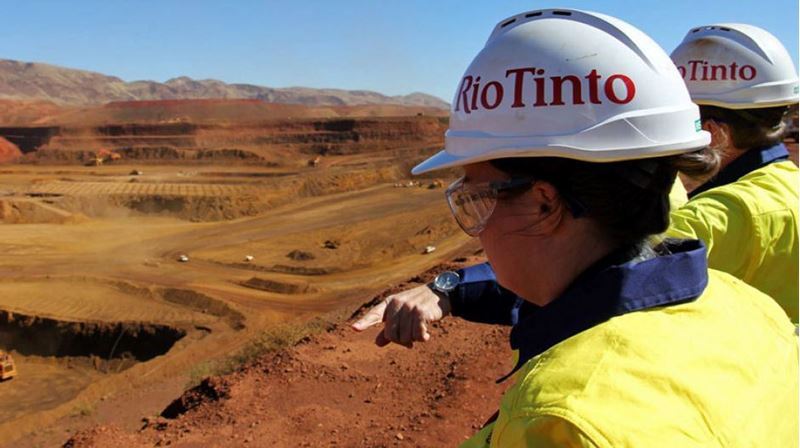
Chief Executive Simon Trott stated that safety is at the core of their operations, noting that two fatalities at the Simandou and Kennecott operations during the year serve as a serious warning for the industry. Following these incidents, both operations were temporarily suspended and gradually restarted once conditions became suitable. At the Kennecott underground project, the phased restart process began as of April 16.
Evaluating operational performance, Trott emphasized that the increase in copper production was supported particularly by capacity expansion at the Oyu Tolgoi mine. It was also announced that drilling activities have commenced at the Resolution Copper project, considered one of the world’s largest copper deposits, following the completion of a land swap.
On the iron ore side, Pilbara operations recorded the second-highest first-quarter production since 2018. While production in Pilbara increased by 13%, sales rose by 2%. However, it was noted that approximately 8 million tons of shipments were affected due to tropical cyclones, and about half of this loss is expected to be recovered in the coming period. Meanwhile, it was reported that the first high-grade shipment from the Simandou project in Guinea was successfully delivered to China, with initial sales carried out in April.
In the aluminum segment, the strong performance of the integrated value chain stood out, while weather-related disruptions in bauxite balanced this performance. Alumina production increased by 6%, while primary aluminum production rose by 1%.
On the lithium side, mechanical completion was achieved as planned at the Fenix 1B and Sal de Vida projects. First production at these projects is expected to begin in the second half of 2026.
According to the company’s production data, global iron ore production increased by 12% to 82.8 million tons, while Pilbara production reached 78.8 million tons. Global iron ore shipments rose by 2% to 75.7 million tons. Bauxite production decreased by 11% to 13.3 million tons, while copper production increased by 9% to 229 thousand tons. Lithium carbonate equivalent production was recorded at 12.7 thousand tons.
Rio Tinto did not revise its production guidance for 2026. Accordingly, production targets for iron ore, bauxite, alumina, aluminum, copper, and lithium were maintained.
The company also emphasized that it is closely monitoring developments in the Middle East and, despite changing conditions, maintains supply chain resilience thanks to its diversified portfolio. It was stated that the first phase of the annual $650 million savings target under the efficiency program has been completed, with additional gains ongoing.
The statement also reminded that forward-looking statements involve various risks and uncertainties, warning that actual results may differ from expectations.




Comments
No comment yet.