


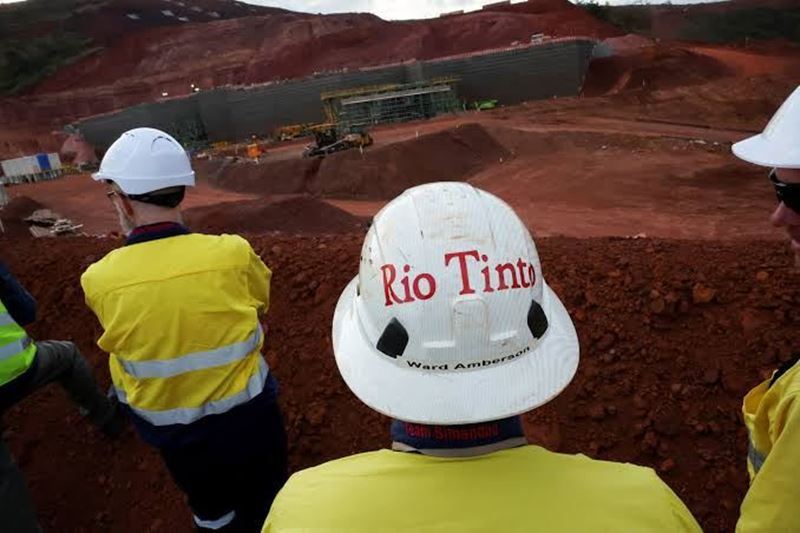
Supported by strong commodity prices and higher production, the company's EBITDA increased by %28 year on year, while free cash flow increased by %75. During the same period, copper equivalent production increased by %3, and the company's growth investments lifted the combined EBITDA contribution of copper, aluminium, and lithium to more than %50.
Rio Tinto CEO Simon Trott stated that the company achieved a significant improvement in performance during the first half, emphasizing that accelerated productivity initiatives are beginning to deliver results. Trott said that productivity gains of USD 870 million have been achieved so far, with the annualized target expected to reach USD 1.8 billion by the end of the year. He also announced an interim dividend of USD 3.4 billion, supported by strong cash flow and a solid balance sheet.
According to the company's first half financial results:
- EBITDA reached USD 14.8 billion, increasing by %28 year on year.
- Free cash flow reached USD 3.8 billion, increasing by %75.
- Profit after tax rose to USD 6.7 billion, increasing by %47.
- Underlying earnings reached USD 6.9 billion, increasing by %43 year on year.
- Cash flow from operating activities reached USD 9.2 billion, increasing by %32.
- Sales revenue reached USD 31 billion, increasing by %15.
- Capital expenditure reached USD 5 billion, increasing by %12.
- The interim dividend was US cents 211 per share, with the total interim dividend amounting to USD 3.4 billion.
- Return on capital employed (ROCE) increased to %17, while net debt stood at USD 14.1 billion.
On the operational side, Rio Tinto continued to advance its growth projects. Pilbara operations recorded the highest first half iron ore production since 2018, while the first shipments of high grade iron ore from the Simandou project were completed in April. More than three quarters of the SimFer mine and port infrastructure have now been completed, and the first railway commissioning phase was successfully carried out during the first quarter. In addition, the company stated that the three new replacement iron ore mines under development in Pilbara are progressing on schedule and within budget, with first ore production planned for 2027.
In the lithium segment, first production at the Fénix 1B and Sal de Vida projects began ahead of schedule. Construction of the full scale Rincon facility is continuing, and the company aims to reach an annual production capacity of approximately 200,000 tons of lithium carbonate equivalent (LCE) by 2028.
Rio Tinto also announced that it aims to generate between USD 5 billion and USD 10 billion through portfolio management and infrastructure optimization, with work underway to deliver approximately USD 5 billion of that amount by the end of 2026. The company added that its strong balance sheet supports a %50 interim dividend payout ratio.
As part of its sustainability targets, Rio Tinto reaffirmed its commitment to reduce Scope 1 and Scope 2 greenhouse gas emissions by %50 by 2030 compared with the 2018 baseline. During the first half, emissions totaled 15.9 million tons of CO₂ equivalent, representing a %14 decrease from the base year.
Rio Tinto also stated that it continues to trial battery swappable electric mining trucks at the Oyu Tolgoi copper mine and is conducting field tests of electric mining trucks and loaders in Pilbara together with BHP and Caterpillar. The company completed financial close for a 75 MW solar power project with Yindjibarndi Energy Corporation and signed a biofuel pellet supply agreement for its Gladstone alumina refineries as part of its efforts to reduce fossil fuel consumption.



Comments
No comment yet.