


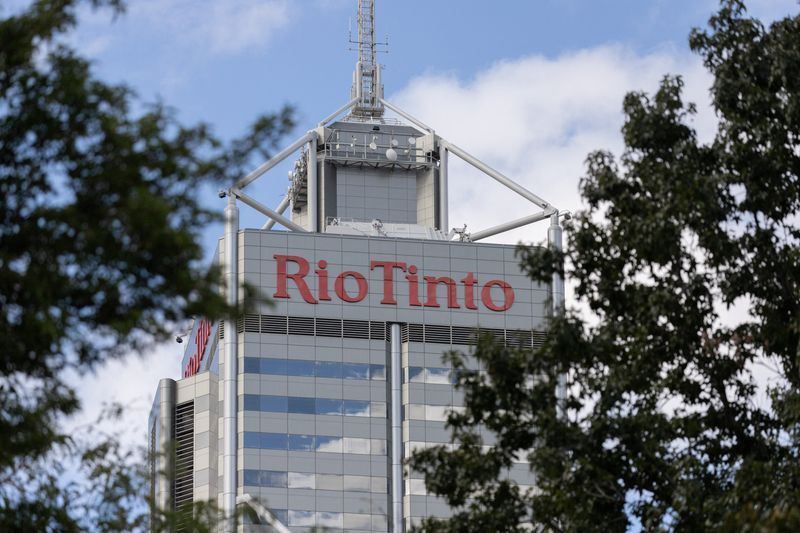
Rio Tinto has announced its production results for the fourth quarter of 2025 and for the full year. The company delivered a notable performance in 2025, increasing its copper-equivalent (CuEq) production by 8% year on year.
Rio Tinto CEO Simon Trott stated that operations delivered a strong production performance on both a quarterly and full-year basis, noting that operational excellence across the portfolio and a solid foundation in project delivery were key contributors to these results. Trott highlighted a strong recovery in Pilbara following disruptions caused by extreme weather earlier in the year, adding that record iron ore production was achieved in the fourth quarter. He also emphasized that the first shipment from the port at the Simandou project marked an important milestone.
On the copper side, the company reported that record production levels have continued following the completion of the Oyu Tolgoi underground project. Rio Tinto noted that the increase in bauxite production throughout the year reflects the maturation of operational capabilities, while in lithium, the planned production increase for 2025 was achieved as part of the disciplined growth of its high-quality portfolio.
According to the disclosed data, copper-equivalent production rose by 8% year on year in 2025, while shipments increased by 5%. This growth was driven by the strong ramp-up at Oyu Tolgoi, a record year for bauxite production, and contributions from lithium operations. In iron ore, Pilbara operations delivered record production in the fourth quarter with a 4% year-on-year increase, while shipments rose by 7%. At Simandou, the commencement of operations enabled the first shipment to be made in the fourth quarter.
Pilbara iron ore shipments totaled 91.3 million tonnes in the fourth quarter, while full-year 2025 shipments declined by 1% to 326.2 million tonnes. Pilbara iron ore production amounted to 89.7 million tonnes in the fourth quarter and 327.3 million tonnes for the full year. At Iron Ore Company of Canada (IOC), pellet and concentrate production fell by 14% year on year to 2.2 million tonnes in the fourth quarter, while full-year 2025 production decreased by 1% to 9.3 million tonnes.
Bauxite production reached 15.4 million tonnes in the fourth quarter and increased by 6% year on year to 62.4 million tonnes for 2025. Alumina production declined by 1% to 2.0 million tonnes in the fourth quarter, while full-year output rose by 4% to 7.6 million tonnes. Primary aluminum production increased by 2% to 0.85 million tonnes in the fourth quarter and by 3% year on year to 3.38 million tonnes for the full year.
Copper production rose by 5% to 240 thousand tonnes in the fourth quarter and increased by 11% year on year to 883 thousand tonnes in 2025, exceeding the company’s guidance range of 860–875 thousand tonnes. Titanium dioxide slag production declined by 6% to 0.2 million tonnes in the fourth quarter and by 2% year on year to 1.0 million tonnes. Boron oxide equivalent production fell by 6% to 0.1 million tonnes in the fourth quarter, while full-year output totaled 0.5 million tonnes.
Rio Tinto stated that the implementation of a stronger, simpler, and more streamlined operating model is ongoing and continues to have a positive impact on operational performance. The company also emphasized that forward-looking statements involve various risks and uncertainties, and that actual results may differ from these expectations.


Comments
No comment yet.