


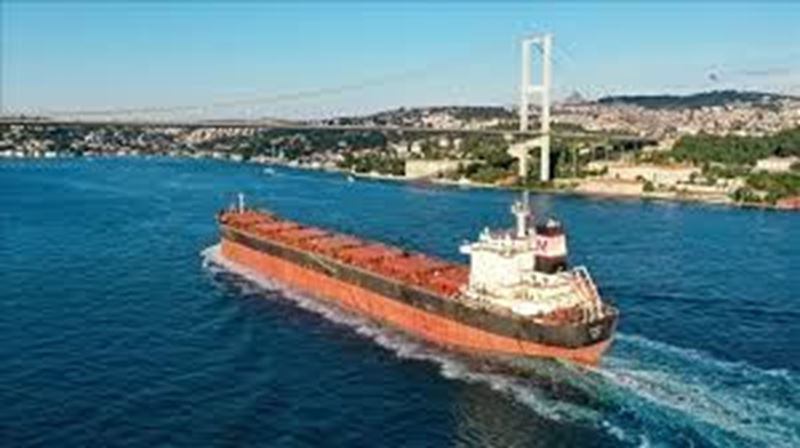
Abdulkadir Uraloğlu issued a written statement on the 2025 Turkish Straits vessel transit statistics published by the Directorate General of Maritime Affairs.
Stating that the Istanbul Strait and the Çanakkale Strait continue to be among the most critical transit points in global maritime trade, Uraloğlu said:
“In 2025, we provided pilotage services to 24,608 vessels, accounting for 61.3% of the 40,172 ships transiting the Istanbul Strait. Of the 44,468 vessels passing through the Çanakkale Strait, 53.9% or 23,971 ships were guided by our pilots. Thus, while vessel traffic in the straits reached 84,640 in 2025, pilotage services were provided to 48,579 ships.”
“General cargo vessels were the most frequent users of the Istanbul and Çanakkale straits”
Providing information on vessel types transiting the Istanbul and Çanakkale straits last year, Uraloğlu noted that general cargo vessels were the most common users in 2025. During this period, 14,724 general cargo ships passed through the Istanbul Strait and 13,870 through the Çanakkale Strait. He added that bulk carriers followed, with 7,493 using the Istanbul Strait and 8,066 the Çanakkale Strait over the year.
Uraloğlu pointed out that a total of 422.8 million tons of cargo 203.7 million tons of which was hazardous was carried by vessels using the Istanbul Strait, while ships transiting the Çanakkale Strait transported 570.3 million tons of cargo, including 232.5 million tons of hazardous materials.
“In this period, 128 vessels longer than 300 meters passed through the Istanbul Strait, while 660 transited the Çanakkale Strait. For ships between 250 and 300 meters in length, 1,836 transits occurred in the Istanbul Strait and 3,011 in the Çanakkale Strait,” he said.
Referring to the flag distribution of vessels using the Turkish straits most frequently, Uraloğlu emphasized that Panama-flagged ships ranked first with 12,823 transits, followed by Turkish-flagged vessels with 12,765 and Liberian-flagged ships with 10,735.
“Maritime accidents and incidents decreased by 21% compared to 2024”
Despite heavy vessel traffic, Uraloğlu underlined that maritime safety was maintained at the highest level and shared the following data on maritime accidents and incidents last year:
“In 2025, through the Main Search and Rescue Coordination Center which coordinates all search and rescue operations within the Turkish search and rescue region at the highest level we responded to 299 maritime accidents involving vessels and rescued 561 people alive. Maritime accidents and incidents involving vessels decreased by 21% compared to 2024.”
Uraloğlu added that efforts to enhance navigational safety as well as the safety of life, property, the marine environment, and navigation in the Turkish straits are continuing uninterrupted. In this context, he recalled that the Implementation Directive governing the application of the Turkish Straits Maritime Traffic Regulations was revised in 2025 in line with evolving needs.
Noting that cruise tourism has also gained significant momentum, Uraloğlu concluded:
“While Istanbul ports were visited by 204 cruise ships carrying 439,968 cruise passengers in 2024, the number of cruise ships calling at Istanbul ports in 2025 increased by nearly 30% year on year, reaching 265 cruise ships and 625,517 cruise passengers.”






Comments
No comment yet.